


For years now, Nvidia has been trying to build a walled garden with proprietary software. Something to give gamers a reason to buy their GPUs beyond just raw performance. Whether we’re talking about DLSS Super Resolution, Frame Generation, or even their newest Neural Rendering technology, Nvidia has built an entire ecosystem of exclusive features designed to convince gamers that they need a GeForce GPU.
Well, that exclusivity is starting to fall apart. Because a new project has managed to get essentially every major DLSS feature running on AMD Radeon GPUs. And this isn’t just some proof of concept that barely works anymore. The project has received massive updates that make it a serious problem for Nvidia.
Plus, both AMD and Nvidia are apparently teaming up with Intel, AMD just gave millions of GPU owners a free upgrade, and more!
So let’s get right to it…
AMD Just Got ALL Of Nvidia’s DLSS Tech!
AMD GPUs just got everything! And it could be a serious problem for Nvidia. Because modders have now managed to get virtually every major Nvidia DLSS feature running on Radeon GPUs! I’m talking DLSS 5 Neural Rendering, Super Resolution with Nvidia’s newer AI models, Ray Reconstruction, Frame Generation and even Multi-Frame Generation up to 4X. All now running on AMD hardware.
If you’ve been reading Meld Bytes for a while, you might remember that I first covered this project back in September. At the time, developer Daniel Blanco had managed to get Nvidia’s new DLSS 5 technology running on Radeon GPUs. And while that was already a pretty big achievement, performance was absolutely terrible. In one early demonstration, an RX 9070 XT dropped from around 85 FPS to just 11 or 12 FPS with DLSS 5 enabled. So yeah, it technically worked. But unless you’re a huge fan of PowerPoint presentations, it wasn’t exactly practical.
Well, things have changed quite a bit since then. Because the developer, Daniel Blanco, has now released version 0.8.0 of his project, DLSS NR on AMD. And instead of just improving Neural Rendering, which he has, he’s also expanded the project to support essentially Nvidia’s entire DLSS feature set.
And one Radeon owner has already demonstrated Ray Reconstruction running in Cyberpunk 2077 on an RX 9070 XT. And at least according to the user, there was essentially zero performance loss when enabling the feature. With that said, one user reported a drop of around 25%, so your results can definitely vary.
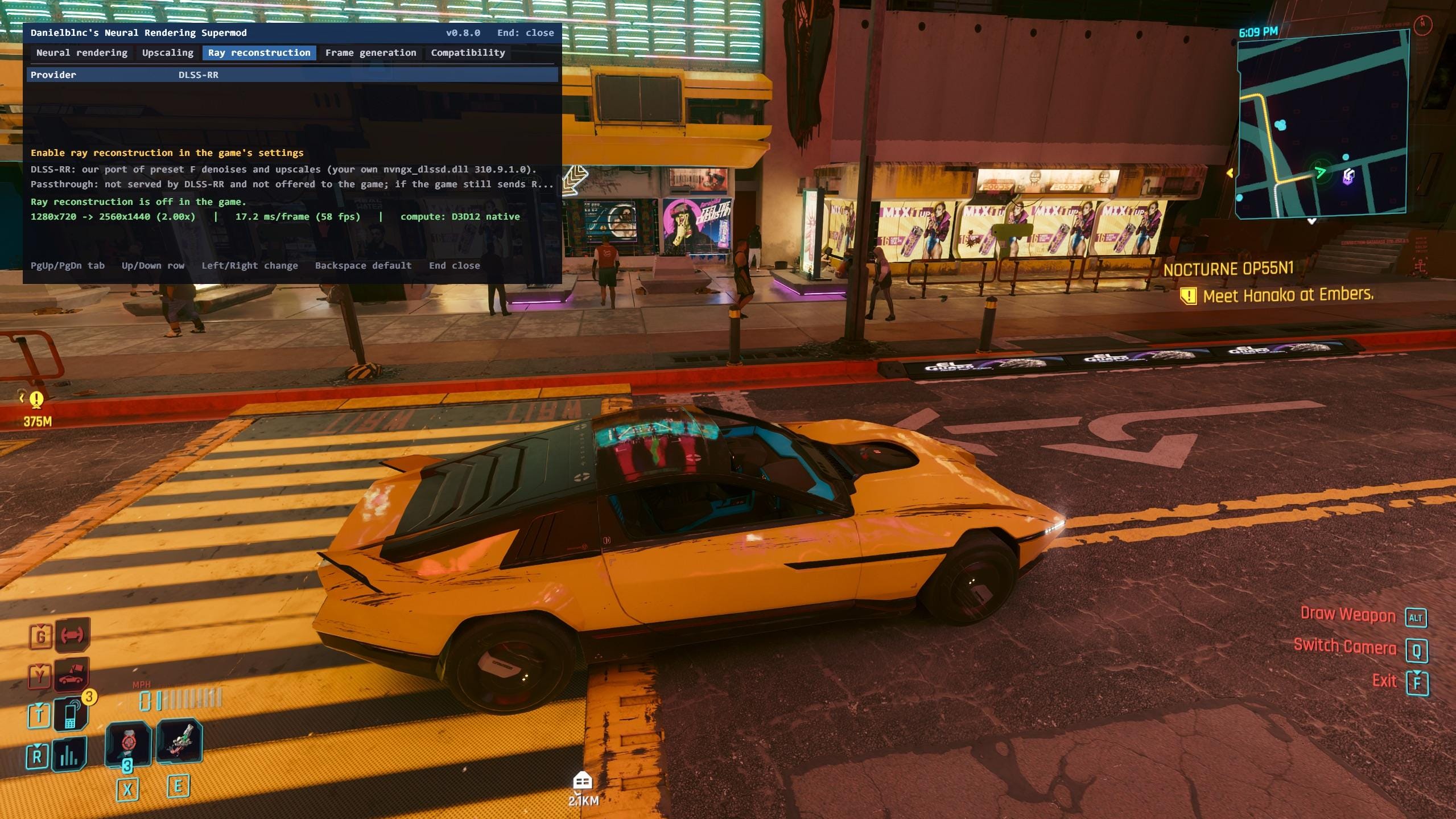
But here’s what I think is the most impressive part. According to the developer, this doesn’t work by simply translating Nvidia’s software instructions through something like ZLUDA. Instead, the developer claims that this is a “ground-up, full reimplementation of every DLSS neural network runtime for AMD GPU architectures (HIP kernels, memory layouts, game integration), written from scratch. No NVIDIA code is included or translated at runtime.” Basically, he’s getting Nvidia’s neural networks to execute using code designed specifically for Radeon GPUs.
Performance has also improved significantly. According to the developer’s own testing, the latest DLSS 5 implementation can now achieve approximately 90 to 100 FPS at 1080p on an RX 9070 XT using the full model. That’s a massive improvement from the early demonstrations, proving that this is the real deal.
With all of that said, there are limitations. The full feature set currently only supports Radeon RX 7000 and 9000 GPUs, while RX 6000 cards have more limited support. You’ll also need Windows 11, a compatible DirectX 12 game, and your own legitimately obtained Nvidia DLL files. Plus, Frame Generation can require additional GPU spoofing, some games have compatibility issues, and anti-cheat systems can block the mod entirely.
Ultimately, this is terrible news for Nvidia, as the company’s goal with DLSS, and especially DLSS 5, is to create a software moat that forces gamers into their ecosystem. And don’t get me wrong. I understand it. The company is trying to offer features that the competition doesn’t have. But we also don’t want Nvidia to win so handily that they end up with yet another monopoly. Luckily, this one developer could shatter that possibility.
AMD Just Gave MILLIONS Of GPU Owners A FREE Upgrade!
As if getting virtually all of Nvidia’s DLSS features wasn’t enough, AMD itself just gave millions of existing GPU owners a massive, free upgrade! And the best part? They actually released it way ahead of schedule. Because AMD has officially brought its latest machine learning based upscaling technology, FSR 4.1, to the Radeon RX 6000 series. And we’re talking about support all the way down to the RX 6400!
If you remember, AMD originally announced that FSR 4.1 would be coming to its RX 6000 GPUs in early 2027. And earlier this month, the company promised to bring the technology to supported Ryzen APUs by the end of this year. Now, when most companies promise something by the end of the year, that usually means like December 20th if we’re lucky. Especially when they make the announcement in October. But AMD apparently decided that gamers had waited long enough, because both upgrades are already here with the company’s new Adrenalin 26.10.1 driver.
And when we look at the announcement, it becomes pretty clear that AMD had to do quite a bit of work to make this possible. Remember that unlike the RX 7000 and 9000 series, AMD’s older RDNA 2 GPUs don’t have dedicated AI accelerators. So AMD had to optimize the implementation to run on the GPU’s regular shader processors. And that’s obviously a pretty major challenge when those same processors are also responsible for rendering the game.
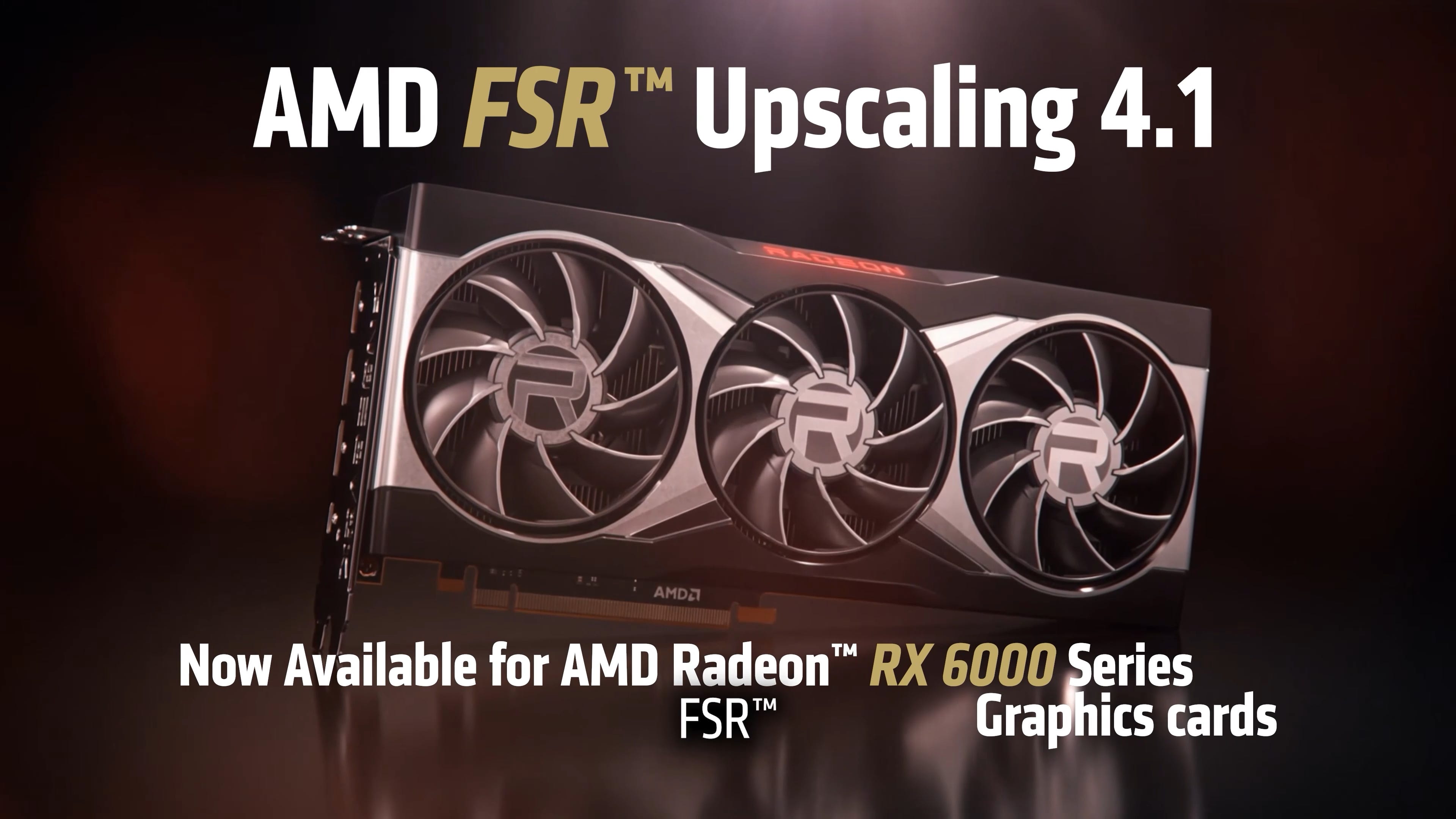
But the company claims it’s managed to optimize the model and its code paths specifically for the older architecture. So much so that it actually works all the way down to their RX 6400. Now, that doesn’t mean performance will be better than FSR 3.1. Machine learning upscaling can introduce additional processing overhead, especially on older GPUs. But if the image quality improvements are good enough, that trade off could absolutely be worth it.
And this brings us to AMD’s APUs. Because FSR 4.1 is also officially supported on the Ryzen AI Max 300 and 400 series, Ryzen AI 9 300 and 400 processors and the Ryzen Z2 Extreme and Z2A. And yes. You did read that right. For mainstream APUs, AMD currently only supports the top end Ryzen AI 9. With that said, AMD did promise that more APUs are coming.

In the meantime, it clearly even took a lot of work to get this running on Ryzen 9 APUs, because AMD claims they had to develop an entirely separate machine learning model specifically for those processors and handheld chips. In fact, the model is less than half the size of its original INT8 implementation. The company also claims to have validated it across hundreds of laptop and handheld configurations, which shows just how much work went into bringing the technology to hardware with tighter power and performance limitations.
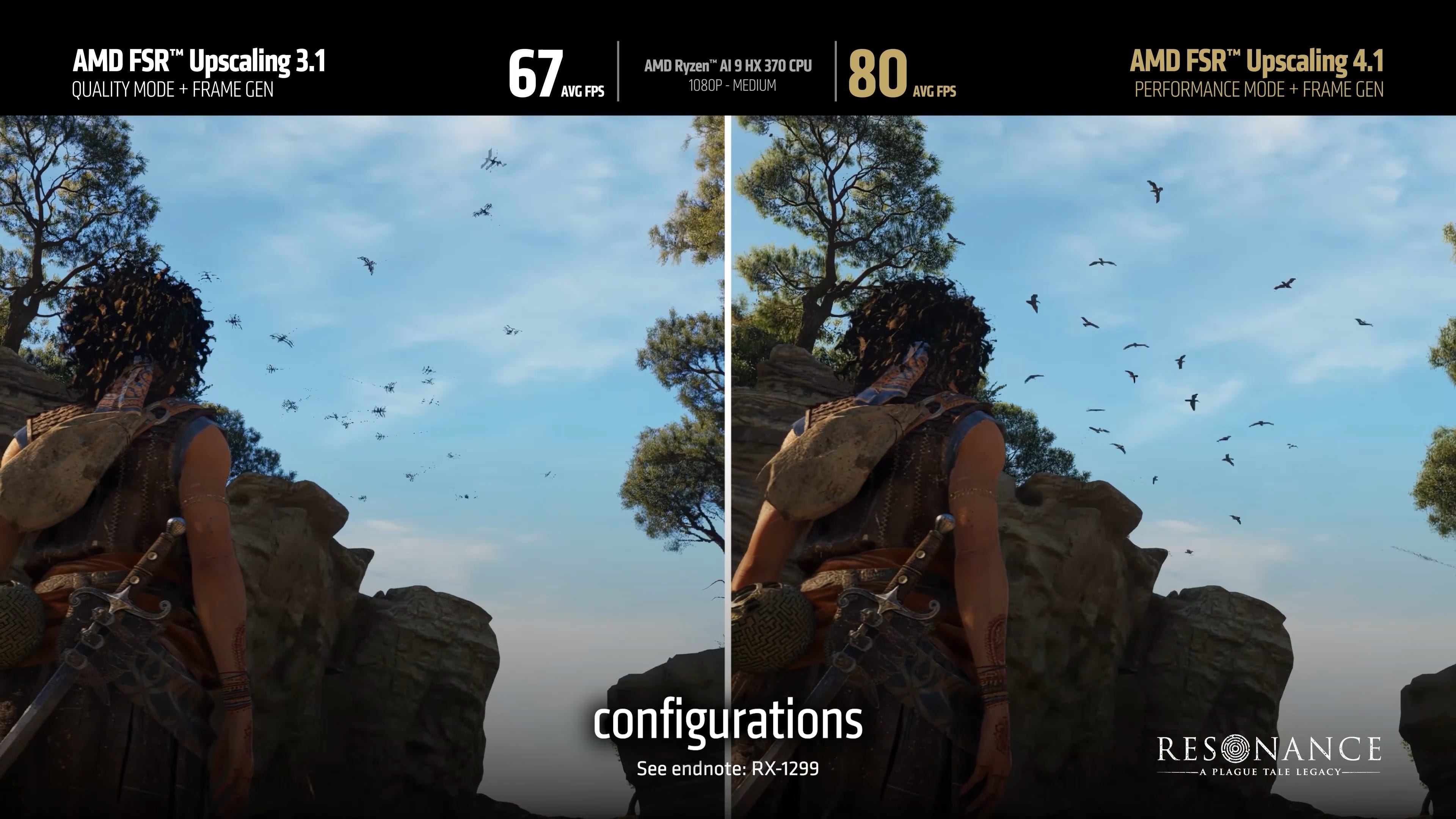
When it comes to actual performance, AMD claims that FSR 4.1 running in Performance mode at 1440p can produce better image quality than FSR 3.1 at higher quality presets. And we can actually see this in a comparison using their Ryzen AI 9 HX 370. Below, you can see that in performance mode on FSR 4.1, the image looks even better than FSR 3.1 in Quality mode. To really see a big difference, look at the moving birds in the sky.
Now, there are some issues. Like I already said, not every Ryzen APU is supported yet, and handheld owners will need to wait for their manufacturers to release compatible drivers. ASUS has already confirmed that support is coming to its ROG Xbox Ally handhelds, along with devices like the ROG Flow Z13 and TUF A14.
And the news doesn’t stop there. Because AMD has also confirmed that FSR 4.1 is coming to the Xbox Series X and S. Unfortunately, there’s no release date for that just yet. But the company is also working on bringing FSR to Vulkan, along with improvements to Frame Generation that should deliver more consistent frame pacing.
Ultimately, I think this is exactly the kind of thing we need to see more of from GPU manufacturers. Instead of forcing everyone to buy a new graphics card just to get the latest software features, AMD is going back and optimizing its technology for hardware that’s already several years old. And with how expensive GPUs have gotten, that’s a pretty big deal.
AMD And Nvidia Are Teaming Up With INTEL?!
Both AMD and Nvidia look set to make one of the most surprising moves we’ve ever seen in the semiconductor industry. Because according to a new report, both companies are planning to use Intel to manufacture future chips. And we’re not just talking about AI accelerators or some small supporting components. This could actually include Nvidia’s next generation gaming GPUs and future Ryzen processors!
The story comes from a new report covered by Wccftech, citing semiconductor analysts at KeyBanc. After returning from a research trip to Asia, the analysts reportedly found that Intel’s foundry business has secured manufacturing wins from a pretty incredible list of companies. I’m talking Broadcom, Google, Apple, Microsoft, AMD, and Nvidia.
And what’s really wild here, is that the report actually identifies what some of those manufacturing deals are reportedly for. According to KeyBanc, Nvidia has secured Intel foundry capacity for Rubin gaming GPUs. Yes, GAMING GPUs. Not just Nvidia’s AI accelerators, which have already been linked to Intel’s advanced packaging technology in earlier reports.
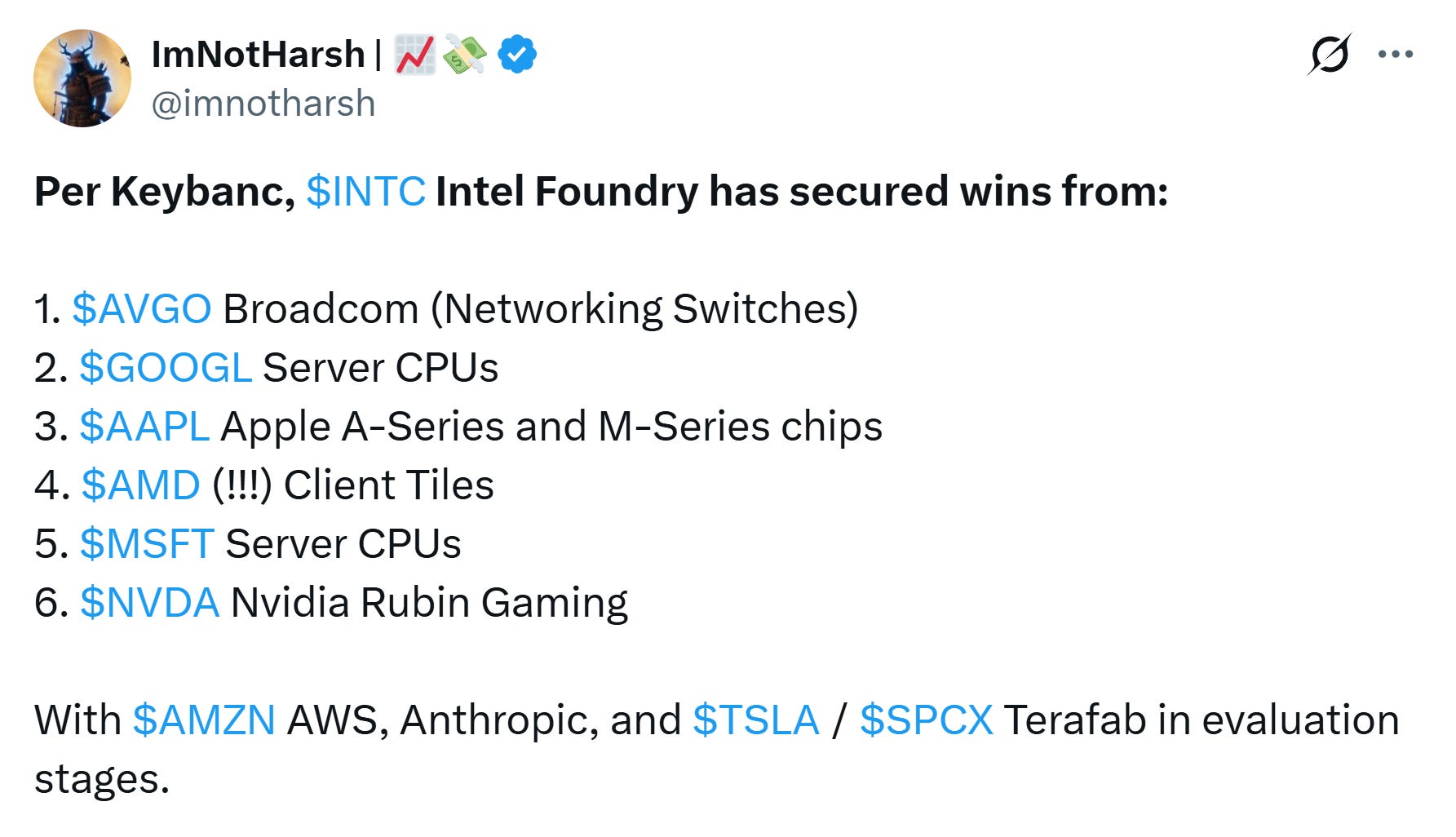
Now, what’s even more wild here, is that Rubin is Nvidia’s next major GPU architecture. Meaning if this is right, Nvidia is set to use Intel for their next generation RTX 6000 cards! Previously, there were reports suggesting that Intel could potentially manufacture some components for Nvidia’s future GPUs, but I expected that to happen much further down the road. Like the RTX 7000 series at the earliest.
But if this report is correct, Intel could actually be involved in Nvidia’s very next gaming generation. Though there’s an important distinction here: the report doesn’t establish whether Intel would be manufacturing complete GPUs, individual chiplets, or another component associated with the architecture. And neither Nvidia nor Intel has publicly confirmed the alleged contract. So this is still very much something to watch rather than a done deal.
But the wild news doesn’t stop there. According to the same report, AMD is also using Intel Foundry for something described as client tiles. For those who don’t know, client products generally refer to consumer hardware like desktop and laptop processors. Meanwhile, a tile is essentially Intel’s terminology for what AMD usually calls a chiplet.
So this could mean Intel will manufacture one or more of the chiplets inside of future Ryzen processors. Now, it could be a main CPU compute die, an I/O die, or something else entirely. We don’t know that part yet. And while there’s also the possibility of AMD using Intel for components of a future chiplet based Radeon GPU, the report specifically refers to client tiles rather than confirming a graphics processor.
Now, here I definitely don’t expect this in Zen 6, because AMD has already confirmed TSMC’s 2nm manufacturing process for its upcoming Zen 6 server architecture, and AMD has historically shared CPU chiplet designs between server and consumer processors. That’s kind of the entire point of using chiplets. So Zen 7 or a later generation would make way more sense.
At the end of the day, this is a massive change for the entire industry. While Intel has traditionally made its own processors, it could now end up manufacturing chips for two of its biggest competitors. And if even some of these reported deals turn into actual products, it could mark a major turning point for Intel’s foundry business.
What a wild time to be alive.
Quick Bytes
RTX 6060 Might Not Launch Until 2029!
Nvidia’s next mainstream GPU could be a LONG way off. Because according to the well known leaker, Kepler, the RTX 6060 might not launch until 2029! That’s nearly FOUR YEARS after the RTX 5060 launched in May 2025. And it gets worse, because Kepler also believes the GPU could be slower than Sony’s upcoming PS6. Now, this is still a rumor, but if true, imagine waiting almost four years for a new graphics card just to get beaten by a console.
Nvidia GPUs Just Got UNLOCKED!
A developer has found a way to load modified VBIOS configurations onto the RTX 30, 40, and 50 series GPUs without permanently flashing the cards. This allows users to modify power limits and other settings that Nvidia normally locks down, with one RTX 5080 reportedly being configured for up to 500 watts instead of its original 360 watts. Though given Nvidia’s history with melting power connectors, I’m not exactly sure pushing even MORE power through these cards is the greatest idea.
AMD Is Finally Bringing Ryzen Overclocking To Linux!
AMD has submitted new Linux kernel patches that could bring official overclocking support to supported Ryzen processors. The new AOD driver exposes controls for various CPU settings, including power limits and memory related information, although the initial implementation still requires reboots for certain changes and doesn’t include a full graphical application.
SSDs Are About To Get A MAJOR Upgrade!
A company called FADU has developed a new SSD architecture that moves filesystem operations directly into the drive, rather than relying on the host CPU. In one preliminary test, the technology reportedly maintained approximately 460,000 file operations per second using just one CPU core, compared with around 40,000 for a conventional storage setup under the same core-count constraint. It’s currently designed for enterprise systems, but the potential performance and efficiency benefits could be enormous.
Samsung And SK Hynix Are Fighting Back!
According to Reuters, Samsung and SK hynix are upgrading their Chinese memory factories to manufacture more advanced NAND flash. Samsung is reportedly targeting 286 layer NAND at its Xi’an facility, while SK hynix plans to produce chips with at least 240 layers in Dalian. Greater storage density could eventually help reduce production costs, so here’s to hoping this comes fast.
That’s all the bytes for this week.
Until next time, may your Radeon run DLSS, your Ryzen never need Intel Inside stickers, and your next GPU upgrade cost exactly zero dollars.