


AMD just reported the best quarter in the company’s entire history.
I’m talking revenue increased 50 percent year over year to $11.536 billion. Data Center revenue reached $6.718 billion alone. That’s up 107 percent. Client revenue rose 23 percent to $3.062 billion. Everything looks great.
Until it doesn’t.
Let’s start with their client side of things. This is AMD’s consumer CPU business. Here, the company shipped 34% more Ryzen processors than it did a year ago. That’s a huge increase, and it helps explain how client revenue grew so much.
But there’s another number hiding underneath it.
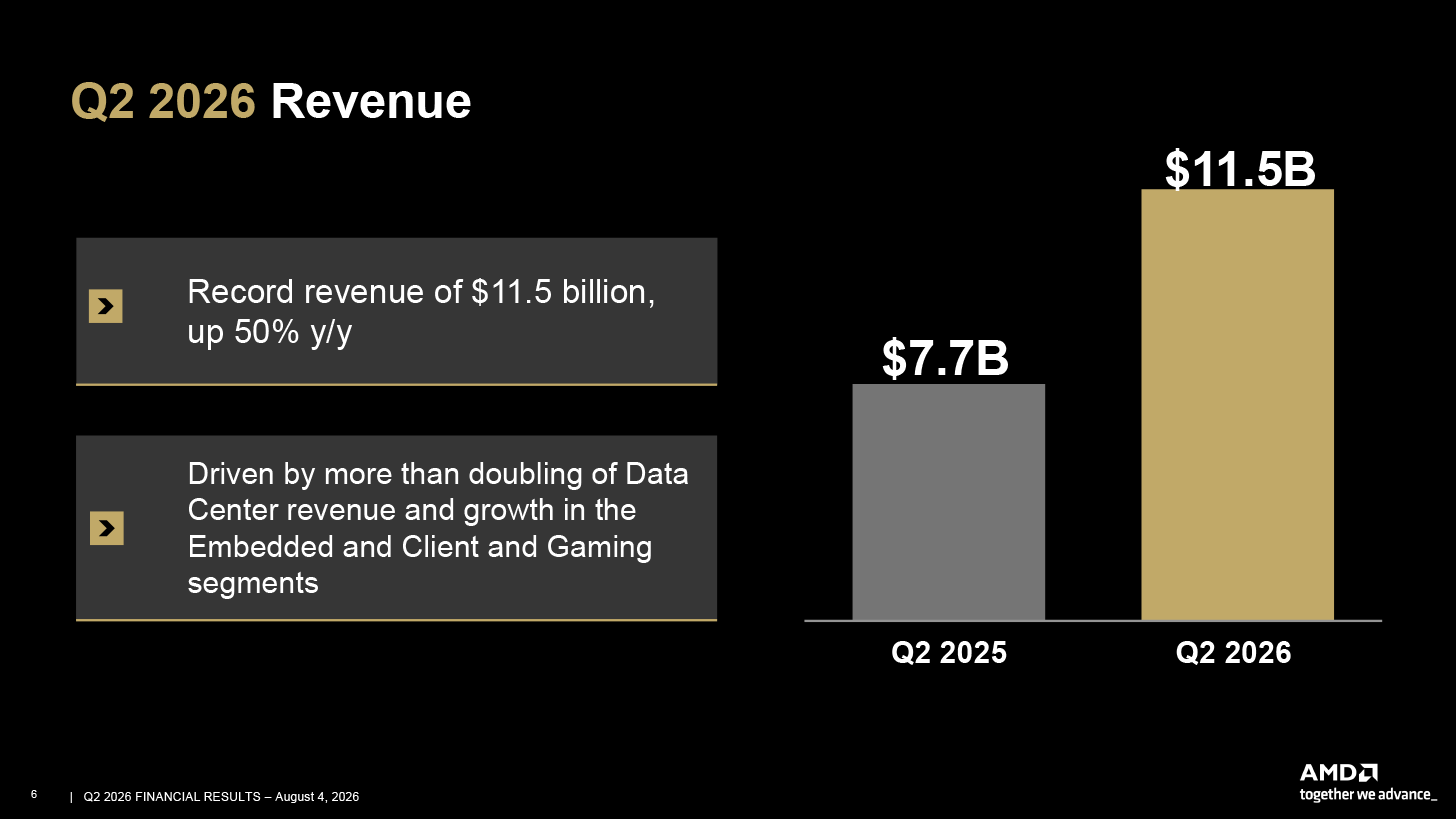
AMD’s average selling price per processor actually fell by 6%. According to the company, most of that shipment growth came from Ryzen mobile processors, while desktop Ryzen sales actually declined. In other words, AMD sold a lot more CPUs, but the mix shifted toward cheaper products.
And the reason is pretty obvious: building a desktop PC has become ridiculously expensive. Even if AMD’s CPU prices stay reasonable, buyers still have to pay for memory, a motherboard, a graphics card, and everything else required for a new system. More people are simply deciding that upgrading isn’t worth it right now.
This brings us to gaming.
And this is where AMD’s record quarter really starts to look terrible.
Gaming revenue actually dropped to $779 million. That’s down a massive 31% from $1.1 billion just one year ago.
Now, AMD blamed most of the decline on their semi-custom business, meaning the chips that they sell for consoles. Specifically, that they’re reaching the late stage of the console lifecycle, but there’s a problem here. Because both Sony and Microsoft actually raised prices on their consoles due to the memory crisis. So that can easily account for at least some of that demand loss.
Plus, AMD’s CEO, Lisa Su, confirmed that their gaming GPU revenue declined year over year because higher industry-wide component costs pushed graphics-card prices higher and weighed on demand. CFO Jean Hu also revealed that Radeon shipments declined compared with the previous quarter.
To give you an idea of how bad all of this is, when Client and Gaming are combined, their revenue increased by 6%, but their operating income actually fell from $767 million to $582 million. Meaning their revenue is up, but profits are down.
AMD says that decline was primarily caused by higher operating expenses. But the result is still the same: this entire side of the company brought in more revenue and produced less operating income.
And the second half could be even worse.
AMD’s CFO, Jean Hu previously said that the company expects Gaming revenue to decline by more than 20 percent compared with the first half, largely because of higher memory and component costs.
Ultimately, AI is beginning to suck the life out of the consumer market.
And that’s the incredible irony behind these results. AMD is having the best quarter in its entire history because AI demand is exploding. While at the same time, its gaming business is collapsing because that same AI boom is making the hardware consumers need far too expensive.
The force making AMD richer is also making its consumer products harder to sell.
So yes, this was AMD’s greatest quarter ever.
But for PC gamers, it may be one of the company’s biggest warnings yet.
We Finally Have Competition
With that said, there may finally be one small piece of good news in this memory disaster.
According to a new report, HP, ASUS, and Acer have all qualified DRAM from China’s CXMT (the company I recently told you about) and they’ve already started using small amounts of it in certain laptops sold outside of the United States.
Now, the important thing here isn’t that a few laptops have Chinese memory inside of them.
It’s that CXMT has apparently passed the testing required by some of the biggest PC manufacturers in the world. Because companies like HP and ASUS aren’t going to put completely unproven memory inside their systems and hope for the best. That means CXMT is beginning to move from a mostly Chinese supplier into a legitimate fourth player in the global DRAM market. And that’s exactly what the industry needs right now.
Samsung, SK hynix, and Micron currently control almost the entire market. So when all three decide to prioritize more profitable AI memory, there aren’t many other places for PC companies to go.
CXMT won’t fix that overnight. Its memory reportedly isn’t even cheaper than chips from the major manufacturers yet, and the number of laptops using it is still extremely small.
But more suppliers eventually means more capacity and ultimately, more competition.
And CXMT is already expanding production while pushing its DDR5 memory to much higher speeds. So if the company continues improving, it could eventually take some pressure off the consumer market.
For now, this isn’t the end of the memory crisis.
But it may finally be the beginning of an actual solution.
Zen 6 Targets The Frames That Benchmarks Hide
Average FPS is a useful number. Unfortunately, it’s also very good at hiding a bad experience.
Believe it or not, a game can average well over 100+ frames per second and still feel terrible. That’s because average FPS doesn’t show how evenly those frames are delivered. If most frames arrive quickly but a few take much longer, you’ll feel a sudden hitch or micro-stutter even though the average still looks great. Those unusually slow frames are what drag down 1% lows, and improving them can make a game feel much smoother without dramatically increasing average FPS.
Well, according to new information shared by the well known Ryzen tuning developer: 1usmus, AMD is preparing several Zen 6 performance-management controls that could seriously help with those 1% lows.
CPPC Performance Priority
The first feature is called CPPC Performance Priority.
Basically, when a processor reaches its power or temperature limit, it has to start reducing performance somewhere. But instead of slowing every core down equally, Zen 6 could prioritize the cores that are actually running your game, while cutting performance on cores handling background tasks.
So if you’re gaming with Discord, a ton of browser tabs, RGB software, and several other programs open, the processor could take power away from those less important workloads and preserve the performance of the cores your game actually needs.
More Accurate Core Ranking
AMD is also reportedly improving how the operating system sees the maximum frequency of each individual core.
Because even inside the same processor, some cores naturally boost higher than others. Giving Windows more accurate information could help it place important gaming threads on the fastest cores more consistently.
It sounds like a small change, but putting the most important work on the wrong core can easily hurt performance and frame consistency.
Per-Core EPP Boost
Then there’s per-core EPP Boost, and this may be the most interesting feature of all.
During gaming, an important CPU thread may briefly stop while it waits for the GPU, another thread, or the next part of the game. The processor can interpret that tiny pause as the core no longer needing as much performance and lower its frequency.
Then, when the game suddenly needs that core again, the clock speed may not increase quickly enough.
That delay may barely affect average FPS, but it can create one unusually slow frame, which is exactly what hurts 1% lows and causes those noticeable stutters.
Per-core EPP Boost could temporarily keep a recently active core in a higher-performance state, allowing it to respond much faster when the work returns.
To give you an idea of how big that could be, a similar feature was recently tested on the original Steam Deck. Average performance barely changed, but 1 percent lows in Civilization VI reportedly improved by nearly 32%.
Background Memory-Bandwidth Limits
This one is big. According to the report, AMD may also let Zen 6 restrict how much memory bandwidth background tasks are allowed to use.
Basically, your browser, Discord, Windows services, game launchers, and the 47 tabs you definitely meant to close would no longer be able to fight your game for as many resources. That could help prevent sudden drops in performance when a background program decides it needs to do something at the worst possible moment.
And when you combine all of these features, Ryzen 10000 may not just improve average FPS. It could specifically target the slow frames that make an otherwise fast game feel terrible.
So on top of more cores, higher boost clocks, and a new process node, Zen 6 may have some major software-level gaming improvements as well.
Next generation is looking seriously impressive.
AMD’s Next Gen Gaming GPUs Are On The Way
AMD’s next Gen Radeon architecture just became a lot more real.
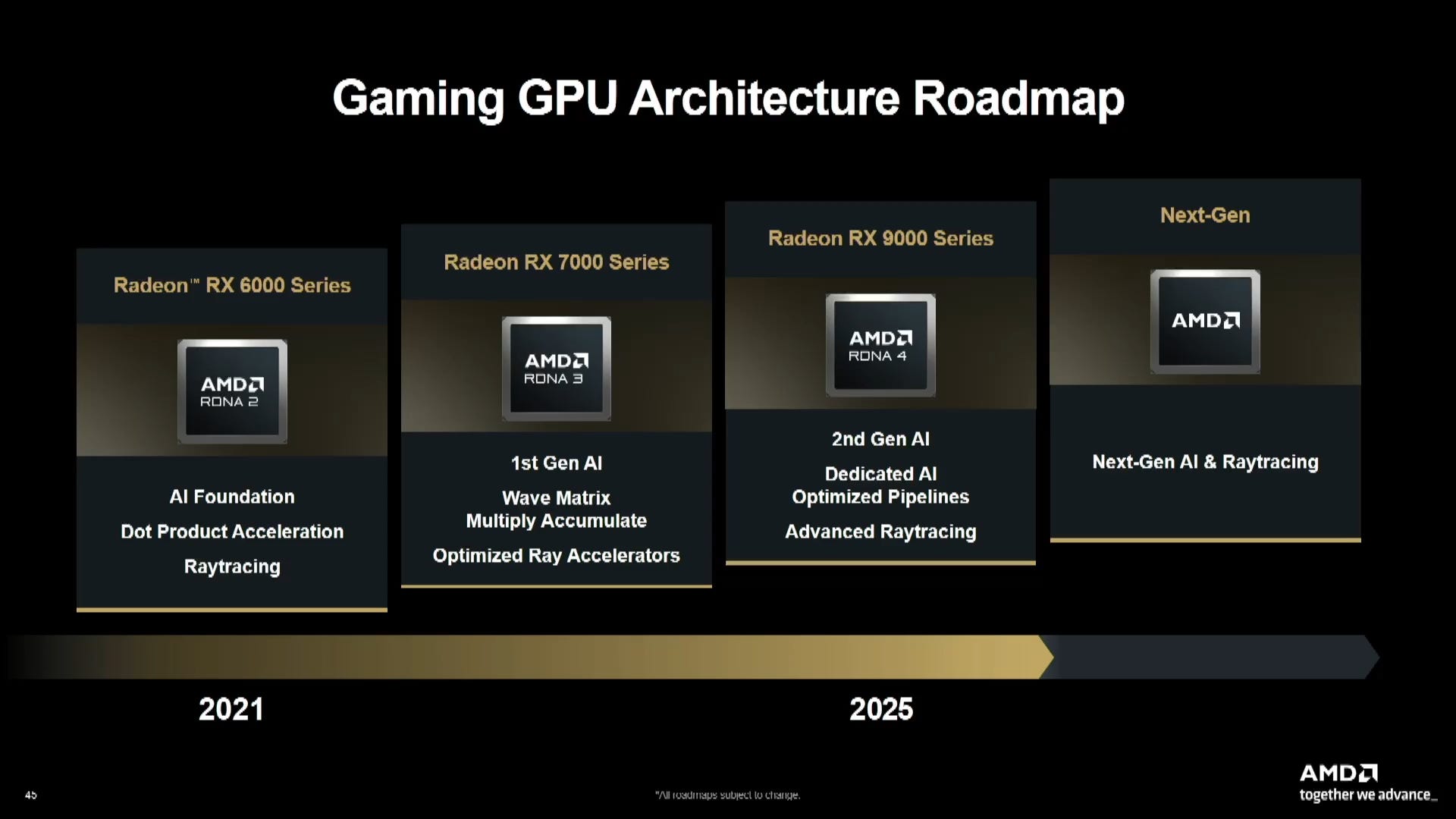
The company has started publishing Linux support for its new DCN 6 display engine, and the code directly connects it to GC 13.0.1. If you didn’t know, that’s part of the GFX13 family widely expected to power AMD’s next-generation gaming GPUs.
Now, we’ve seen references to GFX13 before, but most of those were buried inside compiler code. This is different. DCN 6 is an actual piece of the GPU responsible for handling display output, scaling, pixel formats, and how the final image is sent to your monitor.
The new patches include support for improved scaling of chroma-subsampled formats like 4:2:0 and 4:2:2, along with more control over chroma positioning and image quality. Basically, AMD is now adding support for specific hardware features instead of simply referencing the architecture by name.
AMD has already confirmed that it eventually plans to combine its gaming-focused RDNA architecture and data-center CDNA architecture under one unified design called UDNA. We still don’t know whether GFX13 will be the first full version of that architecture, but a leak from Moore’s Law Is Dead seems to claim that it is.
Either way, AMD’s next GPUs are clearly moving beyond the planning stage, and the company is already laying the software foundation needed before the hardware actually launches.
Quick Bytes
GPU Increases Spread Beyond the First U.S. Listings
High GPU prices are now spreading to other parts of the world.
In Japan, a distributor reportedly warned customers that certain Gigabyte graphics cards were increasing in price by 20 to 40 percent. Meanwhile, eight different RTX 50-series listings in South Korea jumped by roughly 30 percent on average in just a matter of days.
Now, this doesn’t mean every graphics card everywhere is suddenly 30 percent more expensive. These are specific models in specific markets. But that’s exactly what makes this important. What initially looked like a few isolated price hikes is now showing up across multiple countries, brands, and retailers.
AMD’s RX 9050 Makes the RTX 5050 Look Reasonable
One of the first published tests of AMD’s 8GB Radeon RX 9050 showed it trailing the RTX 5050 by roughly 9 to 30 percent across several traditional gaming and synthetic benchmarks. There were a few exceptions, but the overall picture wasn’t exactly flattering.
The card can handle 1080p gaming, and its 92-watt power target makes it an interesting upgrade for lower-power systems. Unfortunately, AMD’s $279 suggested price in select Asia-Pacific and Latin American markets puts it uncomfortably close to, or even above, faster alternatives.
One early review isn’t a final verdict. But if your new budget GPU makes the RTX 5050 look like the sensible purchase, you’re doing something bad.
16GB GPUs and 8 Core CPUs Take the Steam Lead
Valve’s July Hardware Survey shows 16GB graphics cards narrowly passing 8GB models, while 8 core CPUs also moved slightly ahead of 6 core chips.
Now, I’ve never loved putting too much weight on these surveys. Valve only asks a randomly selected group of Steam users, participation is optional, and the results can move around quite a bit from month to month. So this isn’t a perfect picture of every gaming PC in the world.
Still, it does give us a rough idea of where the market is heading. And right as 16GB GPUs and 8 core CPUs are becoming the new mainstream target, memory prices are exploding.
Excellent timing, as always.
That’s all the bytes for this week.
Until next time, may your 1 percent lows stay high, your memory prices stay low, and your next GPU never make the RTX 5050 look reasonable.
the gaming pc market is heading towards whoever can make the best processors with integrated graphics and unified memory.
PCs are gonna get a lot more expensive, and the best way to offset that is not having to buy a processor and GPU separately - not having to worry about both system memory and VRAM.
Next year is gonna revolutionize the way gamers approach their PCs