


Something just completely broke inside the GPU market.
But it feels like everything is broken, doesn’t it? From memory to storage, GPUs, nothing is right. And it’s not just prices. This is the first year that Nvidia hasn’t launched a gaming GPU since 1999, Intel finally made their big Battlemage GPU, but skipped the gaming market altogether, DDR4 is becoming popular again, and the list goes on. Much of that is an outgrowth of prices, but it’s ultimately a market shift.
Where that shift ultimately leads is tough to say, but things are definitely changing.
RTX 6000 Was Made For This
The first odd thing about this year, was actually Nvidia’s release of DLSS 5. It wasn’t the release itself that surprised me. It wasn’t even the fact that it uses AI to change the final design of the game. We know Nvidia ultimately wants the entire game to be generated by AI. No, the surprising part is that Nvidia released this without releasing a new series of cards.
Think about it. The RTX 40 series released with DLSS 3. That added frame generation, and it was locked to the 40 series. Then came their RTX 50 cards. These released with DLSS 4 or multi-frame generation, and were software locked to the 50 series. Now, I specifically say “software” lock because multi-frame generation has since been proven to work just fine on older GPUs. There are some differences, but to pretend that the 50 series was required to make it work is laughable at best.
So when Nvidia suddenly released what’s arguably the biggest change DLSS has ever seen, without a new GPU to sell. That was weird.
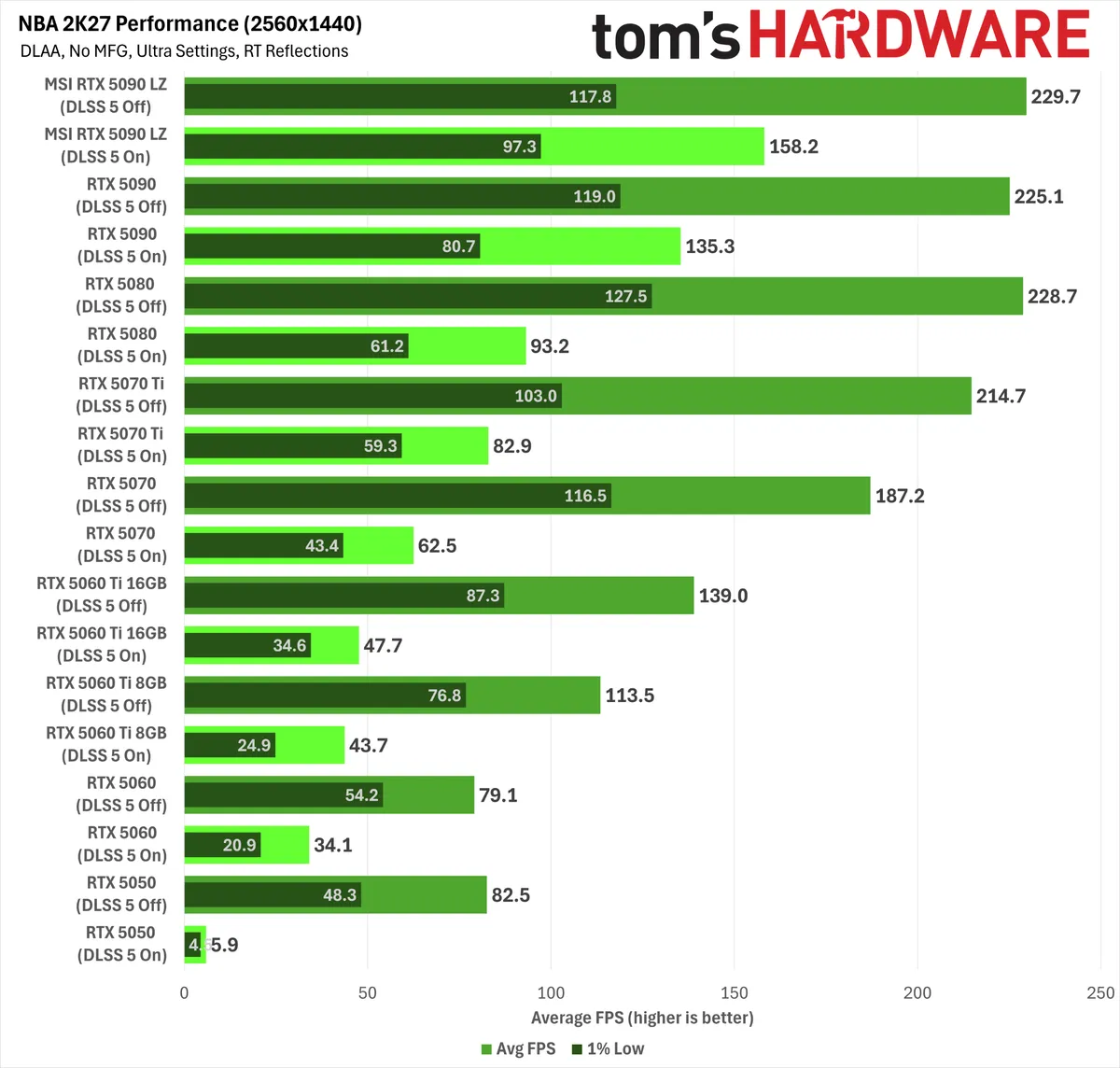
And it gets even weirder when you look at how demanding DLSS 5 actually is. When Nvidia first showed the technology earlier this year, they needed two RTX 5090s to run the demonstration. Nvidia has since claimed that they made the model around 5X faster in just six months, which is obviously a massive improvement. But even after that optimization, Nvidia still says that enabling DLSS 5 can reduce rendering performance by roughly 50 to 60 percent.
Even an RTX 5080 can barely stay above 60 FPS in 1% lows at 1440p in NBA 2K27 with the feature enabled. Basically, DLSS 5 works on the RTX 50 series, but it certainly doesn’t feel like these GPUs were designed around it.
Well, apparently… they weren’t.
According to a new leak from Moore’s Law Is Dead, Nvidia never originally intended DLSS 5 to launch on the RTX 50 series. His sources claim that the tech was originally designed to arrive on the RTX 6000 series of GPUs.
And all of a sudden, everything makes a lot more sense.
The claim is that Nvidia originally planned to launch its next-generation gaming GPUs sometime in 2026, which would have lined up perfectly with DLSS 5. But Nvidia allegedly delayed those cards because it wanted to reserve as much advanced manufacturing capacity as possible for its much more profitable AI accelerators.
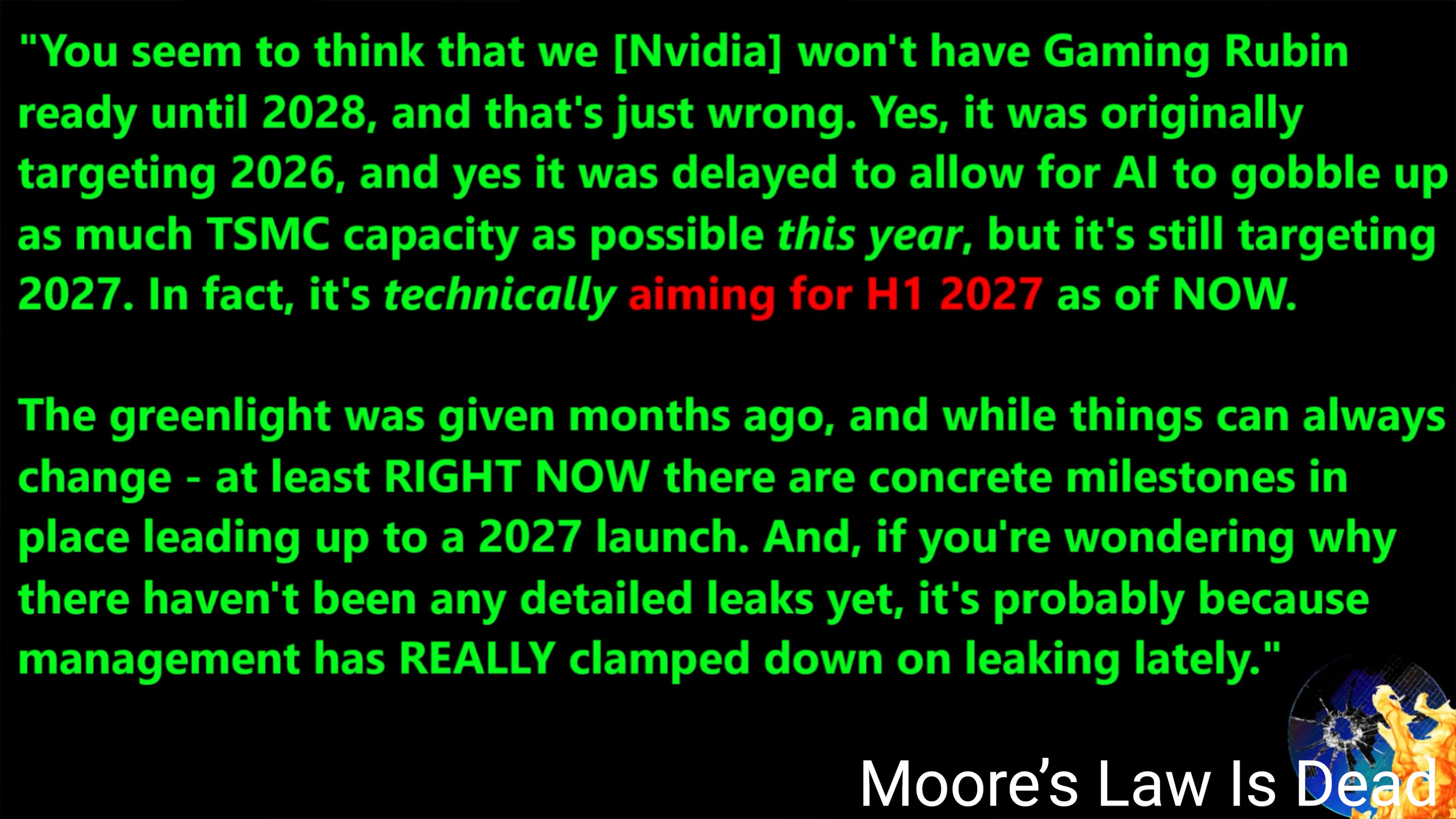
Not only that, but according to the same report, the RTX 6000 series has been given the green light to target a release in the first half of 2027. And I’ll bet that the biggest architectural upgrades will be targeting this exact type of workload. Think faster Tensor cores, more AI throughput, etc. Basically anything to help run DLSS 5 without completely destroying your framerate.
With that said, there is one big issue with this.
Another well known leaker, Kepler, is claiming that both Nvidia’s and AMD’s next gaming generation gaming GPUs have actually been pushed all the way into 2028. So right now, we have two very different timelines.
But regardless of when the RTX 6000 cards arrive, it seems pretty clear that they were made for DLSS 5.
What’s Happening To The 5090?!
It was just two weeks ago that I talked about the 5090 doing the meme. It had reached an eye-watering $5,090. Little did we know, those were actually the good times. Because the card seems to be disappearing everywhere, leaving behind prices that no human should endure. I’m talking some 5090s are retailing for over $9,000! (Insert Vegeta meme here) At this point, the MSRP of $1,999 feels more like a historical document than a price.
Fortunately, we may have a pretty good explanation for at least some of this.
Images shared by HKEPC reportedly show Chinese AI system builders buying pallets of new retail RTX 5090s. And apparently, they’re being used to pack multi-GPU servers for AI.
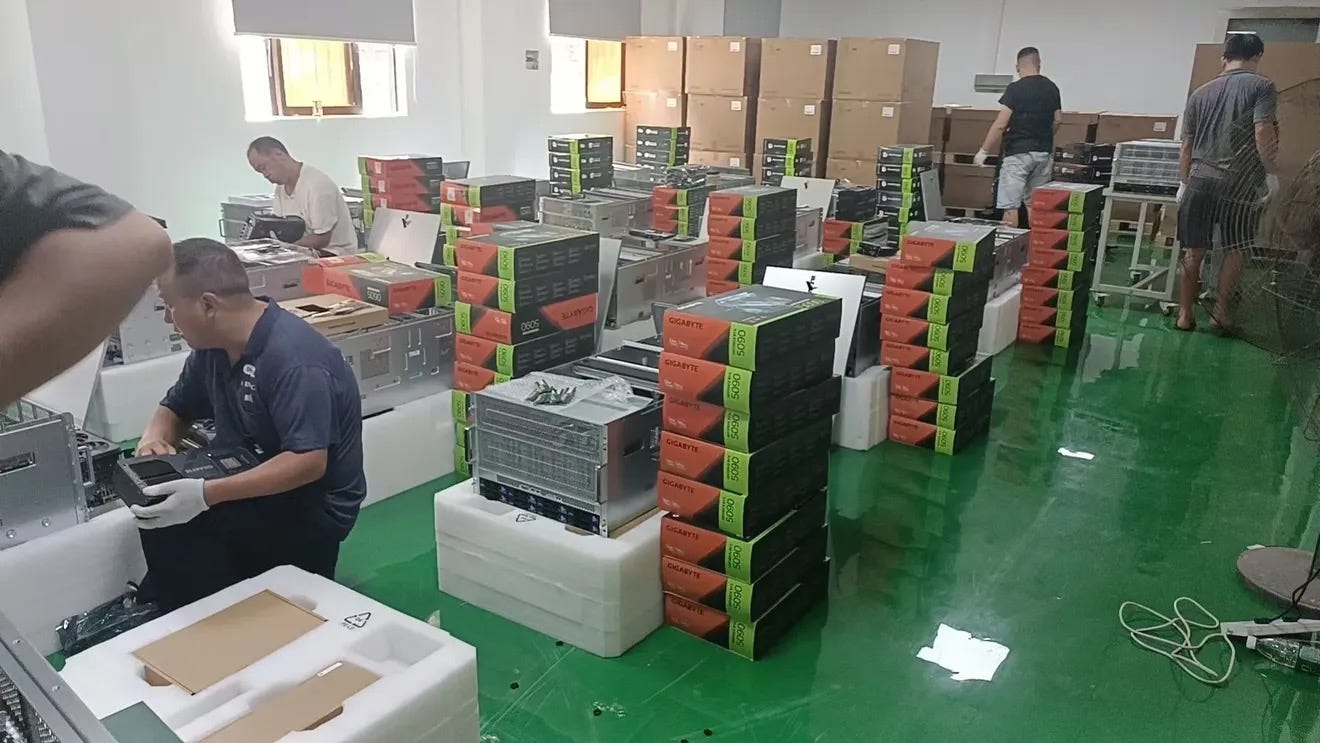
In the picture, you’ll notice that these aren’t RTX 5090 D or the D V2 variant. No, they’re the regular 5090. Which is odd, given Nvidia can’t technically sell the 5090 to China, thanks to US trade restrictions. So what’s going on here?
Well, according to MSI, they’re sourcing them from overseas retail markets through unauthorized distributors and retailers. Either way, this is clearly an issue. Ultimately, it’s really starting to remind me of the crypto boom. Except this time, instead of miners buying every GPU in a 500 mile radius, it’s AI companies.
What’s frustrating is that Nvidia has already shown they can restrict some of the AI capabilities in their gaming card, and it still performs well. Hence, the 5090 D V2. But with DLSS 5, that’s likely not going to happen. Plus, if they software lock it, we’ve seen how well that worked out in the past.
Ultimately, I think Nvidia needs to do something to keep these out of the hands of AI companies.
AMD’s Making Their Own DLSS 5
You read that title right. AMD is apparently planning to launch their own version of DLSS 5.
This story originally comes from the very well known leaker Kepler, Who claims that AMD’s next-generation GPUs are set to get their own version of what he calls “Neural Lighting”, essentially AMD’s answer to the kind of neural rendering Nvidia introduced with DLSS 5.
And this is a huge deal, because like I discussed here, my biggest concern with DLSS 5 is that it could effectively push AMD out of the market. Simply put, developers could begin using it as a crutch to finish designing their games for them, just like many already rely on upscaling and frame generation to make up for poor optimization. And if that happens, gamers could eventually be forced to use Nvidia cards just to experience games the way the developers intended. Think of this as the ultimate walled garden. Luckily, if this is true, and AMD launches a similar tech, that likely won’t happen.
Unfortunately though, there is some bad news. According to Kepler, AMD will probably require RDNA 5 because the workload is simply too heavy for existing hardware. And we’ve already seen some proof of this. AMD already confirmed that FSR Diamond uses next generation neural rendering. Plus, let’s not forget the new tech that they announced for next Gen, including neural arrays that link clusters of compute units to share data like a huge AI engine. Maybe AMD will end up adding support for older cards later, similar to what they did with FSR 4. But given how taxing this likely is, I wouldn’t bet on it.
Now, what isn’t confirmed, is exactly how AMD’s new tech will work.
Kepler discussed one potentially better approach where neural rendering gets more direct information about the scene. Think geometry and material data, so the model has less guessing to do. That would allow AMD’s version to be more accurate, and potentially even faster than DLSS 5.
And get this… AMD has actually published research papers with similar things happening.
With all of that said, there is a new danger here. This could actually split the user base into teams like we’ve never seen before. Because now you wouldn’t just be picking a GPU based on price or performance. You could be picking it based on how the game itself actually looks.
Then imagine what happens if a developer only supports one of these technologies. You’ll effectively be playing two completely different games. To get the best experiences in every game, you may end up having to buy an AMD and Nvidia GPU. Oh no…
Goodbye To Nvidia’s Monopoly
Not too long ago, I went over a big update that AMD made to their AI software with the release of ROCm 10. In it, I spelled out the real advantage that Nvidia has in the market. And believe it or not, it isn’t really their hardware.
It’s their software suite, CUDA.
CUDA has had nearly two decades to become embedded into AI frameworks, scientific applications, research tools and thousands of random projects. Even when an AMD GPU has enough raw compute performance for a workload, the software may simply expect CUDA and refuse to cooperate.
Which is why this next project is so interesting.
A developer called Speedstu has created CUDA-for-AMD-Windows, which is effectively a translation layer between CUDA applications and AMD’s ROCm stack. You may have heard about something similar in the past, called ZLUDA.
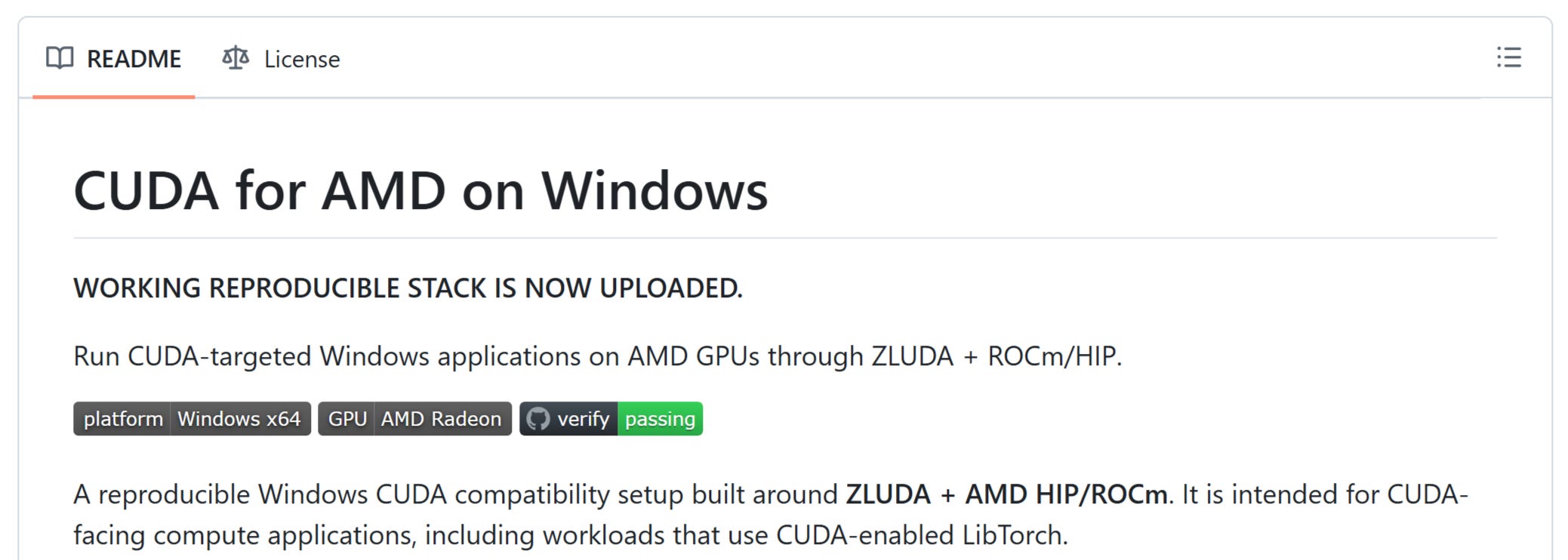
Well, the interesting part is that this doesn’t replace ZLUDA. It expands on it. Specifically, it uses ZLUDA, but adds a much more automated setup, connects it more deeply to AMD’s newer HIP stack, and also adds important CUDA libraries on top of it.
In fact, the developer has already validated CUDA-facing libraries including cuBLAS, cuBLASLt, cuSPARSE and cuFFT on an RX 9060 XT. More importantly, this wasn’t just a case of getting an application to open and declaring victory. The project successfully ran an actual CUDA-targeted LibTorch reinforcement-learning workload with a 2.2-million-parameter network.
Now, don’t go selling your Nvidia GPU tomorrow.
The project has currently only validated the RX 9060 XT, plus some major CUDA support is still missing, but the wild part is that this was put together by a single developer. One guy… Yet he was able to do all of this. So imagine what a team of developers from say, AMD can do.
At the end of the day, every project that makes CUDA software less dependent on Nvidia hardware chips away at their monopoly. We’re nowhere near the point where CUDA suddenly stops mattering. But walls tend to look permanent right up until people start finding doors.
Quick Bytes
AM4 Still Refuses To Die
Somehow, AMD just launched another AM4 CPU in 2026. The new Ryzen 5 5500F is a $99 six-core Zen 3 chip with PCIe 4.0 support. AM4 launched in 2016. At this point, I’m convinced it will outlive all of us.
Microsoft Fixed Windows… Again
Microsoft had to push out an emergency Windows 11 update after September’s regular update caused problems with things like Remote Desktop, USB audio and AMD GPUs.
Unfortunately, reports of Radeon crashes and some File Explorer issues remained afterward.
Remember when Microsoft promised more reliable updates?
Photograph Your GPU’s Serial Number
An RTX 5090 Founders Edition owner reportedly had their warranty claim rejected because the serial number printed on the card had faded and could no longer be read.
So apparently one more thing you should do after spending thousands of dollars on a GPU is... take a picture of it before the ink disappears.
HDMI 2.2 Is Finally Here
The first certified HDMI 2.2 Ultra96 cables are finally going on sale, doubling HDMI 2.1’s maximum bandwidth from 48 to 96 Gbps. There’s just one small problem: basically no current GPU actually supports HDMI 2.2 yet.
WINNER Of The Meld Bytes Giveaway!
Before I go, I can finally announce the winner of the last Meld Bytes giveaway.
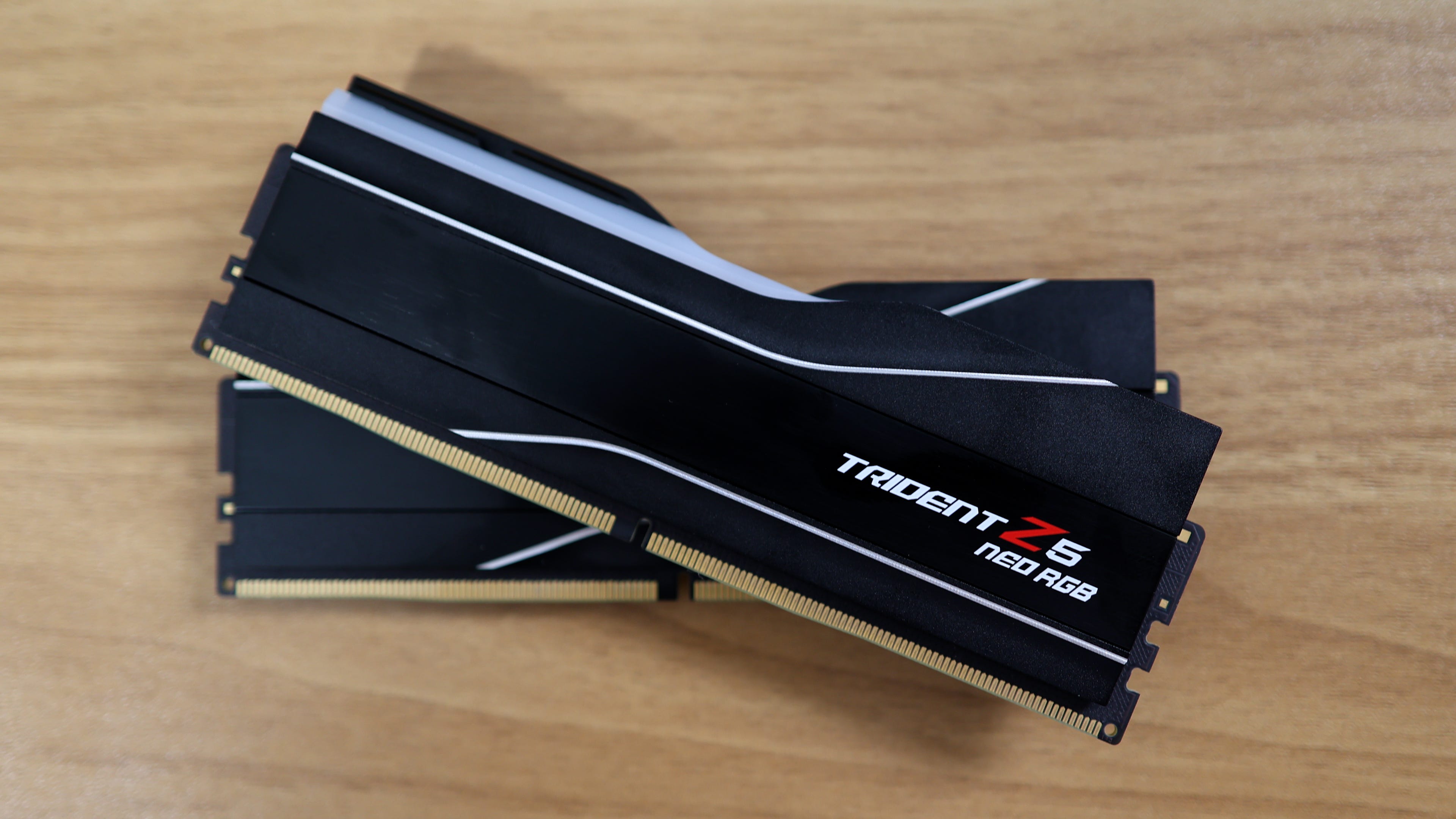
After going through multiple winners who either never responded or weren’t actually eligible, Ryan from Michigan is officially taking home the G.Skill Trident Z5 DDR5 memory kit.
CONGRATULATIONS RYAN!
And if you didn’t win, don’t worry. I already have another giveaway going with three separate prizes, so you’ve got three more chances to win this time around.
Thanks again to everyone who entered, and especially everyone who’s been reading and sharing Meld Bytes.
Until next time, may your AM4 board live forever, your Windows update actually work, and your GPU’s serial number survive longer than the warranty.