


The PC market in 2026 has been full of disappointments. All of it is mostly thanks to the ravenous demand from AI companies, but it’s not just sky-high memory or storage prices. New hardware releases are also sorely lacking. This is the first year since 1999 that Nvidia hasn’t released a new gaming GPU.
Don’t worry though, because Nvidia just released their new DLSS 5. And while it honestly looks pretty good in most cases, the performance hit is pretty drastic. But that isn’t even the biggest issue.
Luckily, I actually have some good news about an oversupply, there’s new competition and AMD is going all out!
DLSS 5 Changes What A Game Even Is
Nvidia’s new technology, called DLSS 5, is officially here. And with it, brings the potential to completely change the entire industry. But the problem with talking about “change” is that most people tend to forget that change can be bad. In this case, it could redefine what a game even is. And in the end, we may not have a choice.
So what exactly is DLSS 5? Well, Nvidia calls it 3D Guided Neural Rendering. Unlike previous version of DLSS, which all focused on raising performance, DLSS 5 actually changes the final image itself. Nvidia research describes it as “the first DLSS technology to generate the final displayed appearance rather than reconstruct a higher-cost reference output from the conventional renderer.”
Basically, DLSS 5 takes information from the engine like color, motion vectors, materials, surface information and lighting and feeds it into an AI model. That model can add things like more realistic skin, light passing through the ears and hair, deeper contact shadows, improved material responses and more complex lighting. And to be fair to Nvidia, this isn’t like typing a prompt into an image generator and hoping your character still has the same number of fingers in the next frame. The system is designed to be deterministic and stable.
Unfortunately, this brings us to our first problem. While Nvidia claims that developers have control over what the AI outputs, they really don’t. They can choose between different neural models, adjust the Intensity, apply semantic masks, and isolate individual assets or groups of objects so DLSS only modifies specific parts of the scene. But they can’t make any specific, meaningful changes to the final output. What I mean is, they can’t talk to it like ChatGPT. So if the AI decides to change something in a way that the developer doesn’t want, they can’t just tell the AI to change it to something else. We’ve already seen this issue play out with character models that end up looking completely different from their original design.
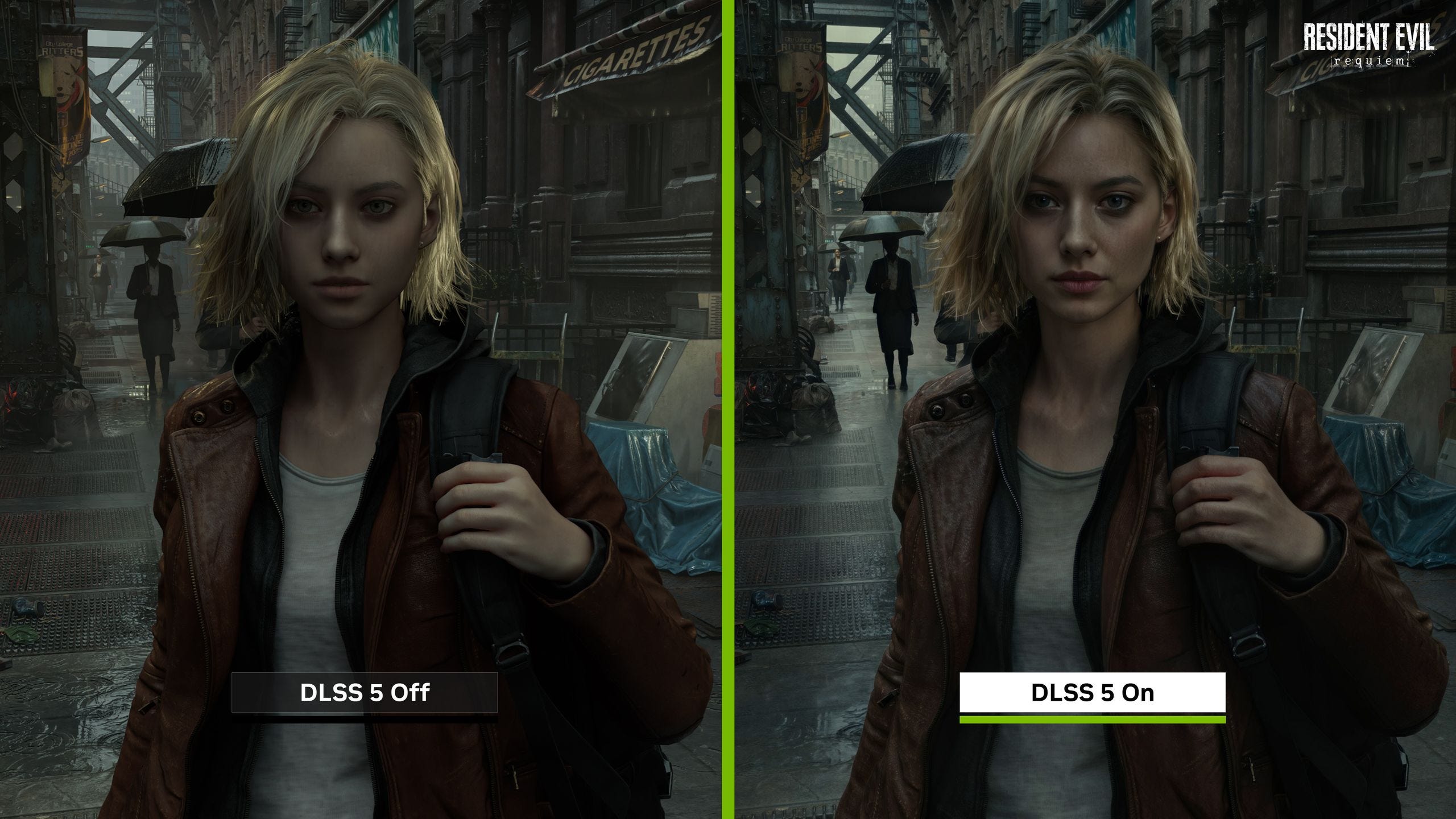
Sure, you could just lower the intensity, but then you end up with a mismatch of some objects that have great lighting and all that DLSS 5 offers and some without.
This also brings up the issue of every game looking the same. As if we don’t already have a major problem with Unreal Engine games that tend to have a very similar style. Now, you’re adding another layer on top of that. Not to mention the argument against games becoming so real that they’re not an escape anymore. That one, I don’t fully agree with, but it is nice to see games that have their own style or design. Not everything has to look like real life.
It EATS GPUs
When it comes to actual performance, Nvidia’s DLSS 5 destroys your GPU. Luckily, it’s not as bad as it was when they first demoed the new tech back in March. Remember they were using 2 RTX 5090s for that. According to Nvidia, it’s now 5X faster than that demo, but unfortunately, there’s still a massive performance penalty.
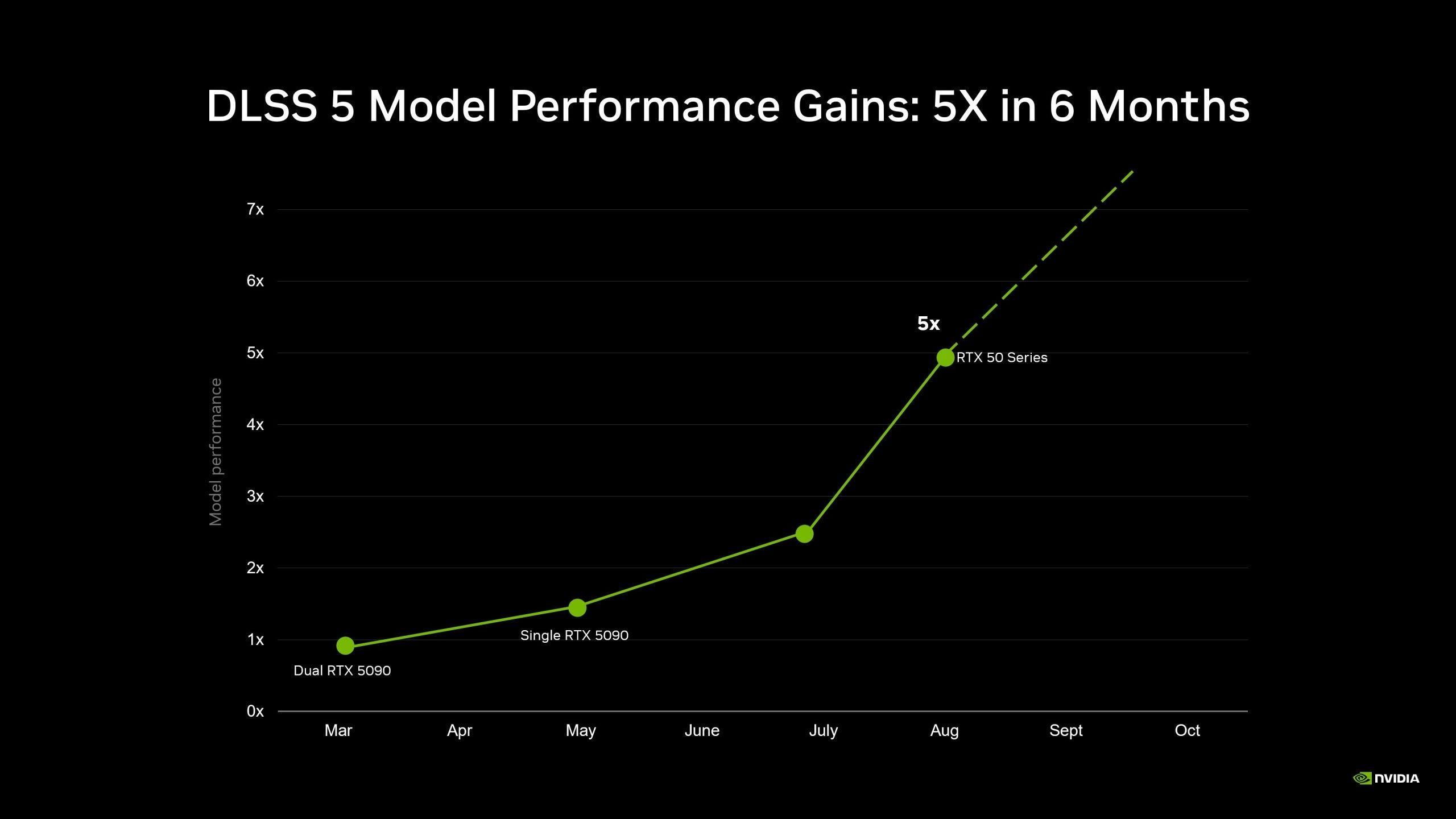
According to Nvidia themselves, you can expect between a 50-60% performance hit when turning it on. But when they actually show the performance in NBA 2K27 (the first game to get DLSS 5), Nvidia makes it look way better than what it really is.
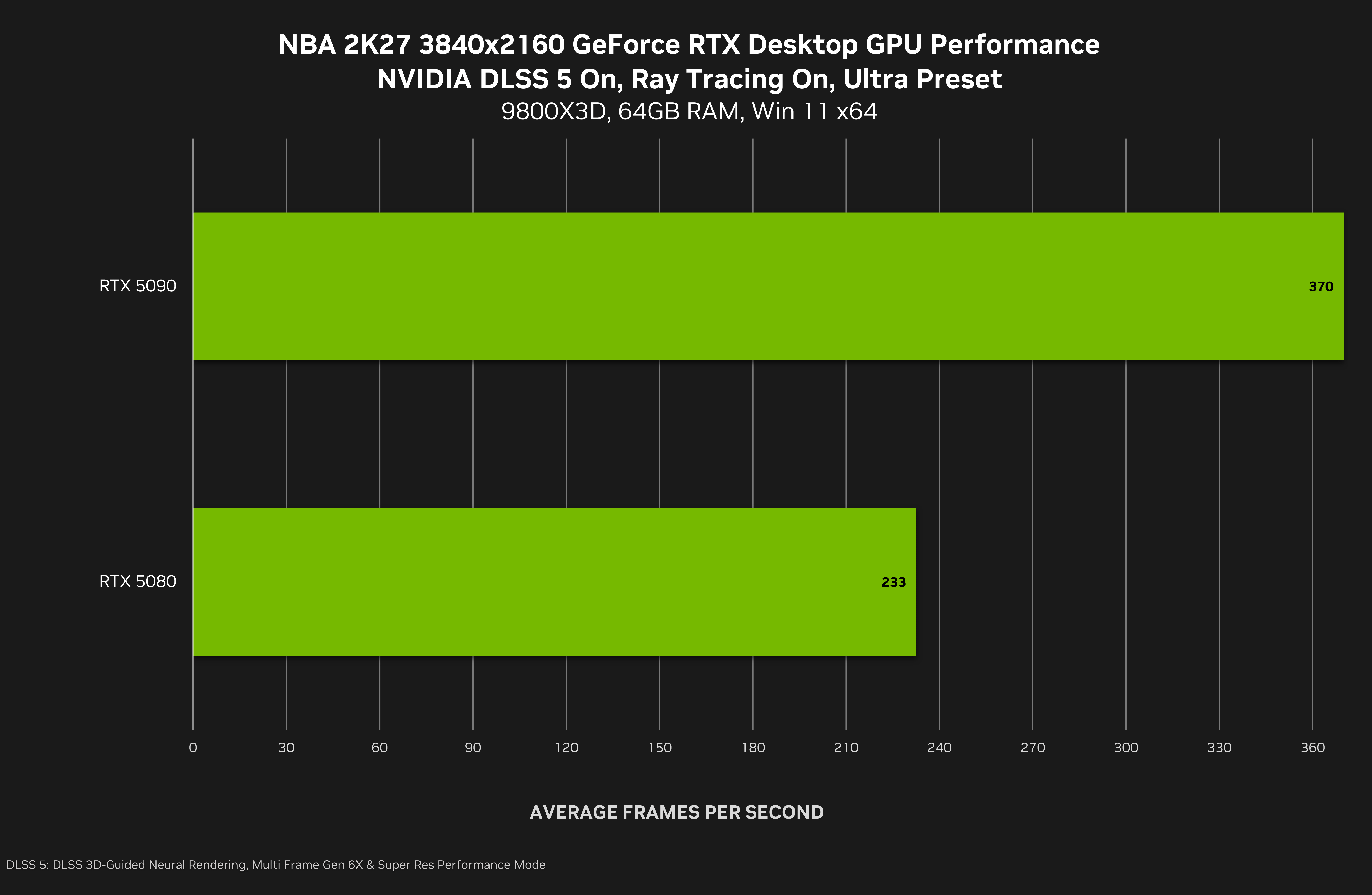
As you can see, the RTX 5090 gets a very impressive 370 FPS in 4K. And the 5080 still gets a respectable 233. BUT if you look down at the bottom of the image, you’ll likely notice something important. This is using 6X Multi Frame Gen! So not Dynamic Frame Gen, where it dynamically changes the number of AI-generated frames between each real frame as they’re needed. Nope. This gets the full 6X. When we do the math, you’ll quickly realize that the 5090 is getting just 62 real frames per second, while the 5080 gets a measly 39. Not to mention that it’s also using upscaling set to Performance mode.
Now, the upscaling part really isn’t the worst of it, because at least with upscaling, you can actually get lower input latency by increasing the number of real frames being rendered. But with frame gen, you don’t get that same benefit. Basically, those AI-generated frames can’t incorporate new input from your mouse or keyboard. The game has to wait for the next real frame to actually respond to what you’re doing. So while the game might look like it’s running at 233 or even 370 FPS, it absolutely doesn’t feel like it. But like I said, the terrible performance isn’t the real problem.
The Real Problem
The biggest reason this isn’t necessarily a problem is the obvious one many of you will likely point out: DLSS 5 is completely optional. If you like the way it looks, turn it on. If you don’t, leave it off. And to be fair, some of the results really are impressive.
BUT while this answers the issue of performance, it also points to the real problem: Super Resolution was also optional.
It originally gave developers a way to take a game that already ran well and make it run even better. But over time, that slowly shifted. To the point where games seem to be designed around the expectation that upscaling would already be enabled.
Instead of optimizing a game to hit 70 FPS natively and letting DLSS push that to 100+, suddenly 70 FPS is only possible with DLSS enabled. So it stopped being the bonus and became part of the performance budget.
And DLSS 5 could easily run into the same problem.
If a developer knows DLSS 5 can create convincing skin shading, ambient occlusion, lighting and material detail afterward, why spend as much time and money building all of that through traditional rendering?
Obviously, Nvidia says DLSS 5 is meant to extend the rendering pipeline rather than replace it, but the economic incentives are pretty apparent. And if the base version of a game eventually gets designed with the assumption that neural rendering will provide a bunch of the final visual detail...
What exactly does the game look like when you turn it off?
An Oversupply Could Finally Be Coming
Believe it or not, I finally have some genuinely good news. Not “prices increased slightly slower this week” good. But actual good news.
Because according to TrendForce, the NAND Flash shortage may finally have an expiration date. For anyone who doesn’t know, NAND is the type of flash memory used inside SSDs. And like basically everything else that AI servers need right now, NAND has been getting hammered. TrendForce estimates that the NAND market will end 2026 with roughly a 4 to 5 percent supply deficit. So unfortunately, we still have to get through the current mess.
But in the second half of 2027, TrendForce expects supply to exceed demand. In other words, we could go from not having enough NAND... To having more than the market needs. And there are multiple reasons why.
First, manufacturers are finally beginning to expand again. An August TrendForce report claims that major NAND suppliers are ending their aggressive capital expenditure cutbacks and restarting longer term expansion plans. That means more advanced manufacturing processes, higher capacity products and even entirely new fab capacity coming online.
At the same time, consumer demand is terrible.
TrendForce expects smartphone production to fall somewhere around 15 to 20% this year, while notebook shipments are expected to drop by roughly 10%. And despite all the attention on AI servers, smartphones and notebooks still account for nearly 40% of total NAND demand.
Then there’s China.
The Chinese NAND manufacturer, YMTC is apparently planning to go all out. Because they’ve reportedly set their sights on becoming the world’s largest NAND supplier by the end of 2027. What’s wild is that to accomplish this, they have to nearly double their market share in just 16 months time.
So when you put all of this together: more fabs, more output per wafer, more Chinese capacity, and weak consumer demand, you get a recipe for turning a shortage into oversupply. And that’s when prices really get good.
China Just Beat The Memory Giants To LPDDR6
And speaking of more competition from China, CXMT just pulled off something that I don’t think many people expected. The Chinese DRAM maker has just become the first manufacturer to publicly confirm both LPDDR6 volume production and an actual device that’s using it. Specifically, it’s set to appear inside Xiaomi’s upcoming 18 Fold smartphone.
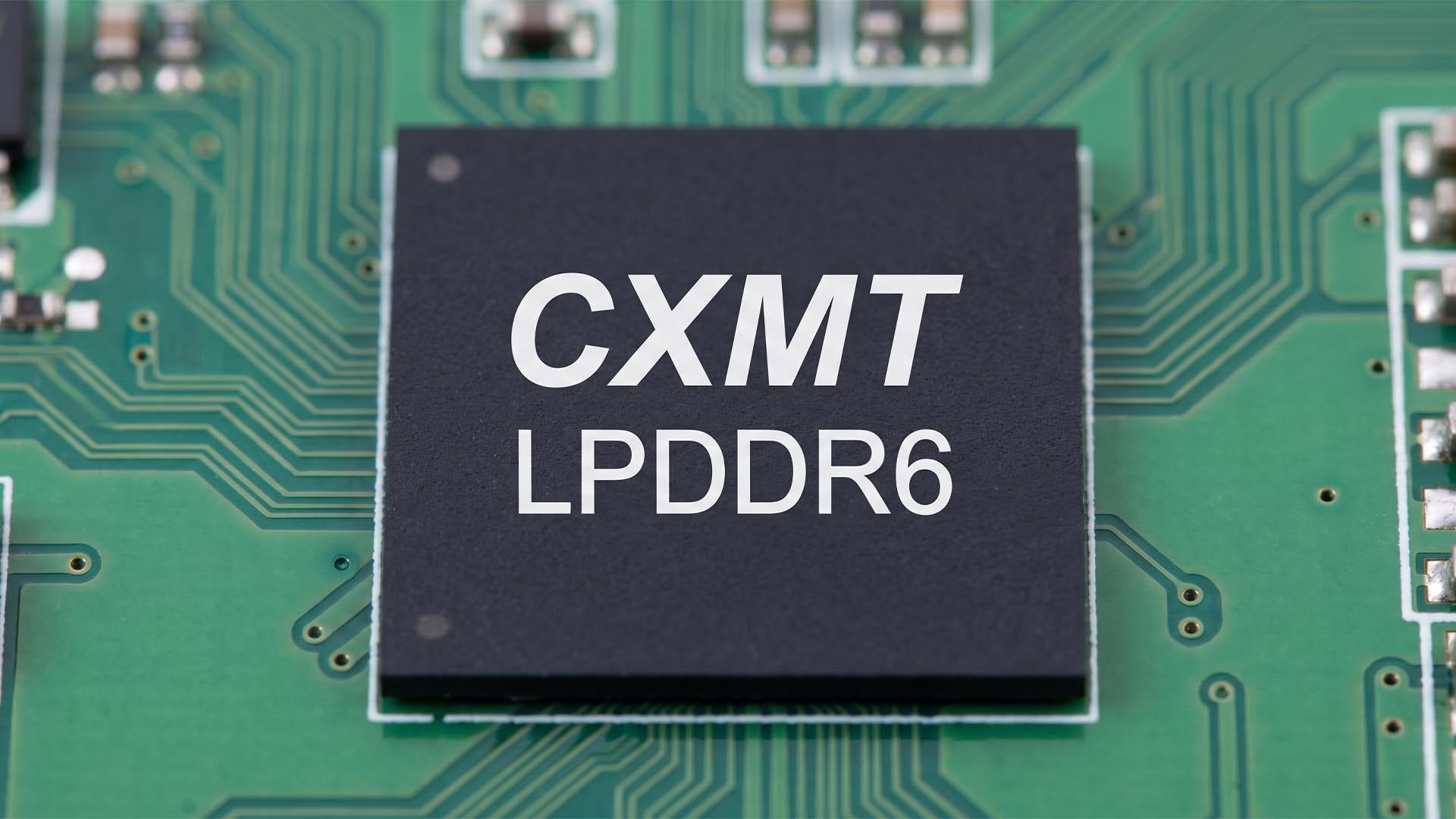
Now, I will say that SK Hynix has already developed and validated LPDDR6, and they previously said that they planned to begin supplying the memory during the second half of this year. So it’s not like CXMT invented LPDDR6 while Samsung and SK Hynix were asleep. But what they did do, was reach actual commercial production before the biggest companies out there.
Not only that, but their new LPDDR6 parts reportedly reach up to 12,800 Mb/s and capacities of up to 16GB. LPDDR6 itself is a pretty big upgrade over LPDDR5 memory as well, moving to PAM3 signaling and providing much more bandwidth. But the main story here is really the speed at which CXMT is catching up.
It was just a few weeks ago that we were talking about CXMT DDR5 getting support for higher frequencies. Then it started appearing in memory products and laptops. Then reports showed their overall production getting much closer to the more established manufacturers. And now it’s at the forefront of a brand new memory generation.
Of course, there are still some big, unanswered questions. Getting LPDDR6 into one flagship phone does not prove that CXMT can manufacture it at Samsung or SK Hynix scale. We don’t know how its yields will compare, how much capacity it has available or how quickly it can expand production. At the end of the day though, it’s great to see new competition.
AMD’s Going After Nvidia’s Biggest Asset
There’s also a completely separate story about competition that’s happening right now. And this one could have huge ramifications for the entire industry. Because it may finally mark the end of Nvidia’s monopoly. AMD just announced ROCm 10.
For those who don’t know, Nvidia’s biggest advantage in the AI market isn’t actually their hardware. But their software. Specifically, CUDA. See, Nvidia has spent nearly two decades building a massive software ecosystem around their hardware. Frameworks are optimized for it. Developers already know it. Companies have built entire infrastructure stacks around it. So even if AMD builds an accelerator with competitive performance (which they mostly have already), convincing a company to rewrite and revalidate their software stack is an entirely different problem.
That’s where ROCm 10 comes in. One of the biggest additions in ROCm 10 is ROCm.AI, which includes a system called Hyperloom. Hyperloom can actually look at an AI workload, find bottlenecks, modify things like kernels, memory management and scheduling, benchmark the changes and then validate that they actually work. Basically, AMD is using AI to optimize software for AMD’s AI hardware.
And AMD is showing some huge performance gains. For example, on the same eight GPU MI355X platform, a preview of ROCm.AI delivered an average 3.3X higher inference throughput across three tested models and 2.4X higher training throughput compared with ROCm 7.
With that said, AMD explicitly warns that these workloads are not universal ROCm 10 performance jumps. But the improvement shows what AMD believes it can gain by attacking the entire software stack instead of relying on faster silicon alone.
Not only that, but ROCm 10 also brings AMD-specific workflows directly into coding tools like Codex, Claude Code and Cursor, while expanding support across major AI frameworks and tools.
Basically, this is exactly what AMD needs to do if they ever want to really compete with Nvidia. They need competitive hardware that developers don’t hate using.
Quick Bytes
920Hz Lasted Four Days
In the last issue, I told you that ASUS had announced a monitor capable of hitting 920Hz. Well, congratulations to anyone who bought it. Your technology is now ancient. Acer just announced the Predator XB253Q U1, a 24.5-inch 1080p IPS gaming monitor capable of running at 1000Hz.
One. Thousand. Hertz.
At this rate I’m expecting 1440Hz by Tuesday. And just like I said last week: if you still miss the shot, I really don’t know what else the industry can do for you.
Microsoft Is Turning On Another Security Feature
Starting in October, Microsoft will begin automatically enabling Windows 11’s Memory Integrity protection on a broader range of eligible PCs. Memory Integrity uses virtualization based security to isolate important parts of the Windows kernel, which is obviously good for security.
Unfortunately, Microsoft has previously acknowledged that it can reduce gaming performance on some systems, with older hardware generally taking the larger hit.
The RTX 5090 Is A Meme Now
Nvidia’s RTX 5090 has actually reached $5,090. And it’s not some liquid-cooled collector card either. PCPartPicker has actually listed the regular ASUS TUF RTX 5090 OC at $5,099, which is now more expensive than MSI’s ridiculous $5,090.99 Lightning Z. The jokes write themselves.
Nvidia’s Newest Driver Has A Problem
GeForce 616.56 has caused black/white flashes, brightness changes and color corruption for some GTX 16 through RTX 50 users. Nvidia says it’s testing a fix; switching from 8-bit to 10-bit color reportedly fixes it for some people.
That’s all the bytes for this week.
Until next time, may your frames be real, your RAM be real, and your GPU cost less than your entire PC.
The GPU that's caught my eye now that time's gone by and they've been user tested for over a year and a half, is the Zotac RTX 5090 32 GB. Sad thing is I'm pretty sure a scalper over on MemoryC bought all the remaining ones on amazon that were going for ~5k USD (Still wouldn't buy that 2.5x the original price is yikes....), and now there being sold for ~7.6K USD. Waiting for that price to hit 10k one of these days. Hoping AMD will save the market next year but wouldn't blame a farmer for making hay while the sun shines.