


PC hardware is beginning to feel like it exists in two completely different realities. In the first reality, upcoming products look incredible. AMD’s early Zen 6 silicon is posting ridiculous benchmark results. Intel’s preparing desktop processors with as many as 52 cores, and Nvidia’s building its first serious Windows-on-Arm gaming chips.
Then there’s the second reality—the one where companies can completely finish a building a new GPU, yet they can’t release it because memory is too expensive.
And that contradiction may be the defining story of the hardware industry right now.
The actual processors are improving faster than ever. But memory shortages, AI infrastructure spending and increasingly expensive manufacturing are determining which products can launch, what they cost and whether ordinary consumers can afford the rest of the computer required to use them.
A $280 Gaming CPU in a $400 RAM World

AMD’s new Ryzen 7 7700X3D perfectly illustrates how strange the market has become.
When AMD announced the processor at Computex, I wasn’t exactly impressed. The 7700X3D is essentially a slightly slower Ryzen 7 7800X3D. Meaning it comes with the same eight Zen 4 cores and 3DV-cache. It just lowers the clocks a bit.
At its official $329 price, it was an absolute no from me.
The 7800X3D is currently $339 at Micro Center, so there’s no world that makes a $329 7700X3D make sense to me.
Then launch day arrived.
Newegg immediately offered a $49 promotional discount, dropping the processor to $279.99 with code PKC337. As of this writing, the retailer is still advertising that promotion. At $280, the entire argument changes. You’re no longer saving $10 or $20—you’re potentially saving around $60 or more compared with readily available retail 7800X3D listings.
That turns the 7700X3D into a genuinely strong gaming CPU for anyone who already owns an AM5 motherboard.
The words “already owns” are important, though.
A cheap processor does not automatically create a cheap computer. DDR5 prices have jumped so high that the cost of memory can wipe out practically everything you saved on the CPU. Add a motherboard, RAM and storage, and suddenly that $280 gaming chip is sitting in the middle of a system that costs far more than an equivalent build would have a few years ago.
There’s also a strange availability problem. The 7700X3D is currently exclusive to Newegg in North America and reportedly won’t appear at additional U.S. or Canadian retailers until at least the fourth quarter. It’s being sold more broadly in other regions, but North American buyers currently have one official option.
So yes, the 7700X3D is now a great deal.
It’s just a great deal inside a hardware market where practically everything surrounding it has become painfully expensive.
Nvidia Built the GPUs. Memory Said No.
That brings us to Nvidia’s RTX 50 SUPER series.
According to a new report, at least one Nvidia board partner has already received physical RTX 50 SUPER GPUs. These reportedly aren’t preliminary specifications or extremely early prototypes, but the final product. The hardware exists, but Nvidia has instructed their partners to hold the cards while the company decides what to do about pricing.
The problem is reportedly the new 3GB GDDR7 memory modules.
Using those higher-density chips will let the 5070 SUPER go from 12GB to 18GB, and RTX 5070 Ti SUPER and RTX 5080 SUPER could jump from 16GB to 24GB.
That would address one of the biggest complaints surrounding Nvidia’s current generation: expensive graphics cards shipping with memory capacities that feel increasingly inadequate.
Unfortunately, the 3GB chips are reportedly absurdly expensive.
The source claimed one 3GB GDDR7 module currently costs somewhere around $60 to $70, compared with roughly $20 for a standard 2GB module. Nvidia and its partners almost certainly negotiate different volume pricing, so those figures shouldn’t be treated as the exact bill of materials. But the larger chips would still be considerably more expensive. Multiply that across six modules on an RTX 5070 SUPER or eight modules on a 5070 Ti SUPER or 5080 SUPER, and Nvidia is left with two options:
Charge customers substantially more or accept lower margins. As you would guess, Nvidia doesn’t like either of those.
The same memory problem is also reportedly holding back a 9GB version of the RTX 5050 that would use three of those higher-density GDDR7 chips. This is where the hardware market starts looking completely backwards.
Nvidia may have finished graphics cards sitting inside its partners’ facilities, yet it still can’t find a price that makes sense. The GPU itself isn’t the bottleneck. The memory surrounding it is.
And it probably won’t stop with graphics cards.
The Temperature Nvidia Didn’t Want You to See
The RTX 50 series is also generating controversy for a completely different reason. When these GPUs launched, normal monitoring software could no longer display the chip’s hotspot temperature. Users could see the general GPU reading, but not the temperature of the hottest individual section of the silicon.
That matters because an average temperature can look perfectly acceptable while a specific section of the chip is running dangerously hot.
Last time I discussed a Brazilian repair specialist, Paulo Gomes, who recently demonstrated exactly that a hotspot approaching 107 degrees thanks to dried thermal material and an uneven cooler installation. Once corrected, temperatures and performance improved.
Developers have since restored RTX 50 hotspot monitoring through HWMonitor, HWiNFO, AIDA64 and a community plugin for MSI Afterburner.
And owners are already discovering questionable results.
One Colorful RTX 5080 owner reportedly measured a hotspot temperature close to 100 degrees. There may have been a measurement error depending on which version of HWMonitor was used, but Colorful’s response was arguably more important than the exact reading.
The company recommended checking airflow and dust buildup first. However, if the hotspot remains at or above 95 degrees Celsius under otherwise good cooling conditions, Colorful recommends submitting the card for an after-sales inspection to check for a cooler defect or another hardware issue.
That doesn’t mean every RTX 50 GPU has a cooling problem. It doesn’t even mean a chip briefly touching 95 degrees will instantly fail.
But sustained high temperatures can accelerate degradation, reduce boost behavior and reveal poor cooler contact that users otherwise have no way to diagnose.
There was never a good consumer-facing reason to hide this reading.
When a $1,000+ graphics card has a cooling defect, the solution should not be hoping the average temperature hides it convincingly enough.
Meanwhile, Next-Generation CPUs Look Insane!
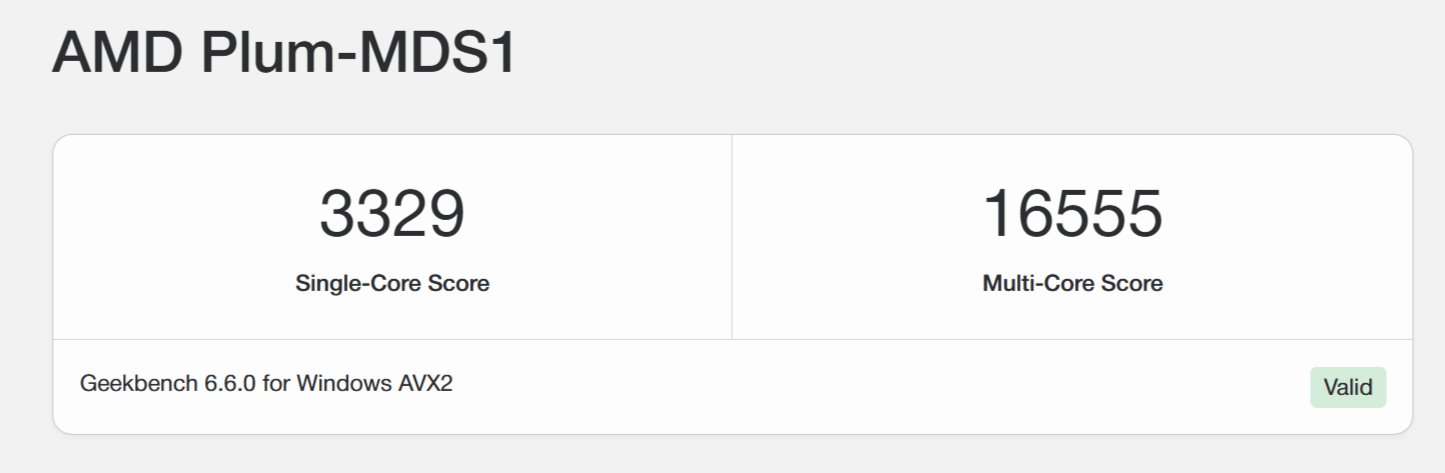
While current hardware struggles with pricing and availability, next-generation CPUs are moving in the exact opposite direction.
A 10-core AMD Medusa Point engineering sample recently appeared in Geekbench with a single-core score of 3,329 and a multi-core score of 16,555. The internal result indicated a peak clock of around 5.37GHz despite the early listing displaying much lower frequencies.
Compared with average results for the 12-core Ryzen AI 9 HX 370, the engineering sample was approximately 28% faster in single-core performance and 24% faster in multi-core—even though the new chip has two fewer cores.
Compared with the existing 10-core Ryzen AI 9 365, the differences grow to around 35% in single-core performance and 33% in multi-core.
Even more impressively, the same engineering-sample identifier had appeared previously with scores of 3,174 and 15,092. The newer run was approximately 5% faster in single-core and nearly 10% faster in multi-core. YET it’s the same silicon revision! Meaning this bad boy gained this much without new silicon, so the final retail version could be way faster.
With that said, as always, leaked Geekbench results should be treated carefully. We don’t know the system’s power limits, cooling configuration or whether these results represent final retail behavior.
But early samples normally aren’t supposed to embarrass the existing lineup this badly.
And it doesn’t stop there, as Intel is preparing an equally aggressive response with their next Gen Nova Lake.
Leaked scheduling information suggests the first 28-core desktop processors could arrive between January and March of 2027, followed by unlocked K-series models around March or April. Smaller 16-core and 8-core models would follow, while Intel’s enormous 52-core flagship may not launch until sometime between May and September. The lineup is also expected to launch under Core Ultra Series 400 branding.
In other words, AMD and Intel are preparing some of the most ambitious consumer processors we’ve ever seen.
The only question is what the rest of the computer will cost by the time they arrive.
Nvidia Wants to Build the Entire PC
And the CPUs don’t stop there, as Nvidia is preparing to enter the CPU battle as well.
The company recently released GeForce driver 616.00, its first native GeForce developer-preview driver created specifically for Windows 11 on Arm and the upcoming RTX Spark platform.
Files inside the driver confirm two high-end RTX Spark configurations.
The full model contains 6,144 CUDA cores paired with a 20-core Arm CPU, while a cut-down version uses 5,120 CUDA cores and an 18-core CPU. These match the previously leaked N1X 675 and N1X 650 configurations. Both can reportedly support as much as 128GB of unified LPDDR5X memory shared between the CPU and GPU.
That could be extremely interesting for gaming, content creation and local AI workloads, but it also creates an enormous software challenge.
Windows on Arm has improved significantly, but Nvidia needs mature graphics drivers, reliable x86 translation and game developers willing to support the platform. Anti-cheat software remains an especially important obstacle because many competitive games still rely on low-level components that don’t automatically translate across CPU architectures.
The hardware may be fast enough.
Whether everything runs properly is the part Nvidia still has to prove.
The $1.65 Trillion Bet Behind Everything
All of these stories ultimately lead back to the same place: the unprecedented amount of money being spent on AI infrastructure.
A recent report estimates that Alphabet, Amazon, Meta, Microsoft and Oracle collectively have approximately $1.65 trillion in off-balance-sheet commitments. That’s roughly 122% more than the debt they already have on their balance-sheet.
Calling it “hidden debt” makes it sound more sinister than it necessarily is.
These companies aren’t secretly fabricating financial statements. Much of the total reportedly consists of long-term data-center leases, power agreements and compute contracts that have been signed, but haven’t taken effect yet. Under normal accounting practices, those obligations may not appear as traditional debt until the projects become operational.
Once they do, the companies have committed to paying for that capacity whether demand ultimately matches their expectations or not.
That is where the real risk begins.
Reuters estimates that the five hyperscalers’ annual capital expenditures could increase by approximately $534 billion by 2027, while their annual operating cash flow rises by only around $340 billion.
That works out to roughly $1.57 in additional investment for every $1 of additional operating cash generated. Oracle’s free cash flow has already turned negative, Amazon and Microsoft’s have fallen sharply.
To be clear, this does not mean that AI demand is fake or that AI is useless.
The internet permanently changed the world, and investors still created a massive dot-com bubble around it. A transformative technology and a financial bubble can exist at the same time.
The issue is that every major technology company is terrified of falling behind.
Microsoft spends more, so Google spends more. Google spends more, so Meta spends more. Nvidia develops a larger AI system, so AMD develops a competing rack. Cloud providers reserve GPUs, CPUs, power and data-center capacity years in advance because waiting could mean losing customers to a competitor.
That creates demand based not only on what companies need today, but on what they fear their rivals may have tomorrow. And as long as that spending continues, consumer memory and storage prices may remain painfully high. Manufacturers have every incentive to prioritize HBM, server DRAM, enterprise SSDs and other products that generate larger margins than ordinary desktop components.
But markets like this often overshoot in both directions.
If AI spending slows just as memory companies complete new production capacity, the shortage could very quickly become an oversupply. Companies that spent years producing every chip they could will suddenly begin competing to unload inventory.
That is the scenario where RAM and SSD prices don’t merely decline. They collapse.
It isn’t guaranteed. AI demand may continue growing quickly enough to absorb practically everything manufacturers can produce. But the longer companies expand based on aggressive projections and competitive fear, the more violent the correction could become if those projections disappoint.
For consumers, that leaves two very different possible futures.
Either memory remains expensive for years because AI demand continues consuming practically everything—or this becomes one of the largest boom-and-bust cycles the semiconductor industry has ever experienced.
Right now, the industry is betting $1.65 trillion that it will be the first one.
What do you think is more likely: memory prices stay painfully high for years, or the AI buildout eventually causing a massive oversupply crash?
QUICK BYTES
Framework’s RAM Pricing Nearly Doubled Overnight
Framework increased the price of a 32GB LPCAMM2 module for its Laptop 13 Pro from $439 to $800. The 64GB option jumped from $849 to an incredible $1,600.
Framework’s CEO said absorbing the supplier increases would put the company’s ability to operate at financial risk.
At that price, the memory upgrade is beginning to look less like a laptop component and more like a lightly used car.
Even DDR2 Isn’t Safe
TrendForce estimates that DDR2 contract prices have increased approximately 55% to 60% during the second quarter of 2026 and could rise by another 35% to 40% in the third quarter.
Yes, you heard that right… DDR2.
The memory standard used by computers old enough to have strong opinions about Windows Vista is experiencing a supply crisis in 2026.
Server CPUs Are Getting More Expensive Too
Intel and AMD are reportedly entering longer-term supply agreements with Chinese customers as AI infrastructure demand creates shortages extending beyond GPUs and memory.
Prices for some server processors in China have reportedly increased by more than 40% since the beginning of the year, while lead times on certain Intel products have reached as long as six months.
Xbox Games Are Finally Coming to PC—Properly
Microsoft announced Xbox Backward Compatibility for PC, allowing select classic Xbox games to run on Windows PCs and handhelds.
The first releases include Blinx: The Time Sweeper, Conker: Live & Reloaded, Crimson Skies: High Road to Revenge and Fuzion Frenzy. Digital owners won’t need to repurchase supported titles, and the games will also receive Xbox Play Anywhere and cloud support.
It’s only four games to start, but officially bringing the console backward-compatibility library to PC could eventually become a very big deal. Then again, this could be the precursor to Microsoft announcing an end to discs just like Sony. Fingers crossed that isn’t the case.
That’s all the bytes for this week.
Until next time, may your GPU hotspot remain below 95 degrees and your RAM kit cost less than the rest of your computer.
I agree with almost everything you always hammer i think there will be a saturated market for sure an then things will get way cheaper but the question is will it be cheaper than the prices before the ai bubble took place or is there gonna be a slightly higher price that becomes the new normal an thanks for all that you do you have kept me well informed for many years keeo up yiur great work
We soon will have insane low memory prices, just wait it up!