


The gaming GPU market seems to be completely off the rails. Nvidia’s RTX 5090 has officially gone from a graphics card you game on to something you need to discuss with your financial advisor. A 30-year mortgage for a new PC probably isn’t too far off. And it looks set to get much worse. Luckily, we just found out a big reason why it’s happening to the 5090. As a hint, it’s AI, but not exactly what you think.
Luckily, you won’t have to buy the 5090 anyway, because AMD’s much cheaper Radeon card is managing to beat Nvidia’s flagship in some very surprising ways. Plus a major memory manufacturer has unveiled technology that could eventually help bring RAM production back up. There are some exciting updates for Nvidia owners, Intel fans and more.
So let’s get right to it…
The 5090 Has Been Cancelled?!
You did in fact read that right. And it’s not an exaggeration, click-bait, or whatever. It’s exactly what two well-known hardware leakers and one Taiwanese publication, Benchlife, are saying. According to them, Nvidia is ending the supply of its GB202 chips to graphics card partners for the RTX 5090. Instead, the company plans to reserve future supply of the silicon for its much more expensive professional GPUs.
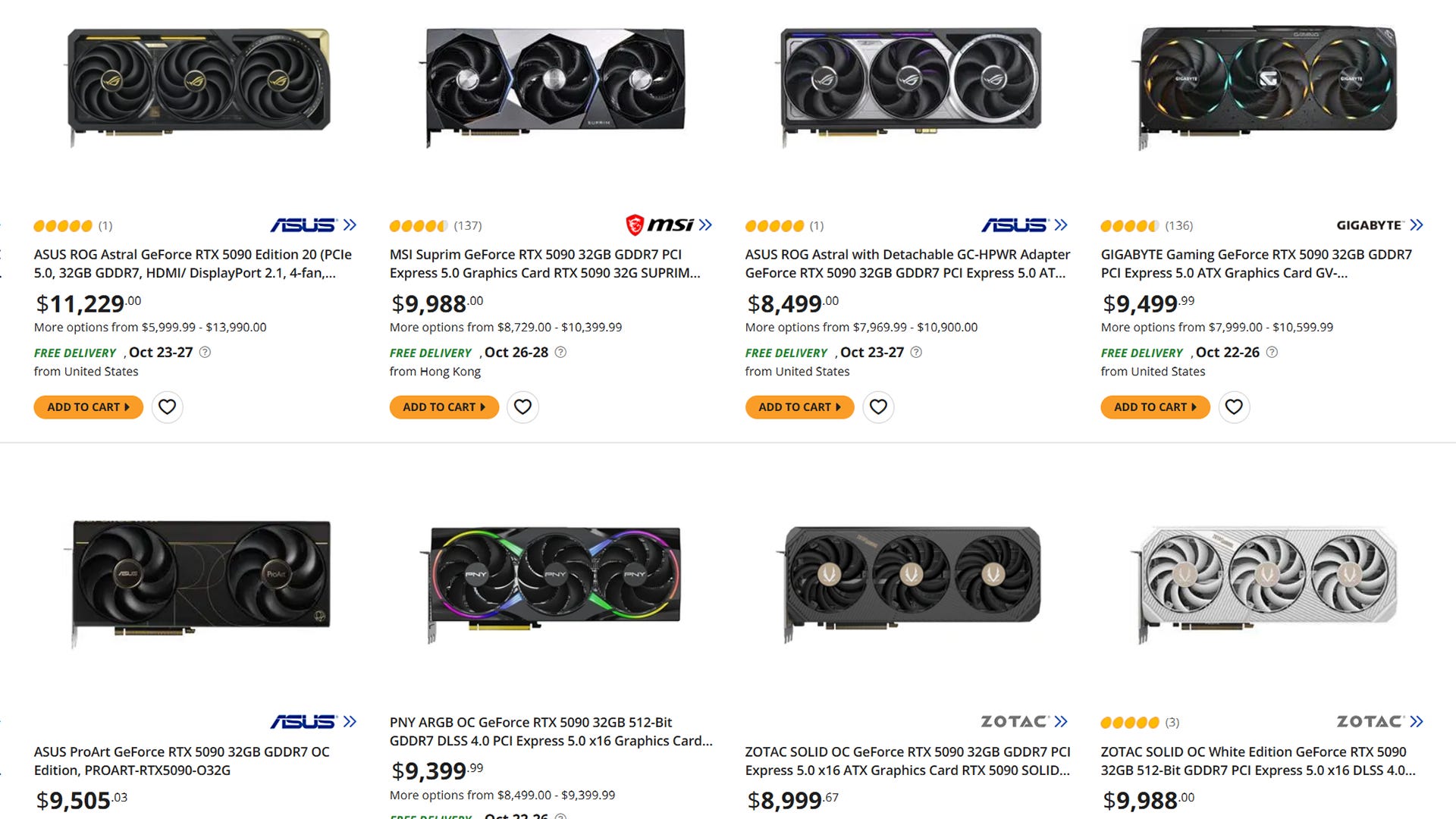
For those who don’t know, Nvidia uses the same underlying GB202 chip in both the RTX 5090 and the RTX PRO 6000 Blackwell workstation GPU. The difference is how much of the chip is enabled, along with the memory configuration and other features. So rather than manufacturing separate chips for every product, Nvidia can choose which GPUs receive the silicon. And given the RTX Pro cards are far more expensive than the 5090, the company’s decision isn’t exactly surprising. Especially because Nvidia still sells their Founders Edition 5090 at MSRP. And the actual kits that AIB partners buy are likely much closer to the original MSRP. So most of that profit isn’t going to Nvidia.
Now, Nvidia hasn’t officially confirmed the 5090’s discontinuation. Benchlife’s reporting specifically points to an end in chip allocations rather than a formal end-of-life announcement. However, Micro Center has now started listing multiple RTX 5090 models as “Not Carried”, rather than simply out of stock. That’s not definitive proof that production has ended, but it certainly makes these reports far more believable.
Oh, and that’s not all. According to Benchlife and one leaker, Nvidia’s replacing the 5090 with a 24GB 5080. And they’re apparently getting rid of the 16GB 5080.
Ultimately, if you thought the 5090 was expensive now, just wait until no one makes them anymore.
The Reason Nvidia’s 5090 Is So Expensive
The timing of these reports on the 5090’s demise couldn’t be crazier. Because a new Financial Times report, later shared by Tom’s Hardware, may have just revealed the biggest reason why. And it’s not as simple as: AI. Okay, that’s a big component, but it’s specifically Chinese AI. According to the report, Chinese AI companies have purchased over ONE MILLION Nvidia gaming and workstation GPUs in a single year. And as you would expect, they aren’t buying them to play the latest Call Of Duty. They’re repurposing these cards for artificial intelligence workloads. I actually covered a story last month about images showing pallets of gaming GPUs being re-purposed into AI workstations and servers.
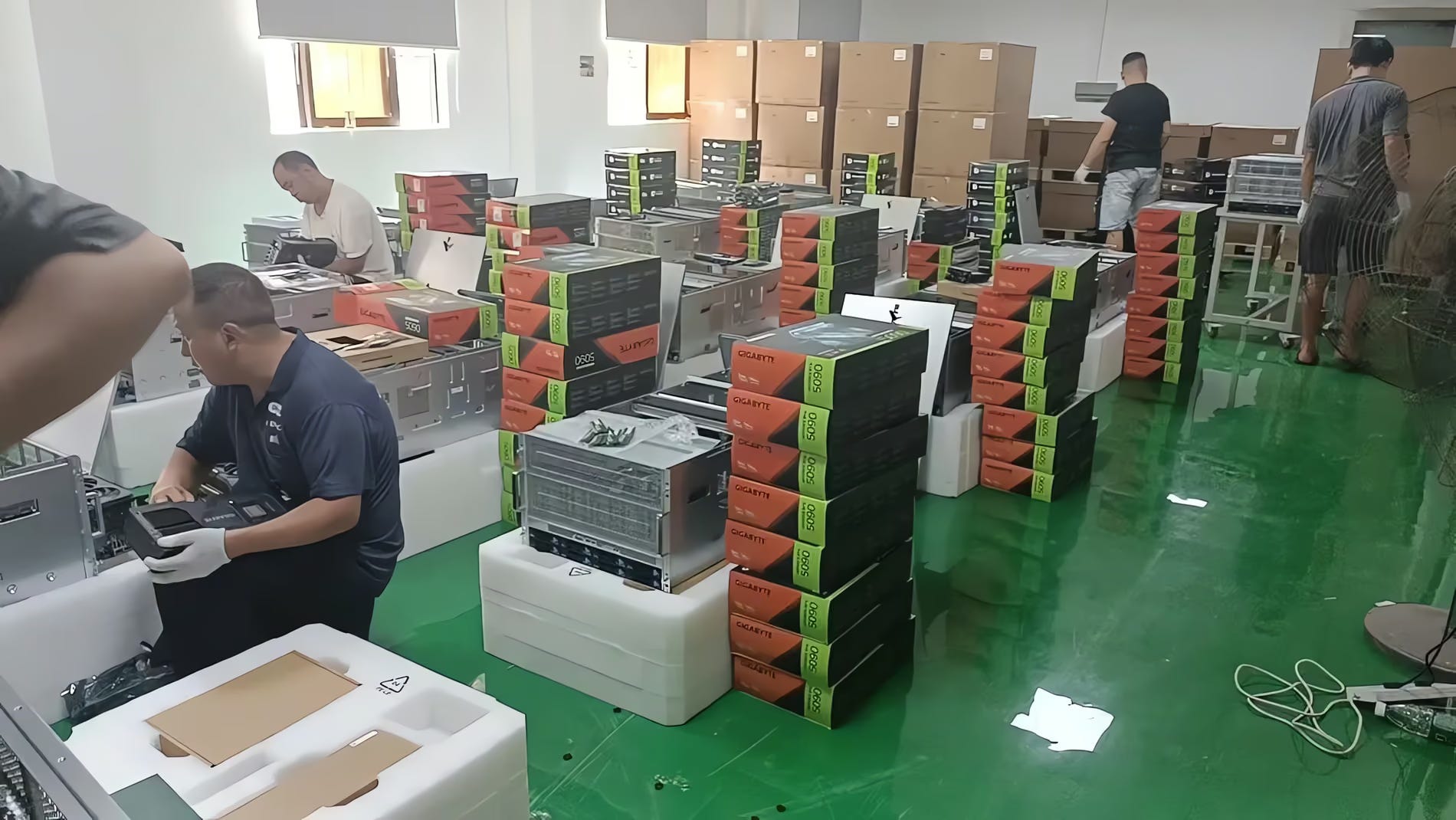
According to the report, China expects to manufacture approximately 3.5 million domestic AI chips this year. That obviously sounds like an incredible number, until you realize demand is expected to exceed 5 million. So Chinese companies have been filling the gap with products they can still obtain, including Nvidia’s RTX PRO 6000D, RTX PRO 5000, and RTX 5090s.
And this actually explains two things. First, it perfectly illustrates one of the biggest reasons Nvidia’s RTX 5090 has been exponentially growing in price. AI companies have the funding to pay $7,000+ per GPU. As you might have also noticed in the image above, those aren’t the Chinese specific 5090 D or 5090 D V2. Those are regular 5090s. Now I will say that there was some suspicion about one of the images being made or altered by AI, but the main image above seems to be authentic. Either way, based on this new report, it seems clear that Chinese companies are bypassing the export restrictions placed on them by the US. So it’s clear that this is likely a big explanation for these prices.
The second thing this answers is why Nvidia would risk cancelling their 5090. Basically, they know that the demand is there to eat up all of those chips and then some.
What’s even more frustrating is that even if these companies had access to the best AI accelerators, the situation wouldn’t really improve much. Nvidia could simply dedicate more of its limited manufacturing capacity to those products instead, potentially leaving gaming GPUs with an even smaller share. And we’d likely see even higher memory prices than we do now.
AMD’s RX 9070 XT Just BEAT The RTX 5090
What if I told you that AMD’s RX 9070 XT can actually outperform Nvidia’s RTX 5090? And I’m not talking about some obscure game that heavily favors AMD or anything. We’re talking about situations in several popular games, even when using one of the fastest gaming CPUs out there.
But how is this even possible? Well, a big part of the problem comes down to driver overhead. Before your GPU can render a frame, the CPU has to prepare the instructions and drawing commands that tell it what to do. And depending on the graphics driver, that process can require substantially more CPU resources. Nvidia’s drivers have historically used more CPU time in certain scenarios, which can leave less processing power available for everything else a game needs to do.
You would think that this problem only shows up when you’re using a really old CPU at insanely high framerates. But as you’ll see in a minute, that simply isn’t the case.
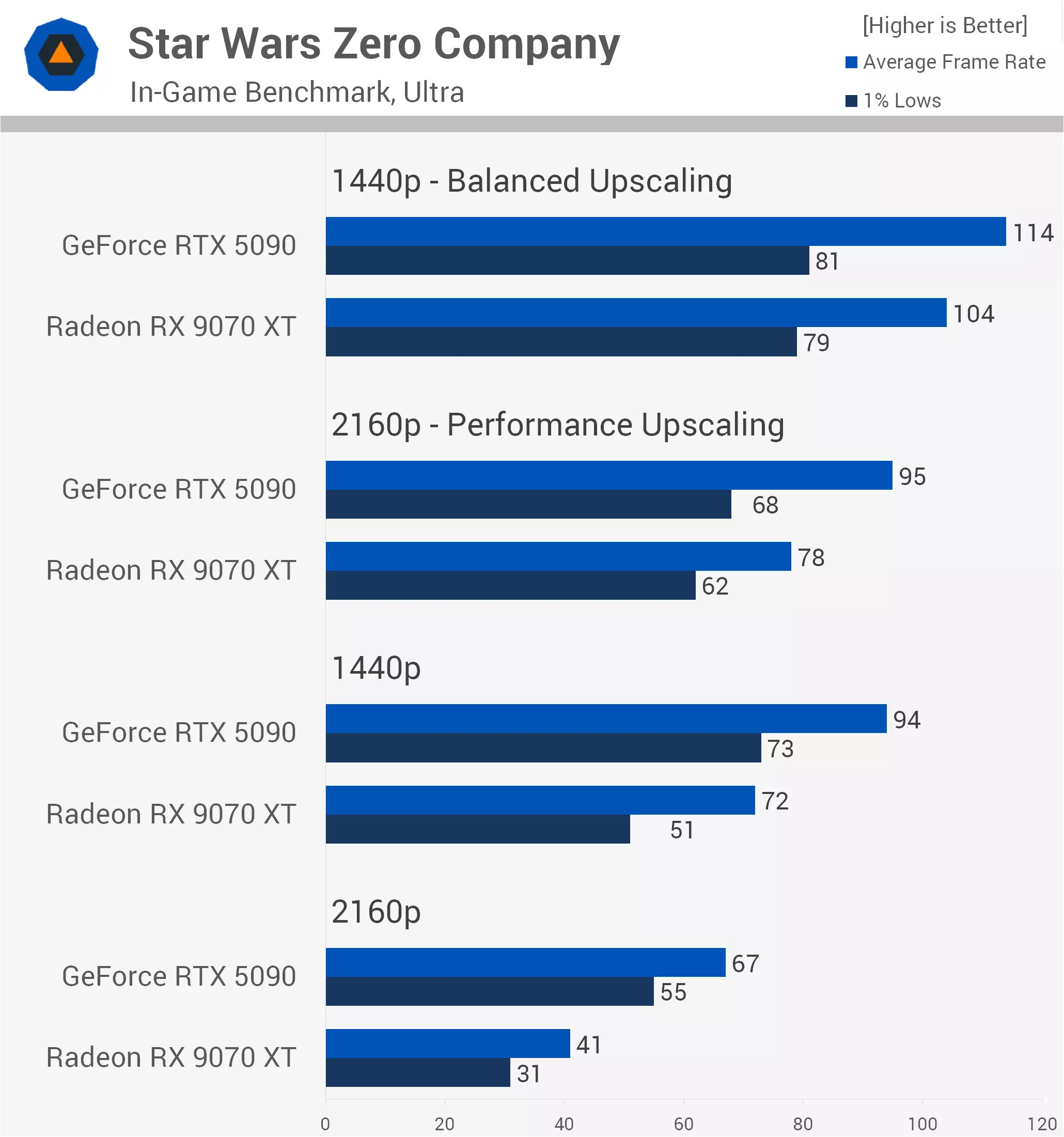
So starting things off, TechSpot recently tested the RX 9070 XT against the RTX 5090 across 11 games using AMD’s Ryzen 7 9800X3D. Now, when both GPUs are pushed to their limits at native 4K with high graphics settings, Nvidia absolutely dominates. For example, in Star Wars Zero Company, at 4k ultra settings, the 5090 completely destroys the 9070 XT. But there’s a problem. The 5090 only gets an average of 67 FPS, with 1% lows below 60 FPS. So most gamers won’t exactly be happy about that. But as we move down in resolution, you’ll quickly notice that the 9070 XT starts getting a lot closer. While the 5090 clearly hits a wall at 1440p.
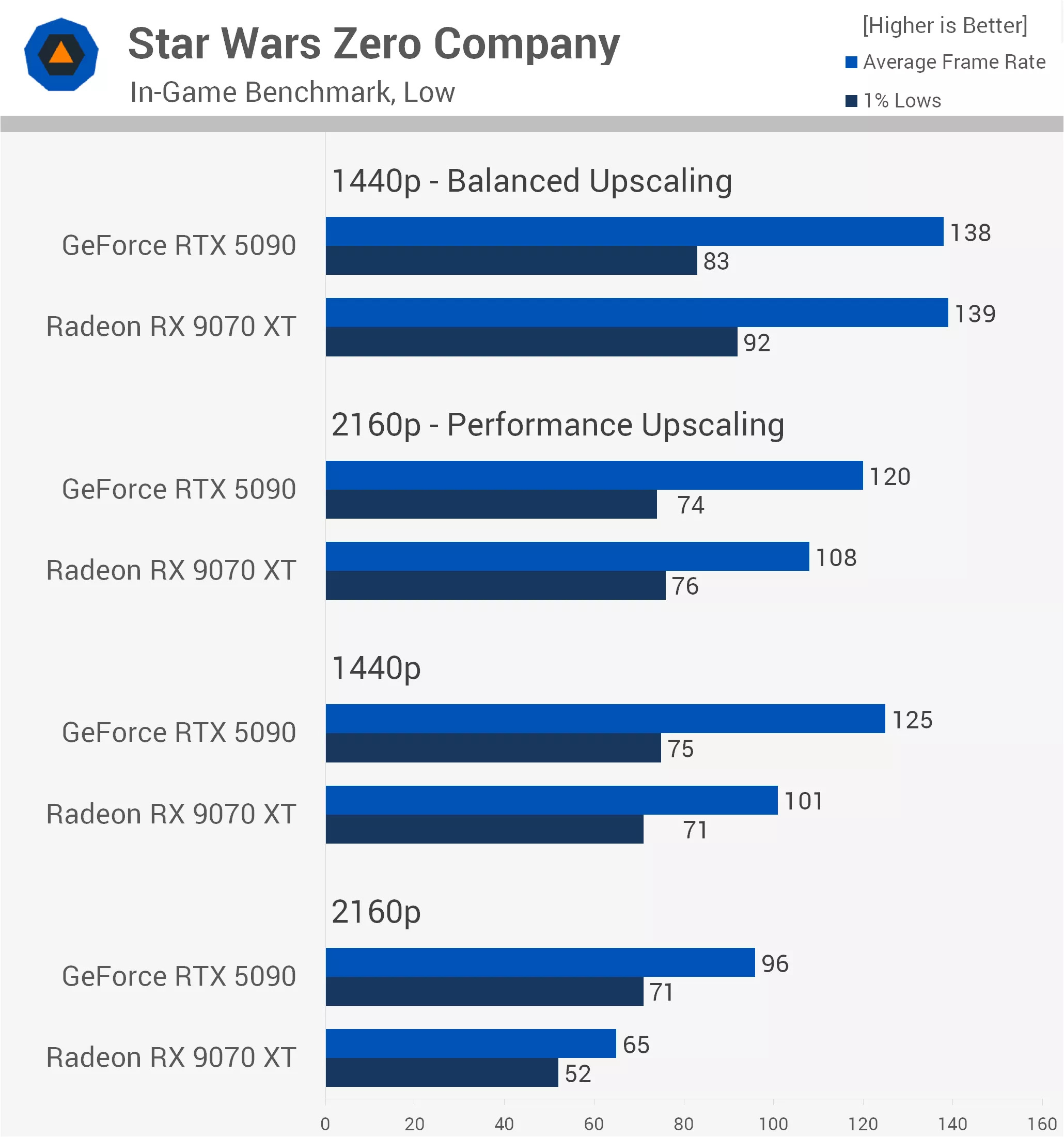
At 1440p with balanced upscaling, the 9070 XT starts getting extremely close to the 5090. With 1% lows being just 2 FPS away. But you’re still not getting great FPS. Yet you spent all of this money on a high FPS monitor. So if we decided to lower the graphics settings down to low, we get a meaningful jump in performance. But here, at 1440p balanced upscaling, you’ll likely notice that AMD’s 9070 XT actually catches up and BEATS Nvidia’s 5090. At both average FPS and 1% lows. Meaning if you want to play this game at high FPS, the best card to get would actually be the 9070 xt. Even if they were the same price.
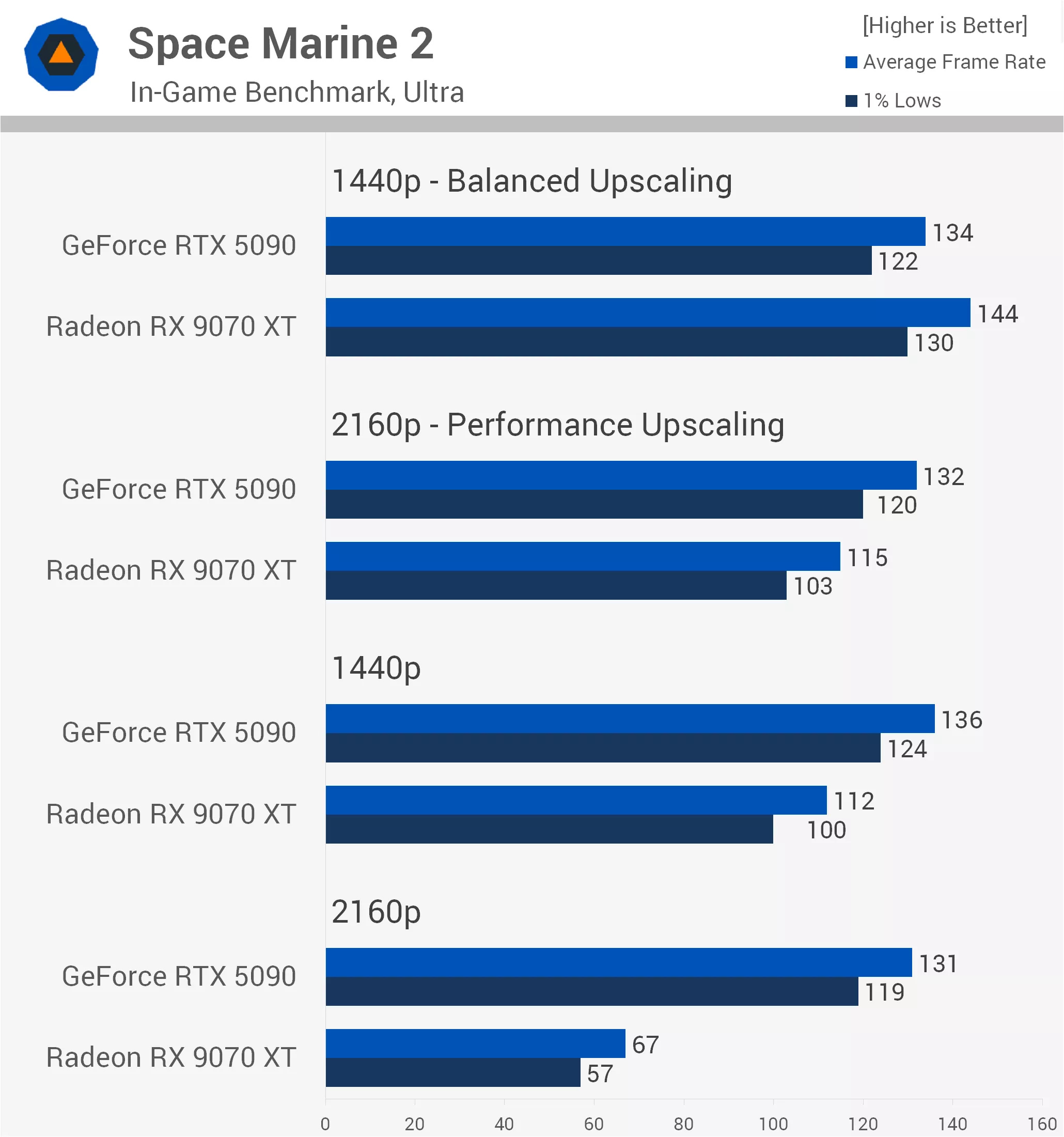
For another example, we can look at Space Marine 2 on Ultra settings. Here, the 5090 hits a wall at even 4k. And while it still crushes AMD, the 9070 XT ends up beating out the 5090 in both average FPS and 1% lows when we get to 1440p balanced upscaling. And that’s still at Ultra settings. Though you can get nearly that FPS at 4k with the 5090, so in practical terms, it isn’t all that worth it.
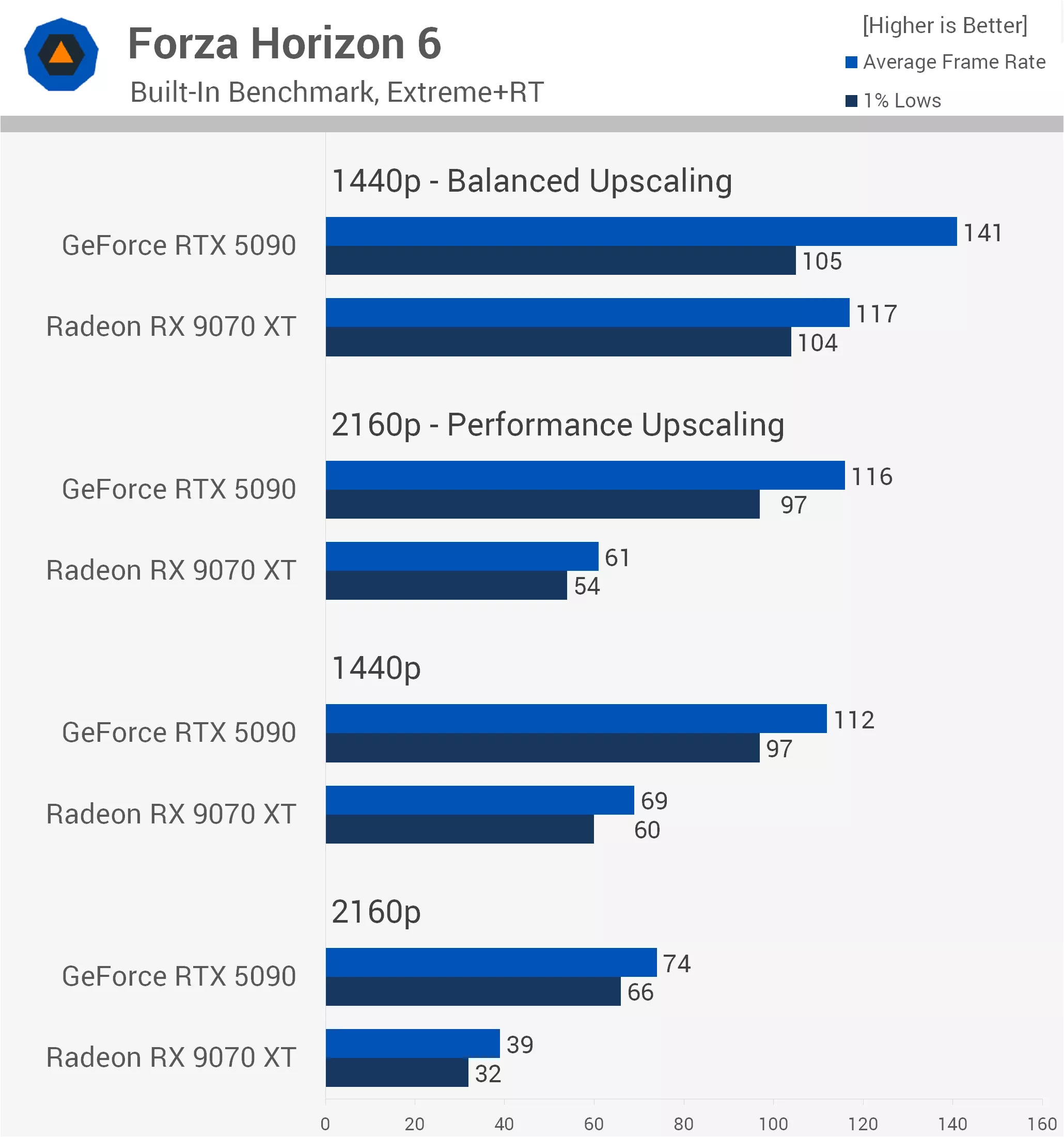
BUT when we look at Forza Horizon 6, things start to change a bit. Even with extreme Ray Tracing, we can see that the 5090 does end up gaining a good bit of performance at 1440p balanced upscaling, but the 9070 XT starts getting close in average FPS, but it’s 1% lows are actually just 1FPS behind the 5090. Don’t forget this is a card that’s nearly 10X cheaper than Nvidia’s 5090. We can see something similar playing out in Spider-Man 2, Fortnite and multiple other games.
With that said, there are definitely titles where this isn’t the case. Like in Doom the Dark Ages or Battlefield 6. Basically, if you care way more about high refresh rates than higher resolutions, even if you have a great CPU, the 5090 isn’t nearly as good as you may have thought. And that’s even if it was still selling for MSRP. Speaking of, was it ever really at MSRP? $1,999 is starting to seem more like a fever dream. Not that it was a great deal at that price either.
A RAM Breakthrough Could Change Everything!
Finally, we have some good news when it comes to memory production. And it’s all thanks to a new breakthrough that could actually release before the end of this year.
According to a new report from TrendForce, the Chinese memory manufacturer CXMT has unveiled a new DRAM architecture known as 4F², which could increase memory density by approximately 30–50%. Now, that probably doesn’t mean much to most people, but the implications could be huge. Because rather than simply relying on smaller manufacturing processes, CXMT is changing the actual structure of the memory cell.
See, most modern DRAM uses what’s called a 6F² design. Essentially, each memory cell occupies an area equivalent to six times the square of a minimum manufacturing feature size. And as manufacturers have continued shrinking these cells, they’ve run into increasingly difficult problems with things like electrical leakage and transistor reliability.
CXMT’s new approach uses something called a Vertical Surrounded Gate transistor. Instead of laying out the transistor and all of its connections using the same conventional structure, parts of the design are arranged vertically. Think of it like building a multi-story house instead of spreading everything out across a massive property. You’re fitting the same essential functionality into a smaller footprint without necessarily having to shrink every individual component.
And that’s where the potential 50% improvement comes from. Moving from 6F² to 4F² theoretically reduces a memory cell’s footprint by one-third. So in an ideal scenario, manufacturers could fit 50% more cells into the same area. In practice, complete DRAM chips contain plenty of additional circuitry, so the actual improvement will depend on how successfully the technology can be manufactured and integrated.
Now, CXMT isn’t the only company developing this technology. Samsung has already demonstrated a 4F² DRAM prototype using advanced hybrid bonding, while SK hynix is working on vertical-gate memory designs as well. The difference is that according to reports, Samsung isn’t expecting its next-generation approach to reach the market before 2028. Meanwhile, CXMT claims that it’s preparing to introduce a server DDR5 RDIMM using 4F² technology before the end of 2026.
That’s an aggressive target to say the least, but there are some major caveats. For one, launching a product isn’t the same as achieving high-volume production. And according to a new report from South Korea’s Seoul Economic Daily, the supposed 50% density advantage might not be nearly as impressive as it sounds. That’s because CXMT is reportedly using a larger 15nm manufacturing process, compared to around 12.2nm for competing Korean memory. So despite the more compact cell design, the actual density could end up being almost identical. And then there’s the issue of manufacturing yields, which remain unknown, with some experts suggesting meaningful mass production might not arrive until late 2027 or even 2028. So while this is definitely promising technology, it’s not necessarily going to solve our RAM shortage tomorrow. Still, it’s great to see companies further push technology forward to finally solve this RAM crisis!
Quick Bytes
Nvidia Just Made DLSS 5 Twice As Fast!
Nvidia announced a new DLSS 5 model that’s twice as fast, uses 20% less VRAM at 4K, and can boost frame rates by up to 40% compared to its previous version. That’s an incredible 10X improvement in model performance since it was first announced in March!
Nvidia’s Frame Generation Just Got 35% Faster!
Nvidia released a new Performance Mode for DLSS Frame Generation that reduces processing overhead by up to 35% on the RTX 5060. Best of all, it works on both RTX 40 and 50 series GPUs and is already available through the Nvidia app beta!
Nvidia Could Be Teaming Up With Intel
A new analyst report claims Nvidia could begin using Intel’s Foveros advanced chip-packaging technology in 2028. The current report focuses on AI hardware, but it raises interesting possibilities for the companies’ future GPU partnership.
Intel Isn’t Giving Up On Older Motherboards
Gigabyte has confirmed that new Intel LGA1700 processors are coming in early 2027, complete with support for existing DDR4 motherboards. The company has already released BIOS updates for compatible boards, giving owners another upgrade path.
That’s all the bytes for this week.
Until next time, may your GPU survive the AI takeover, RAM prices finally come down, and your RTX 5090 not mysteriously become a workstation overnight.