


AMD’s next generation Ryzen processors are starting to look absolutely insane! And I’m not just talking about the massive increase in core count that we’ve more or less known about for a while. Instead, we just got our first performance leak from someone who would definitely know, as well as our first real Zen 6 benchmark.
And that’s just the beginning when it comes to this week’s Meld Bytes. Elsewhere in the PC industry, developers have found a way to unlock huge performance for Nvidia, Intel’s Nova Lake benchmarks are finally here and more!
So let’s get right to it!
Ryzen 10,000 Could Mean Double
Ryzen 10,000 CPUs, or whatever AMD decides to call them, are really shaping up to be one of the biggest upgrades in YEARS. And the latest information suggests that things might be even better than the early leaks originally claimed.
Specifically, we just got our first performance look from someone who goes beyond your average leaker. In fact, he’s a developer that we know has worked closely with AMD in the past. Because he’s the creator behind the DRAM Calculator For Ryzen and the Hydra Software: 1usmus. Basically, someone who’s been deeply involved in Ryzen overclocking and optimization for years, and who has previously worked with AMD hardware before its public release.
Well, he recently made a pretty incredible statement about the performance of AMD’s next generation Ryzen CPUs.
It all started when 1usmus responded to a Cinebench benchmark showing several processors that were crossed out. He initially suggested that one of the results might be from a 12 core Zen 6 chip. Which was pretty wild, because the scores were right up there with AMD’s current 16 core Ryzen 9 9950X3D2.

But someone quickly pointed out that the redacted processors were also 9950X3D2s, based on the color used in the benchmark chart. And 1usmus admitted that he was wrong.
But here’s where things get REALLY interesting.
Because he followed that up by explaining why he made the mistake in the first place. As you can see in the image below, he flat says that a “12-core Zen 6 gets surprisingly close to those scores. You won’t have to wait much longer for the leaks.”

Let that sink in for a second.
According to 1usmus, AMD’s upcoming 12 core Zen 6 processors can apparently get close to the multithreaded performance of a current-generation 16 core Ryzen 9 9950X3D2!
Now, assuming we’re comparing similar workloads and performance levels, that’s a massive improvement. For a 12 core processor to match a 16 core chip, each core would effectively need to deliver roughly 33% more performance on average.
And here’s where things get even crazier.
We’ve been hearing for a while now that Zen 6 would be increasing the number of cores per compute chiplet from 8 to 12. And 1usmus specifically referenced a 12 core Zen 6 processor with a single CCD. Which is another indication that AMD really is preparing to increase its core counts next generation.
And obviously, if that’s accurate, a desktop Ryzen processor with two compute chiplets would feature a total of 24 cores and 48 threads. That’s a 50% increase over the 16 cores found inside today’s Ryzen 9 9950X3D.
Now if we combine that with the potential increase in performance per core. Remember, you don’t simply add these performance improvements together. If you have 50% more cores, and each of those cores can deliver 33% more performance, the theoretical improvement multiplies.
And if this is accurate, when we do the math, we’re looking at very nearly DOUBLE the multithreaded performance over Zen 5!
But that’s still not all. Because we aren’t just hearing about higher performance from more cores or higher frequencies anymore. We’re finally starting to see actual benchmarks suggesting that AMD has made some substantial improvements to the architecture itself.
Which brings us to our next story.
First Zen 6 Benchmarks Mean Huge IPC
We finally have our first real benchmark of AMD’s Zen 6. And if these results are right, AMD’s next generation CPUs could deliver a huge improvement in IPC.
For those who don’t know, IPC stands for instructions per clock. Basically, how much work a processor can perform during each clock cycle. And it’s one of the most important ways to measure improvements between CPU architectures, because it helps separate architectural performance from simply increasing clock speed. Though obviously, clock speed improvements can come from the architecture as well.
Either way, this story originally comes from a new Geekbench 7 benchmark that was found and shared by HXL on X. And as you can see in the screenshot below, it’s testing an AMD EPYC 9996 CPU.
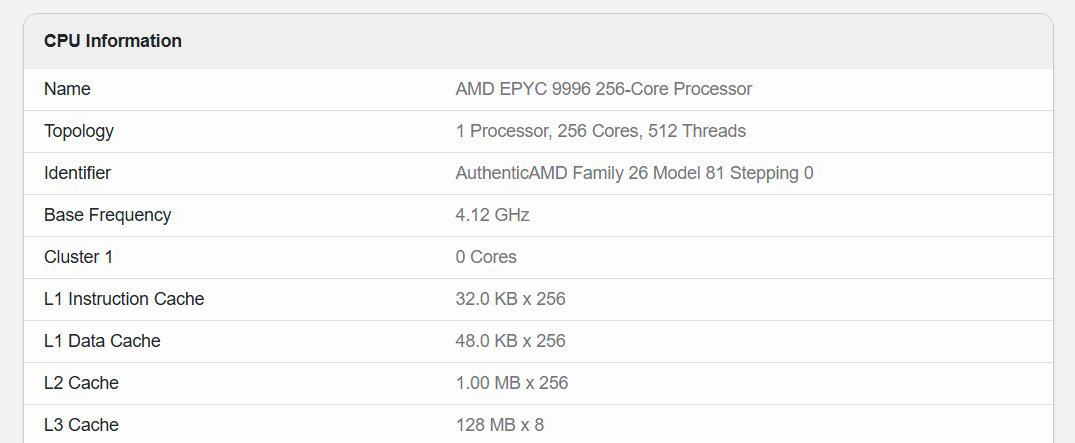
Now, you might be wondering why I even care about a server grade CPU. Especially one with an unreal 256 cores and 512 threads! I mean a CPU like this would never make it to the consumer side.
Well, don’t forget that AMD uses a very similar architecture across their entire CPU lineup. Whether that’s consumer Ryzen, workstation Threadripper, or server EPYC chips. Even in this case, where the EPYC 9996 uses the Zen 6c architecture. Because unlike Intel’s traditional efficiency cores, Zen 6c is essentially just a more compact version of Zen 6. It maintains the same instruction set and generally delivers comparable instructions-per-clock performance, although clock speeds and cache configurations can differ.
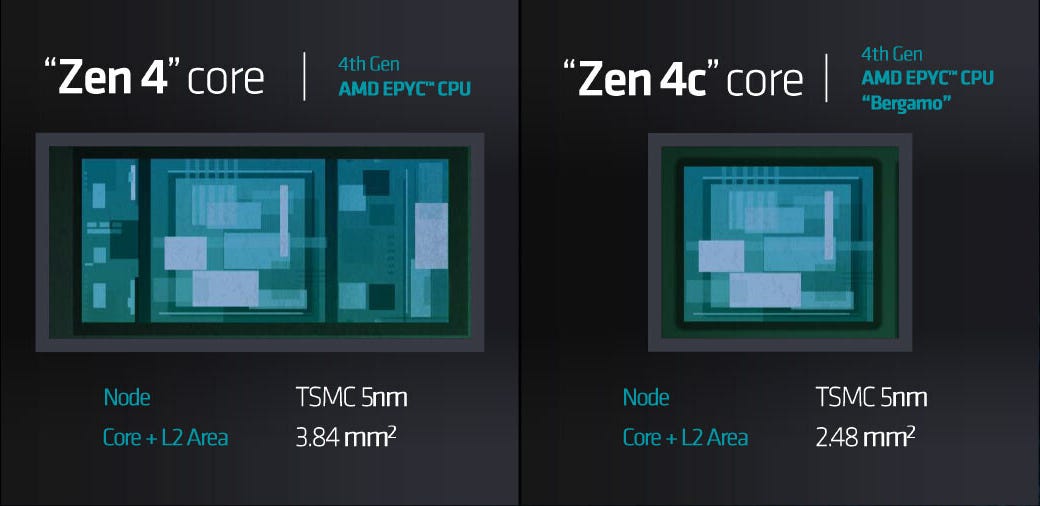
So by looking at the single core performance, we can get a pretty good idea of the architectural improvements that are coming to next generation Ryzen processors.
And that’s exactly why one enthusiast decided to test it.
The X account three twenty six took a Ryzen 7 9700X, which of course uses AMD’s current Zen 5 architecture, and locked its frequency to 4.1GHz. Essentially the same frequency the EPYC processor was running at during its Geekbench 7 test.
And the results are really interesting. For one, the new Zen 6c CPU managed to score roughly 16.5% higher in overall single threaded performance! That’s impressive in itself, but when we look at some of the individual benchmarks, the improvements can get a lot bigger.
Multiple tests, like video encoding and photo editing showed gains over 20%. Other workloads also posted substantial improvements, though some tests like the HTML5 Browser test, can be heavily affected by memory latency. So the huge amount of L3 cache on the EPYC chip could have helped in those. But there are definitely tests that the cache wouldn’t affect, meaning AMD has made some meaningful changes to the underlying architecture.
Plus, don’t forget that IPC performance doesn’t include any kind of clock or core count increases. And while we already talked about the leaks claiming a 50% increase in the number of cores for next Gen, we’ve also seen leaks claiming a massive clock speed increase.
Basically, the performance we heard from 1usmus is looking more and more plausible. In fact, it could be UNDERSELLING next gen Ryzen.
Nvidia GPUs Just Got 2X The Performance?!
Imagine buying a graphics card, using it for years, and then discovering that it was capable of substantially more performance this entire time. Not because someone optimized a game or because Nvidia released a better driver. But because the company was artificially restricting what the hardware could actually do.
Well, that’s essentially what a group of developers just discovered and unlocked.
According to VideoCardz, modders have found a way to remove certain Tensor Core performance restrictions on Nvidia’s RTX 20, 30, and 40 series GPUs. And the results are pretty incredible, with some AI calculations nearly DOUBLING in throughput!
For example, an RTX 4090 reportedly went from 165.6 TFLOPS to a whopping 331.6 TFLOPS in an FP16 Tensor Core throughput test. Meanwhile, an RTX 2080 Ti jumped from 59.9 to 111 TFLOPS. And an RTX 3090 Ti increased from 87.5 to 157.4 TFLOPS in a BF16 test.
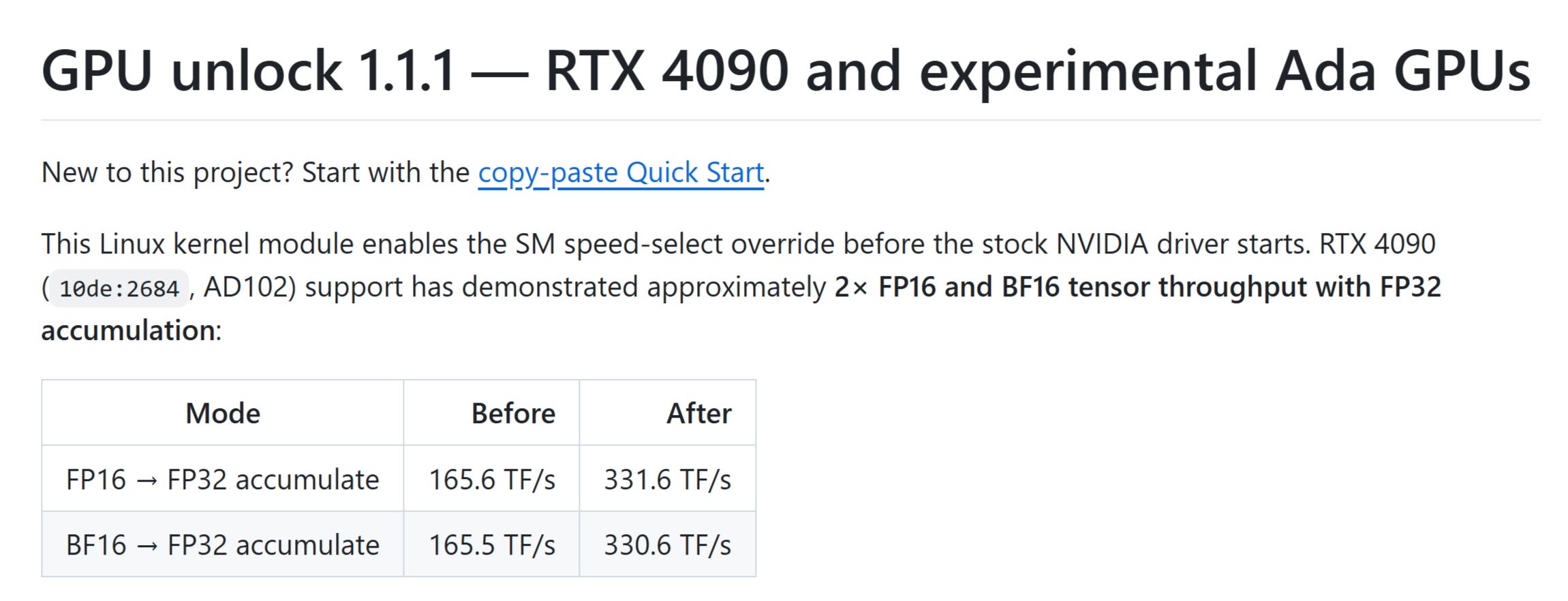
That’s obviously an enormous amount of previously restricted compute capability!
Now, before you get too excited, there is an important distinction here. We’re talking about specific AI compute workloads, not traditional gaming performance. And there also isn’t evidence that gaming technologies like DLSS will suddenly gain this kind of performance either. Still, it’s really interesting to see modders give us back free performance.
The projects, including GPU-Unlock and GPU-Unlock-Ada, work by modifying low-level GPU configuration settings before Nvidia’s graphics driver loads. Rather than physically changing the chip or flashing a modified BIOS, they bypass restrictions that limit how quickly certain Tensor Core operations can be issued.
And because the modifications are temporary, they disappear when the GPU loses power. The projects are still experimental, however, and support varies between cards and operating systems.
So the question you might be asking is: why would Nvidia restrict this performance in the first place?
Well, product segmentation is almost certainly a major reason. Nvidia doesn’t just sell gaming GPUs. It also sells incredibly expensive workstation and data-center graphics cards designed for professional computing and AI workloads. And if a comparatively inexpensive GeForce card could do the same work just as quickly, there would be less reason to purchase those professional GPUs.
Now, manufacturers have been doing similar things for decades. It’s why some lower-tier graphics cards have perfectly functional cores disabled to create different products. But this situation is a little different because it appears that some of these restrictions can be removed entirely through software. Still, this may have ultimately been a good thing for Nvidia to do. I mean, could you imagine how expensive these GPUs would be if AI companies got double the performance out of them?
With that said, while the theoretical throughput gains are massive, actual performance improvements depend heavily on the workload. Tests involving large language models have shown much smaller real world gains in some cases, especially when memory bandwidth becomes the limiting factor. Still, this is a pretty impressive achievement.
Quick Bytes
Intel’s Nova Lake Benchmarks Are HERE!
Our first alleged Intel Nova Lake desktop benchmarks have appeared in PassMark! A 28-core sample scored 5,210 points in single-threaded performance, roughly 3% ahead of the current Core Ultra 9 285K. Unfortunately, its multithreaded score was actually lower. But there’s a catch: the chip was reportedly running at just 4.8GHz, suggesting there’s still plenty of performance left to unlock.
Dell Just LOCKED Down A Ryzen CPU?!
An Alienware Area-51 owner reportedly discovered that his Ryzen 9 9950X3D wouldn’t work in another motherboard! According to Wccftech, the suspected culprit is AMD Platform Secure Boot, which can permanently tie a CPU to a manufacturer’s firmware. It’s happened with Dell and Lenovo systems before, but this needs to be called out.
Nvidia STILL Isn’t Taking RTX 5090 Orders!
Follow-up: Nvidia insists the RTX 5090 hasn’t been discontinued, but der8auer’s investigation found a board partner claiming it can’t order GB202 GPUs with 32GB of GDDR7 memory. Apparently, Nvidia isn’t even accepting backorders! A cooler manufacturer also reportedly has no RTX 5090 heatsink orders for Q2 2027. Not exactly encouraging.
DLSS 5 Performance Jumps OVER 60%!
Modders have managed to boost DLSS 5 performance by more than 60% using foveated rendering! By reducing AI processing resolution toward the edges of the screen, an RTX 4090 reportedly jumped from 49 to over 80 FPS in The Witcher 3 at 7680 × 2160. Another experimental mod even supports eye tracking. The results are promising, although testing remains limited.
That’s all the bytes for this week.
Until next time, may your IPC keep climbing, your Ryzen cores keep multiplying, and your motherboard actually let you use the CPU you paid for.