


The day has finally come... I have GOOD News! In a world where it feels like every week brings another price hike or supply shortage, we're finally starting to see some light at the end of the tunnel. Plus, we've got some exciting developments surrounding AMD's next-generation CPUs, an absolutely insane turn of events at Nvidia, and plenty more.
So let’s get right to it!
Price Crash Here We Come
After months of seemingly endless price hikes, I finally have some fantastic news for SSDs. I wish I had something good to say about RAM prices, but that’ll have to wait. Because according to a new report from the market research firm, TrendForce, the NAND market is heading toward an oversupply much faster than they originally expected. In fact, it’s much, much faster.
For those who may not know, NAND flash is the memory used in SSDs, and just like RAM, NAND prices have been skyrocketing for most of the year. But specifically thanks to GPU shortages, high inventory and weak AI monetization, Chinese cloud service providers recently cut their 2027 enterprise SSD orders. At first, TrendForce claimed that these cuts offset increased demand from North American cloud service providers, with contract prices set to fall a quarter earlier than they said before. Specifically, Q2 of 2027. But now, things are happening even faster!
Because just two days later, TrendForce updated their forecast to Q1 of 2027. Part of that is still thanks to a loss in demand from China, but they also claim that supply keeps growing. Specifically, while YMTC has slightly lowered their expansion, other suppliers continue moving to newer process nodes, as well as using QLC. Basically, output is growing faster than demand, which as always, means lower prices.
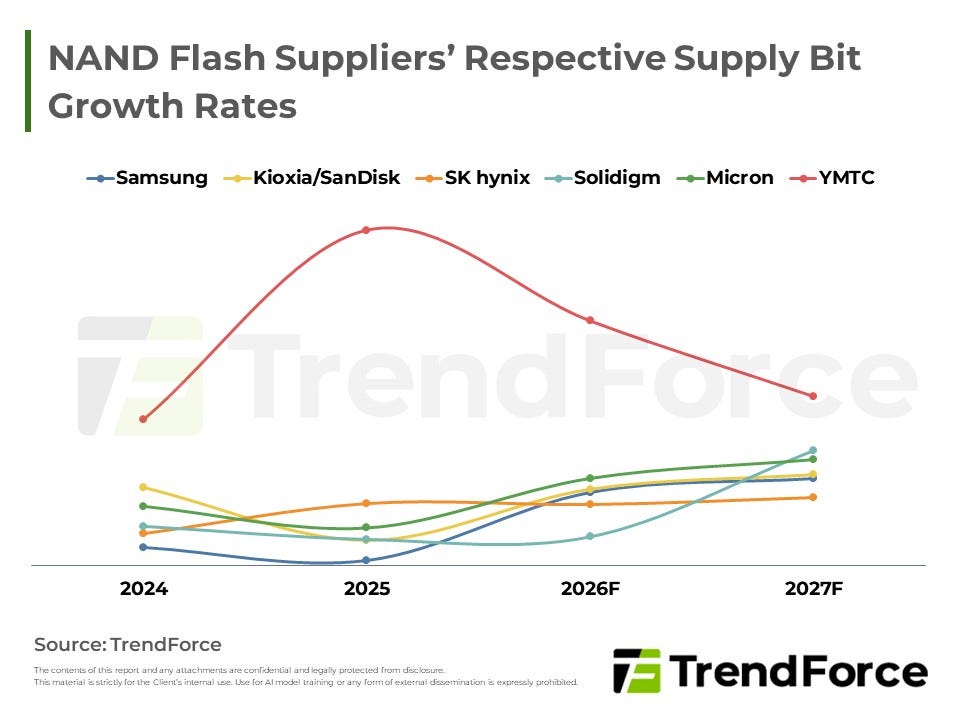
Right now, they’re forecasting just 0-5% decline in the overall market in Q1 with every single product category to drop starting Q2. Currently, they still predict a price increase for q4 of this year, but they’ve lowered it to an 8 to 13% increase, but the fact that they’re moving the timeline so quickly, tells me that this could move a lot faster than they think.
Now, if you follow my YouTube channel, you may have seen me talk about NAND spot prices dropping in the past. And while that’s a very important indication of the day to day market, most of the largest manufacturers buy NAND using contracts. And those contracts are agreements that only change at renewal. That’s why we haven’t seen much of a decrease in actual retail SSD prices. BUT TrendForce is now talking about actual contract prices decreasing. So this is a really big deal that should have a serious effect on SSD prices in stores. Time will tell just how fast things begin to drop, but every indication is pointing to good things. At least, so far.
The Story Of One Nvidia CEO
For anyone who hasn’t been following the absolute insanity surrounding Nvidia over the last couple of weeks, the CEO and co-found of the company, Jensen Huang, was caught having extramarital affairs, including one involving an executive at a major Nvidia customer who was reportedly suspected by US officials of having ties to Chines intelligence.
Now, whether she was actually a spy or not is still up in the air. But Alice Huang is a Chinese national. And it’s also fairly known that Chinese organizations and citizens are required to “support, assist, and cooperate with national intelligence efforts in accordance with law.” Basically, the Chinese government can legally compel its citizens to assist with intelligence operations.

Whether she was a spy or not, US intelligence and media investigations allege that Alice Huang, along with the company she worked for, Megaspeed, did play a central role in a network to funnel restricted Nvidia GPUs into China. These smuggled chips reportedly supplied Chinese tech companies like Tencent and Huawei, so it’s a pretty big problem for Nvidia.
Megaspeed has denied any wrongdoing and claims that Alice Huang left the company in August of 2025.
All of this led Nvidia’s board of directors to launch an independent investigation, and on November 12, the company officially announced that Jensen Huang had resigned as CEO, president and even as a member of Nvidia’s board of directors. Nvidia’s CFO, Colette Kress, took over as interim CEO while the company began searching for a permanent replacement.
This, I have to admit, completely shocked me. For those who don’t know, Jensen Huang isn’t just a founding member of Nvidia. He’s a central figure leading the entire AI boom. So when he announced that he was stepping down, I honestly couldn’t believe it.
But this is where things get really interesting. Because a campaign called Stand With Jensen started gaining widespread support from investors, Nvidia employees and some of the biggest names in tech, including Elon Musk, Epic Games CEO Tim Sweeney and Replit CEO Amjad Masad. Jensen himself eventually released a statement saying that he’d be willing to return if the board believed it was in the best interests of the company.
Unfortunately for him, Nvidia’s chairman made it abundantly clear during the company’s earnings call that the board had no intention of reinstating him.
Meanwhile, the AI market was getting absolutely decimated. Nvidia’s stock fell a staggering 23% in one week alone, and countless other AI companies saw massive losses. Obviously, there were other factors at play, but Jensen’s departure certainly didn’t help.
Well, less than a week after saying they had no intention of bringing him back, Nvidia’s board of directors UNANIMOUSLY voted to reinstate Jensen Huang as CEO, president AND a member of the board. Apparently, the board even received input from senior members of the US government, including President Trump, which gave them confidence that his reinstatement posed no national security risk.
And almost immediately, the AI market came roaring back, with Nvidia’s stock rising over 30% in a single day!
Now, it’s worth mentioning that the independent investigation is still ongoing, and Nvidia has even formed a new National Security and Export Control Committee. So this story isn’t necessarily over.
But regardless of what you think of Jensen Huang, it’s absolutely wild to see just how much influence one person has over an entire multi-trillion-dollar industry.
Ryzen 10,000 Could Be HUGE!
AMD’s Zen 6 architecture is shaping up to be the company’s most insane architectural upgrade since first Gen Ryzen.
AMD’s upcoming server processors feature up to 12 full-sized cores per CPU chiplet, compared to eight with Zen 5. That’s a whopping 50% increase in core count, alongside an increase in L3 cache from 32MB to 48MB per chiplet.
Assuming AMD brings that same configuration to desktop Ryzen, we could potentially see a flagship consumer processor with 24 cores. And that’s before we even get into the rumored IPC improvements and significantly higher clock speeds.
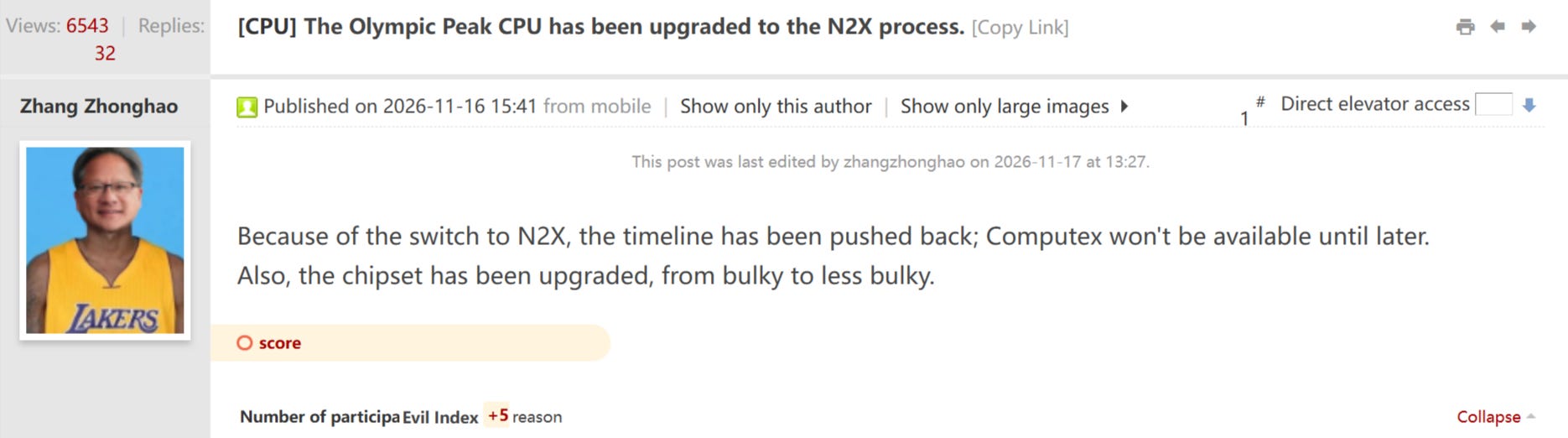
Now, I do have some amazing news, but it comes with somewhat bad news. The bad news is that a recent leak claims that AMD’s next generation desktop processors, codenamed Olympic Ridge, may not arrive until after Computex in June of 2027. But the potential reason behind that wait is really exciting. According to a known leaker on the Chiphell Forums, AMD’s delaying next Gen specifically so they can switch the chips over to TSMC’s N2X node. For those who don’t know, N2X is the highest performance version of their regular N2 process node. According to TSMC, it offers roughly 15% higher performance compared to N2. And it does that through further transistor and design optimizations, as well as support for higher voltages.
Now, another leaker actually claims something a little different. According to him, initial desktop Zen 6 is built on N2P, an enhanced variant of TSMC’s N2, while a refresh based on N2X is planned for Q4.
He also claims that the first variant will feature boost clocks of up to 6-6.2GHz. With the N2X variant potentially approaching 6.8-7GHz!
At the end of the day, between a potential 50% boost in cores, more cache, higher clocks, a better node, AMD’s Zen 6 is truly looking like a champ!
Quick Bytes
AMD Just Broke a GPU World Record!
AMD managed to push its Radeon RX 9060 XT to an absolutely insane 4.837GHz using liquid nitrogen, setting a new GPU frequency world record. We're getting dangerously close to seeing a GPU hit 5GHz!
Nvidia's Hotfix Needed a Hotfix!
Nvidia recently released a driver to fix an issue that was causing its GPUs to constantly write data to users' SSDs. Unfortunately, some users reported that the problem persisted, forcing Nvidia to release yet another fix with driver version 621.40.
A FREE Competitor to DLSS!
A company called Apex Compute is developing an open-source, cross-platform alternative to Nvidia's DLSS called Apex Neural Rendering. Its frame generation technology is already available in beta, and it reportedly took just ONE engineer to develop it!
The RTX 4090 Ti Is Back From the Dead?!
he latest version of AIDA64 has added support for both the unreleased RTX 4090 Ti and TITAN Ada GPUs. Unfortunately, that doesn't necessarily mean Nvidia has any intention of releasing them.
Nvidia Is Cutting GPU Supply AGAIN!
According to a new supply chain report, Nvidia is reducing gaming GPU allocations by another 20–30% between November and January. Because apparently GPUs weren't expensive enough already.
That’s all the bytes for this week!
Until next time, may your SSD prices plummet, your GPU drivers leave your storage alone, and your favorite tech CEO actually stay employed for more than a week!