


There are weeks where PC hardware news feels like nothing but a bunch of unrelated product launches left and right. And, while that can be fun, this is NOT one of those weeks.
Instead, basically every story seems to be yet another sign of just how weird the hardware market has become. Memory prices have gotten so ridiculous that companies are redesigning AI hardware to use less of it. At the same time, Intel is apparently getting back into the memory business. Then a four year old, $80 Ryzen CPU briefly became Amazon’s best-selling CPU, and a ton more.
So yeah. Everything is “normal.”
The RAM Crisis Is Eating Itself
While the memory crisis obviously isn’t over, some of the forces that could eventually mark it’s end are getting much stronger!
For example, TrendForce recently reported that DRAM spot price increases were losing momentum. Mainstream DDR4 spot pricing increased by just 0.17% between July 29 and August 4. Now, I know that’s still an increase, but compared to a whopping 3.27% jump only a couple of weeks earlier, that’s a noticeable slowdown.
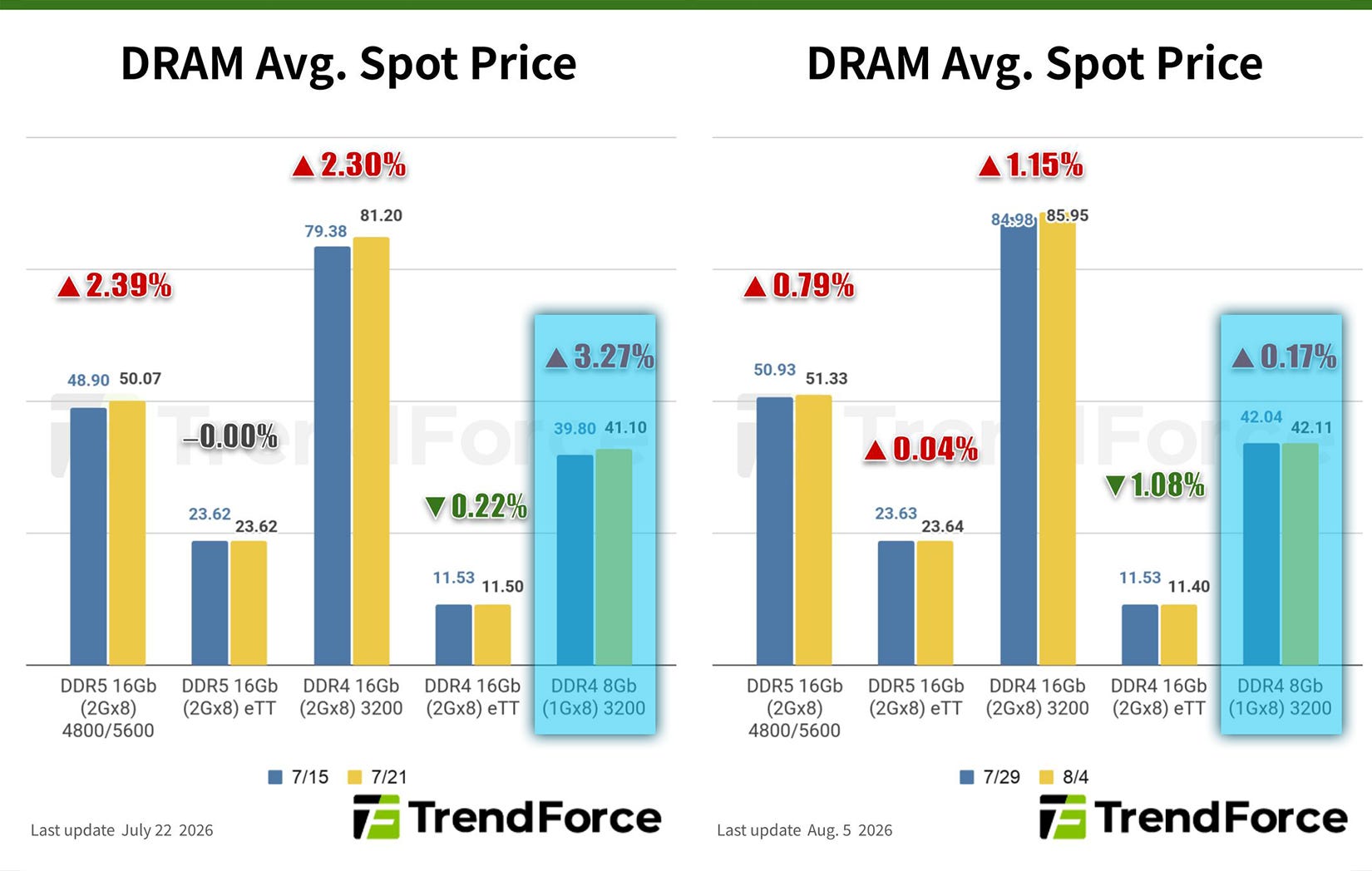
What’s even better, is that buying activity has remained incredibly weak over the days since. For example, on August 6, most inquiries were basically just buyers checking prices. On August 7, DDR5 inquiries weren’t really translating into purchases, and on August 10, inquiries were actually slowing down.
Basically, buyers are starting to reach the point where they simply refuse to keep chasing prices higher.
What’s wild is that even AI companies are feeling this way as well. And this includes NVIDIA!
According to another report from TrendForce, Nvidia has begun evaluating lower memory configurations for its future Rubin Ultra hardware, including versions that use fewer HBM4E layers, stepping back to HBM4, or even looking for alternatives. TrendForce also says that cloud providers are considering similar reductions. All while Nvidia already cut the planned SOCAMM capacity of it’s Vera Rubin Superchip modules because of LPDDR5X supply concerns.
Meaning the companies that helped to create the memory shortage, are now looking for ways to use less memory because it’s gotten so expensive.
That’s a big deal.
At the exact same time, manufacturers are pouring money at supply. The Chinese memory maker, CXMT, is now considering to build another 12-inch DRAM fab in Beijing. And this is on top of a huge expansion that’s already underway. They’re expanding so fast, that their new facilities being build could eventually more than double their production from 300,000 wafers per month to 600,000.
But that’s just the beginning. SK Hynix just announced that they’re investing an insane 54 TRILLION into building new memory fabs. Okay, that’s 54 trillion Korean Won, but that’s still roughly 38.3 billion US dollars.
And now things are getting even stranger.
Intel’s CEO, Lip-Bu Tan just revealed that new memory architectures are one of his “pet projects.” He used to be against the memory business because he considered it a commodity, but not anymore. To give you an idea of how serious he is, Intel recently hired the former SK Hynix CEO, Seok-Hee Lee. What’s wild is that Intel actually started out as a memory company before leaving it decades ago. So we’re now going full circle.
Now, this doesn’t mean that memory prices will get cheaper next Wednesday, but with buyers refusing to pay higher prices, AI companies designing products to use less memory, and major memory makers ramping aggressively, things are ripe for a correction.
And it could be cataclysmic!
An $80 Ryzen CPU Proves Just How Bad It’s Gotten
Here’s another great example of what the memory crisis is doing to the PC market.
AMD recently shared a screenshot showing the four year old Ryzen 5 5500 sitting at the top of Amazon’s best selling CPU list, even beating out AMD’s popular X3D processors.

The 5500 has since lost the top spot again, and Amazon’s ranking obviously aren’t the same thing as audited sales data, but the interesting part is why a roughly $80 Zen 3 processor is still anywhere near the top in 2026.
It runs on AM4. And that means DDR4.
Tom’s Hardware noted that, among Amazon’s top 25 CPU listings at the time, nine were Zen 3 processors using DDR4 platforms, compared with 12 Zen 4 or Zen 5 chips using DDR5. That’s kind of incredible when you remember that AM5 launched nearly four years ago.
For years, the normal enthusiast advice was pretty simple: if you’re building a new machine, move to the latest platform.
But when DDR5 costs enough to make you question every decision that brought you to the checkout page, suddenly an $80 processor and some cheap DDR4 you may already own starts to look pretty good.
It means price is becoming a much bigger part of the performance equation.
Your CPU Has A Vulnerability
AMD recently announced two new vulnerabilities that affect just about everyone, including Intel.
Specifically, there are two separate flaws in code that was published by the Trusted Computing Group. And they both involve TPM 2.0. Yes, the same TPM 2.0 that Microsoft requires for Windows 11.
One vulnerability has the potential to expose sensitive TPM information and allow falsified keys, while the other involves a timing side channel that can expose TPM protected data.
AMD confirmed that this vulnerability affects a wide range of Ryzen processors. I’m talking Ryzen 3000, 4000, 5000, 6000, 7000, 8000 and even Ryzen 9000 CPUs. Plus tons of mobile processors, multiple Threadripper generations and even some Epyc chips.
Intel confirmed that a ton of their platforms were affected as well, stretching across numerous Core generations and chipsets.
With that said, there is some good news. The mitigations already exist.
For most desktop users, you want to check your motherboard manufacturer’s support page and see whether there’s a newer BIOS available. If so, you likely want to update it. You can cross reference the firmware with the updates from AMD and Intel to make sure that it includes the mitigation.
Nvidia’s First PC CPU Looks Surprisingly Good
Even though we’ve known about it for quite a while, it’s still odd to think about Nvidia becoming a direct CPU competitor to AMD and Intel. But here we are.
And today, two versions of Nvidia’s upcoming N1X recently appeared in Geekbench 7.
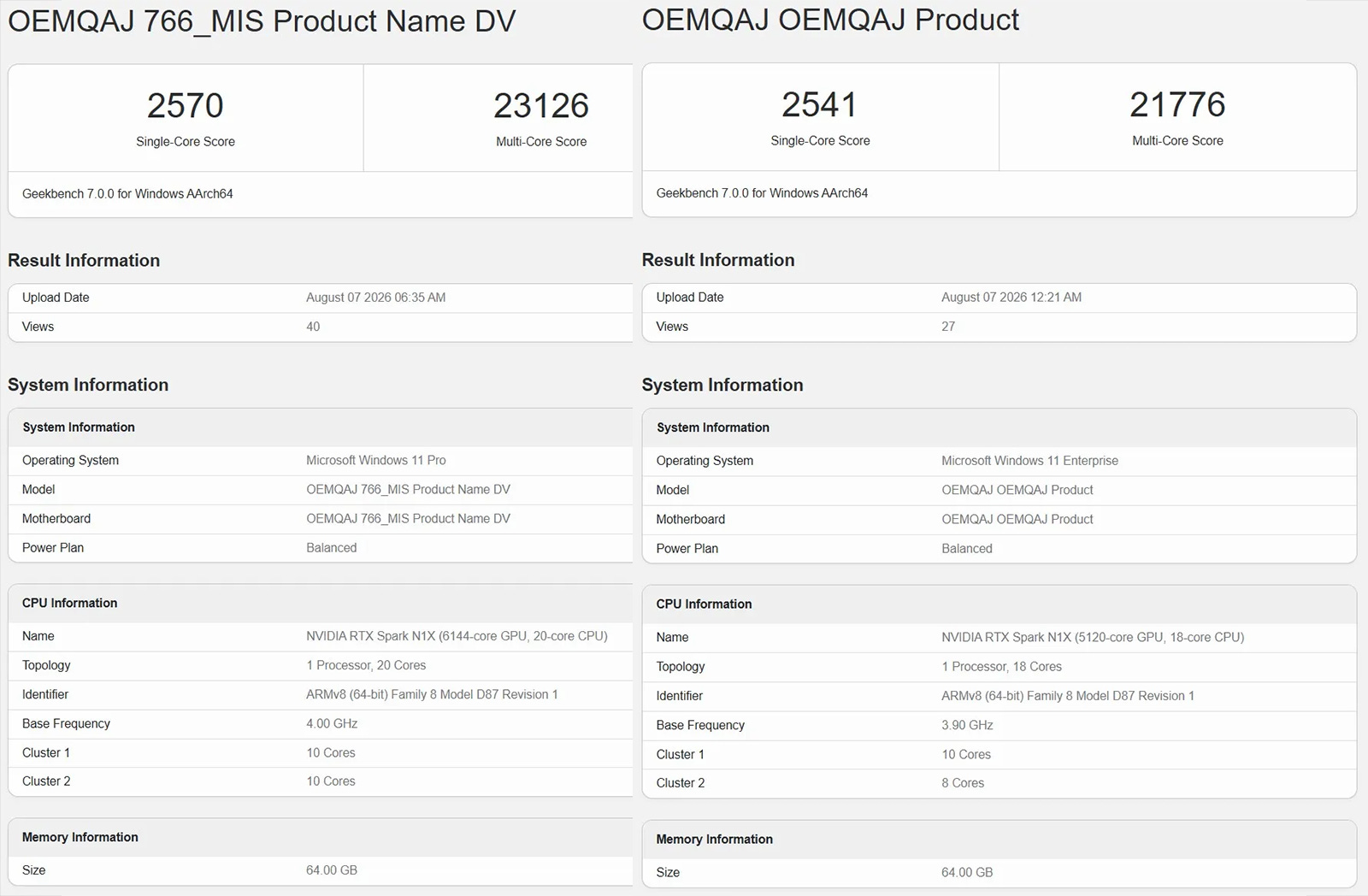
The full model comes with 20 CPU cores alongside the huge Blackwell integrated GPU with 6,144 CUDA cores. Then there’s a cut down version with 18 CPU cores and 5,120 CUDA cores.
The cut down version scored 2,541 in single core and 21,776 in multi core. That’s not bad at all. But obviously the more interesting chip, is their flagship model.
That 20 core chip scored 2,570 in single core and 23,126 in multi core. When comparing this to AMD’s Ryzen AI Max+ 395, Nvidia’s new chip is roughly 6% faster in single core and 12% faster in multi core. Against Intel’s newest Panther Lake Core Ultra X9 388H, Nvidia was roughly 7% behind in single core, but nearly 20% ahead in multi core.
With all of that said, there is one problem with this. It’s Geekbench. So it isn’t the best representation of real world performance, but it can at least be an indication of what to expect. And if this is right, Nvidia’s upcoming CPU is a seriously impressive chip. Time will tell just how far Nvidia can take this.
Microsoft Has Lost It
Remember when Microsoft recommended 32GB of RAM as a “no worries” Windows 11 upgrade? Then they quietly removed it? Well, they’re now pulling even more articles that recommend 32GB of memory for gaming. That’s almost certainly thanks to the fact that their now selling a Surface PC with only 8GB of RAM.
So you’d think Microsoft would seriously start worrying about RAM usage in Windows, right? RIGHT?!
Wrong. Because new testing from Windows Latest found that the built-in Windows 11 Weather app can consume more than 1.2GB of memory across multiple processes, all while it’s just sitting there. That’s over 1/8th the memory of Microsoft’s newest Surface. From a weather app…
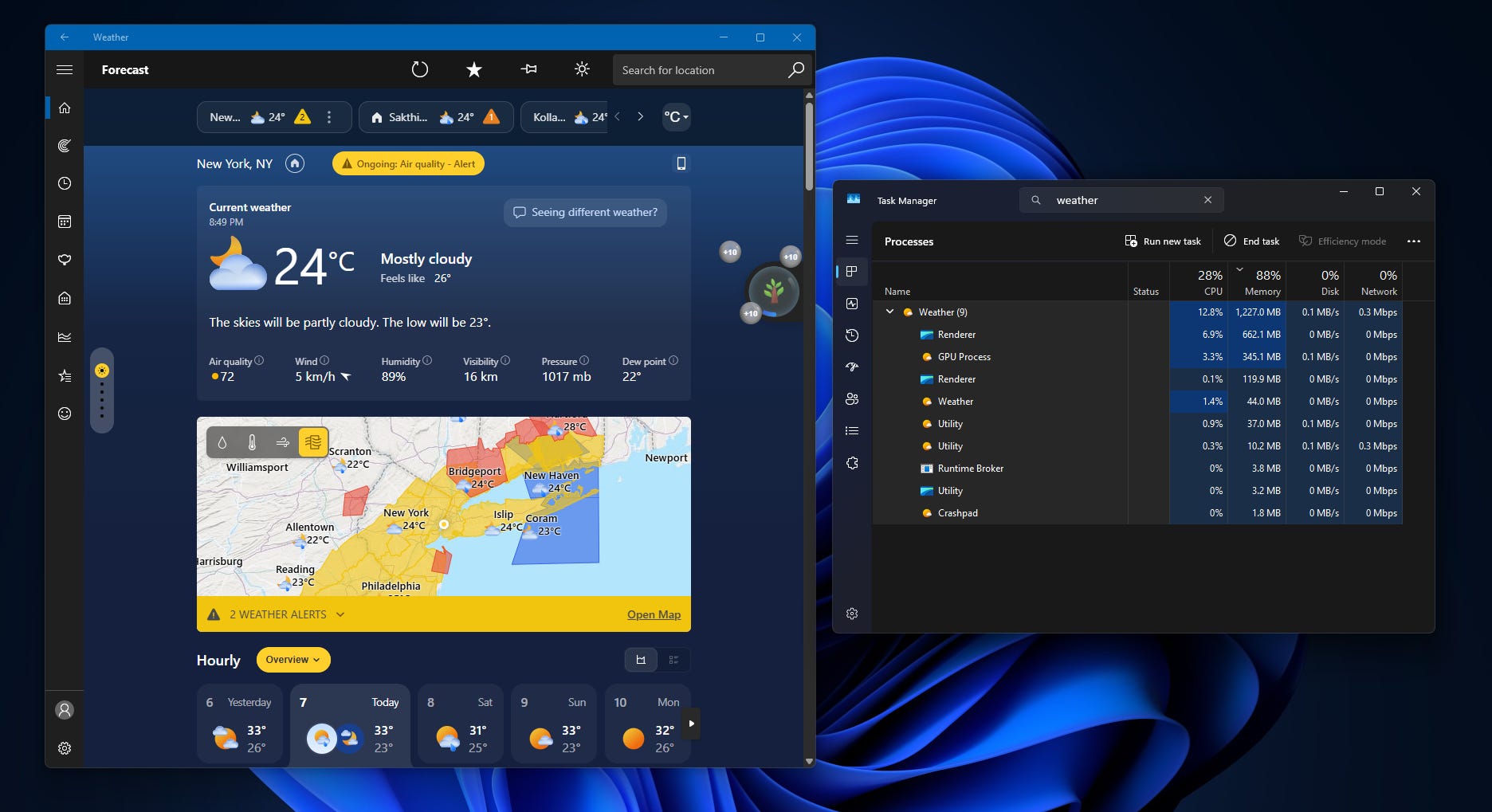
What’s infuriating is that the app itself is effectively just a web app wrapped inside a Windows app, that also includes ads. Microsoft has truly fallen.
For comparison, Apple’s native weather app in MacOS takes up 1/5th as much memory with just a single process. I honestly still think that’s a bit much, but it clearly shows the difference between actual optimization and whatever Microsoft is doing.
Quick Bytes
Xbox Game Pass on Linux?!
The developers behind Heroic Launcher are working on an open-source project called Xodus that aims to reverse engineer the services needed to run modern Xbox PC titles on Linux. The project can already log into Xbox services, download packages and obtain licenses, although there’s obviously still a ton of work ahead.
One RTX 4090 Owner Got the RMA Jackpot
After reportedly going through four problematic RTX 4090s, Zotac ultimately upgraded their customer to an RTX 5090 for free. The strange part: the replacement reportedly received only a 30-day warranty, but I still think Zotac is a champ for doing this.
Crucial’s Exit is Creating Some Problems
One customer with a failing 48GB DDR5 kit reportedly received an initial reimbursement offer far below the kit’s current replacement cost before Micron eventually improved the offer. Micron had previously promised to continue supporting warranties after shutting down the Crucial consumer business.
Intel’s Big APU Gets Spotted
HWiNFO has added preliminary support for the rumored Razor Lake-AX, which is expected to be one of Intel’s upcoming high-end APUs. There still aren’t many confirmed specs yet, but software support showing up is usually a pretty good sign that the hardware is moving along behind the scenes. So this could actually be the real deal.
So yeah. A pretty weird week. If this keeps up, AM4 is going to outlive all of us.
Until next time, may your memory prices keep falling, your four-year-old CPU keep winning, and your weather app use less RAM than the game you’re playing.
I had a quick question: if anybody could answer it, I picked up a Samsung 990 last night. They had them on sale at Best Buy. It did not come with a heat sink. Does this drive absolutely need a heat sink? I guess it depends on what I’m using it for?