


At some point, a premium GPU stops being a premium GPU and starts becoming a practical joke. We may have just reached that point.
Over the past few days, new distributor pricing from MSI and Colorful showed increases across almost the entire RTX 50 series in China. Some cards jumped by as much as 20% in roughly one week.
At the time, there was still a chance that the increases would remain isolated to the Chinese market. Different regions have different inventory levels, demand, taxes, currencies, and retailer margins.
But now several premium RTX 50 cards have become far more expensive at Best Buy, including an RTX 5080 that costs more than Nvidia’s original MSRP for the RTX 5090.
So, unfortunately, the price increases are no longer limited to China.
They have reached the United States.
The First Warning Appeared in China
New distributor sheets from MSI and Colorful show higher prices across almost the entire RTX 50 lineup, ranging from the RTX 5050 to the RTX 5090 D V2.
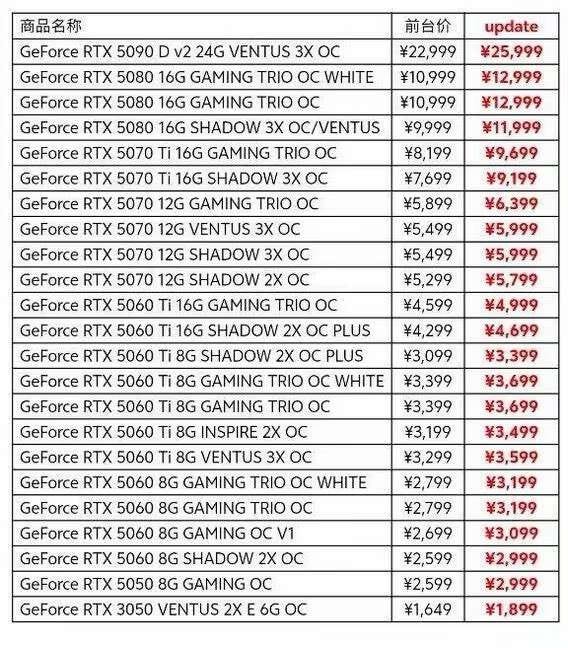
MSI’s document is especially important because it includes both the previous and updated prices.
For example, the RTX 5080 Shadow and Ventus models reportedly increased from 9,999 yuan (approximately $1,478 USD) to 11,999 yuan (approximately $1,773 USD). That’s a whopping 20% increase!
The RTX 5080 Gaming Trio went from 10,999 (approximately $1,626 USD) to 12,999 yuan (approximately $1,921 USD), while MSI’s RTX 5070 Ti Shadow jumped from 7,699 (approximately $1,138 USD) to 9,199 yuan (approximately $1,360 USD). But that’s not all!
Even the more affordable cards were affected.
MSI’s RTX 5060 Shadow increased from 2,599 (approximately $384 USD) to 2,999 yuan (approximately $443 USD), and the RTX 5050 Gaming OC received the same 400-yuan adjustment.
Colorful’s document doesn’t show its previous prices, so we can’t calculate exactly how much each model increased during this specific change, but its current prices are still completely absurd compared with Nvidia’s official Chinese MSRPs.
Colorful’s least expensive RTX 5070 Ti now starts approximately 38% above MSRP, while some premium versions are nearly 59% higher. Its RTX 5080 models range from around 26% to 59% above MSRP.
The reported cause is exactly what you would guess: rising GDDR6 and GDDR7 memory costs.
Notices circulating among Chinese distributors reportedly suggest increases of approximately:
600 yuan for cards with 8GB of memory
900 yuan for cards with 12GB
1,200 yuan for cards with 16GB
That helps explain why the 16GB RTX 5070 Ti and RTX 5080 received some of MSI’s largest increases.
But MSI and Colorful are not necessarily where the increases began.
To understand what’s happening, we have to move one step further up the supply chain.
Nvidia Reportedly Raised the Cost of Building
GPU manufacturers don’t normally purchase a GPU from Nvidia and then shop around for the memory separately.
Instead, partner companies like ASUS, MSI, Gigabyte, Zotac, etc. typically purchase a complete kit containing both the graphics processor itself and the GDDR6 or GDDR7 memory needed to build the card. Those companies then design the PCB, cooler, power-delivery system, and finished graphics card that ultimately reaches retailers.
Well, according to a report from BenchLife, Nvidia recently informed its board partners that the price of those GPU and memory kits was increasing.
Nvidia had reportedly already adjusted kit pricing for the RTX 5090 and China’s RTX 5090 D V2 in May.
The newer increase apparently extends to additional GeForce products using both GDDR7 and the older GDDR6 standard. The exact models and size of the adjustments were not disclosed, but given the increases from MSI and Colorful, I would assume it’s a lot.
Board partners are also reportedly paying more for coolers, PCBs, and packaging, although those increases are said to be smaller than the additional memory costs.
Nvidia and its partners have not publicly announced retail price changes directly connected to the reported adjustment. But only days after the report appeared, the new MSI and Colorful distributor sheets showed widespread increases across China.
And now the same thing is beginning to appear in the United States.
An RTX 5080 Just Passed the 5090’s MSRP
According to VideoCardz, Best Buy has raised the prices of several premium RTX 50-series GPUs.
The ASUS ROG Astral RTX 5080 OC is now listed for an unreal $2,099.99! Up from its previous Best Buy price of $1,899.99.
That makes this particular RTX 5080 $100 more expensive than Nvidia’s original $1,999 MSRP for the RTX 5090.
Yes, an RTX 5080 now costs more than the RTX 5090 was originally meant to cost.
Apparently, calling it “Astral” meant the price also needed to leave Earth’s atmosphere.
When ASUS first launched the card, its official price was $1,499.99. That means its Best Buy price has increased by $600, or 40%, since launch. Several premium RTX 5090 models have also moved higher.
The ASUS ROG Astral RTX 5090 is now listed for $4,829.99, while MSI’s RTX 5090 Suprim Liquid SOC has reached $4,599.99. For that kind of money, the GPU should at least come with the rest of the computer.
With that said, there is an important caveat.
These increases have not affected every RTX 50 card at Best Buy. Other RTX 5080 models remain significantly cheaper, meaning this currently appears to be a price adjustment affecting certain premium cards rather than a uniform increase across the entire lineup.
But the sequence of events is difficult to ignore.
First, Nvidia reportedly increases the cost of GPU and memory kits. Then Chinese distributors raised prices across almost the entire RTX 50 series. And only days later, several premium cards at one of America’s largest electronics retailers become even more expensive.
The U.S. increases are not yet as widespread as the new distributor pricing in China. But they are now here.
And unless memory costs begin moving in the opposite direction, these premium cards may only be the beginning.
Valve May Have Found the Breaking Point
There is at least one force powerful enough to prevent companies from raising prices forever…
Customers refusing to pay.
In May, Valve increased the price of their 512GB Steam Deck OLED from $549 to $789, and the 1TB model jumped from $649 to $949. That’s a massive 44% increase for the 512GB version and a 46% increase for the 1TB model.
Valve blamed the changes on rising memory and storage costs. And I have no doubt that’s true, but according to a new analysis from Boiling Steam, customers may have responded exactly how you would expect.
Before the increase, the Steam Deck was estimated to sell between 11,000 and 18,000 units per week. Afterward, estimated weekly sales fell to somewhere between approximately 1,400 and 3,000 units.
That represents an unbelievable decline of as much as 82%!
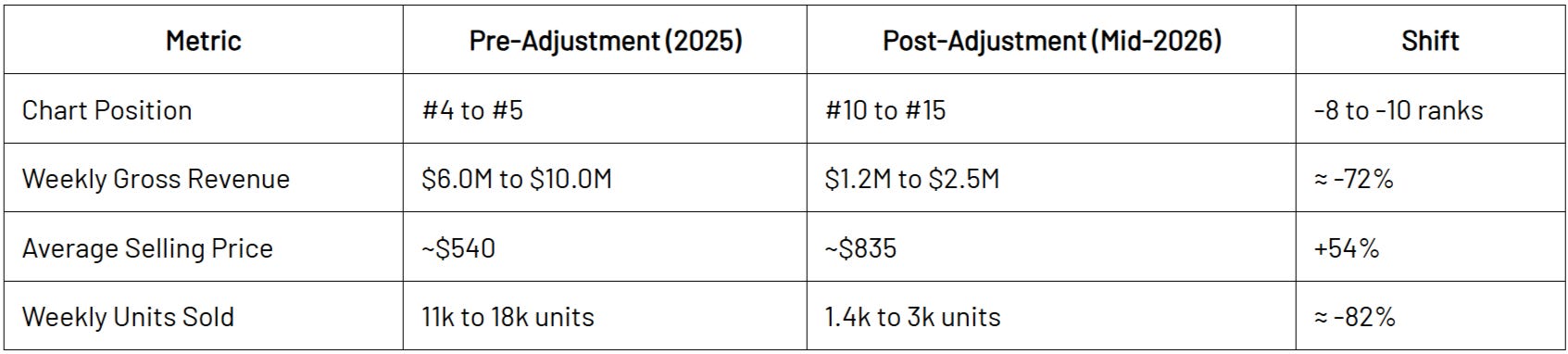
With that said, these are not official figures from Valve. The company doesn’t publish weekly Steam Deck unit sales, so the analysis uses the device’s position on Steam’s best sellers chart, estimated revenue associated with each position, and the Steam Deck’s higher average selling price.
Meaning there are multiple assumptions involved, so the exact drop off could be smaller, or potentially even bigger. Regardless, Steam’s own rankings support the broader conclusion that demand fell considerably.
Before the increase, the Steam Deck generally remained around fourth or fifth place on Steam’s weekly chart. Afterward, it fell into approximately the tenth to fifteenth place range.
That is what people mean when they say companies charge what the market can bear.
A company cannot simply select any price and expect customers to continue buying the same number of products. It can keep raising prices only until the additional profit earned on each device is no longer enough to offset all the customers who stop buying.
Valve increased its prices largely because its own costs were rising. The company was attempting to protect its margins, but if the decline in demand is anywhere close to this estimate, the adjustment may have hurt Valve more than it helped.
The Market Has Only Looked Like This Once Before
One of the biggest stories of the year I would say, is that the Shiller price-to-earnings ratio, or CAPE ratio, reached approximately 41 during July.
That may sound like an obscure financial statistic, but the underlying idea is fairly simple. A normal price-to-earnings ratio compares the current price of a stock with the company’s recent earnings.

The problem is that earnings can rise or collapse during a single year because of a recession, temporary shortage, tax change, or any other unusual event.
The Shiller P/E attempts to smooth out that noise.
Instead of using only one year of profits, it compares the value of the S&P 500 with the average inflation-adjusted earnings of those companies over the previous ten years.
Historically, the ratio’s average is around 17.4.
Its all-time record was approximately 44.2 in December 1999, near the peak of the dot-com bubble.
There have only been two modern periods when the ratio remained around or above 40 for a meaningful amount of time.
The first was the dot-com bubble.
The second is now.
That does not mean the market will collapse tomorrow.
Valuation measurements can show that stocks are historically expensive, but they are generally terrible at predicting the exact moment when investors will stop paying those prices.
There are also legitimate differences between the companies driving today’s AI boom and many of the businesses receiving money during the dot-com era.
Microsoft, Nvidia, Amazon, Alphabet, and Meta generate enormous revenue, profit, and cash flow. They aren’t three employees, a website, and a business plan written on a napkin. But profitable companies can still become overpriced.
The internet genuinely transformed the global economy. It changed how people communicate, shop, work, access information, and watch entertainment.
That did not prevent the dot-com bubble from collapsing.
A revolutionary technology can be completely real while the amount investors are willing to pay for it is still completely insane.
That is the risk facing AI.
AMD’s Next Two CPU Generations Could Both Be Massive
AMD recently revealed a processor roadmap extending through Zen 8, and the company appears to be done saving its largest manufacturing improvements for every other generation.
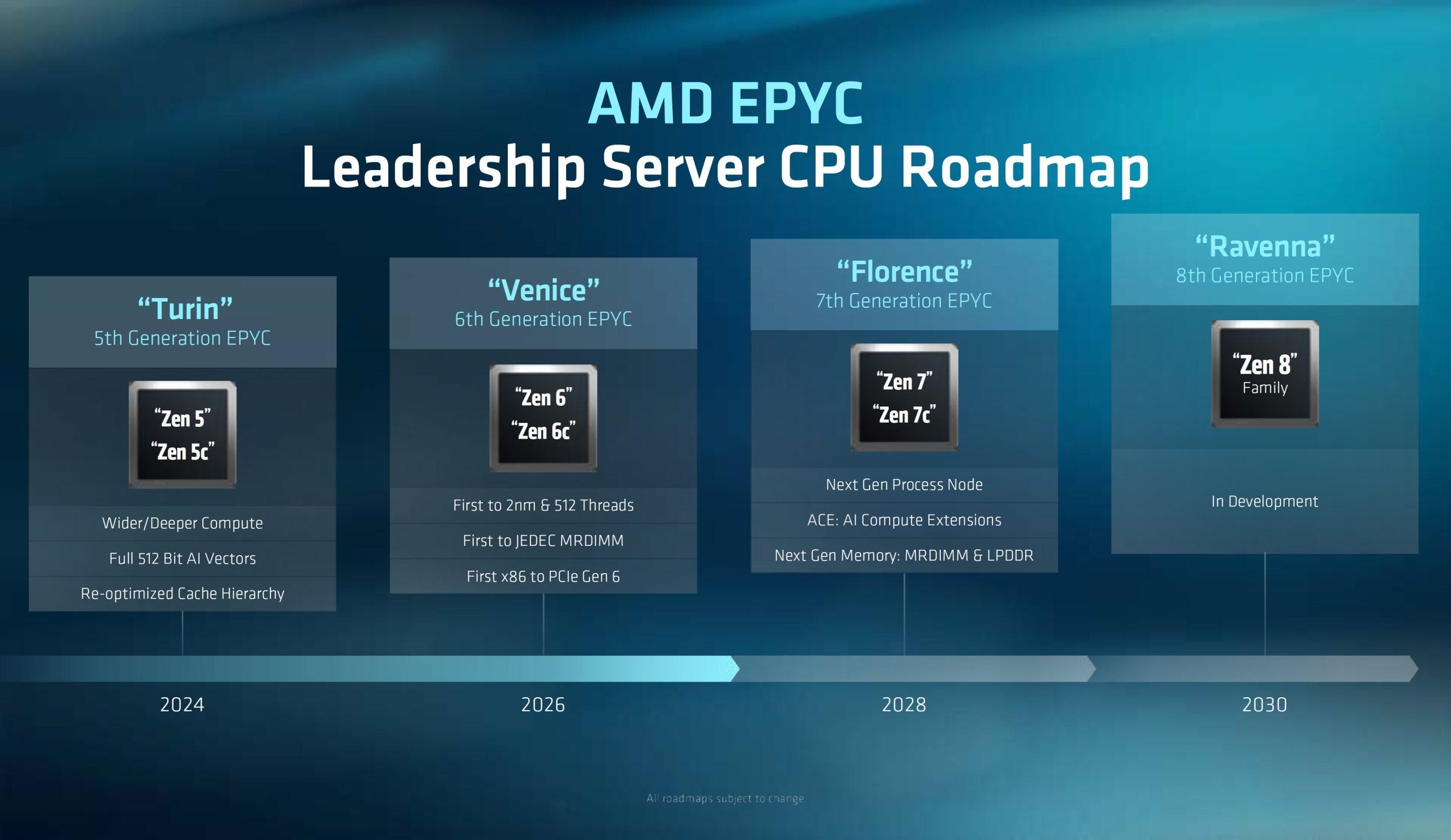
Its Zen 6-based EPYC Venice processors use TSMC’s advanced 2nm technology. Current Zen 5 compute dies are manufactured using a 4nm process, meaning AMD is effectively skipping the traditional 3-nanometer step for its next major CPU architecture.
Venice scales to as many as 256 cores and 512 threads, supports up to 16 channels of DDR5 memory, and adds PCIe 6.0 connectivity.
AMD has already begun ramping production, describing Venice as the first high-performance computing product to enter production using TSMC’s advanced 2-nanometer process. But here’s the thing: AMD’s also planning another manufacturing transition immediately afterward.
The company’s Zen 7-based Florence processors are scheduled for 2028 and will use what AMD calls a “next-generation process node.” AMD has not officially named that node, but a separate report claims the Zen 7 compute die, codenamed Grimlock, could use TSMC’s A14 technology, but that remains unconfirmed.
AMD has also confirmed that development has begun on Zen 8, with the EPYC Ravenna family planned for approximately 2030. That means AMD could move from 4nm with Zen 5, to 2nm with Zen 6, and then make another process-node transition with Zen 7 just two years later.
The company is apparently done taking its foot off the gas.
Nvidia’s First Consumer CPU Was Just Tested
You’re never going to believe this, but someone “found” an alleged prototype Microsoft Surface Laptop Ultra with Nvidia’s upcoming RTX Spark inside. And he actually spent a month testing it!
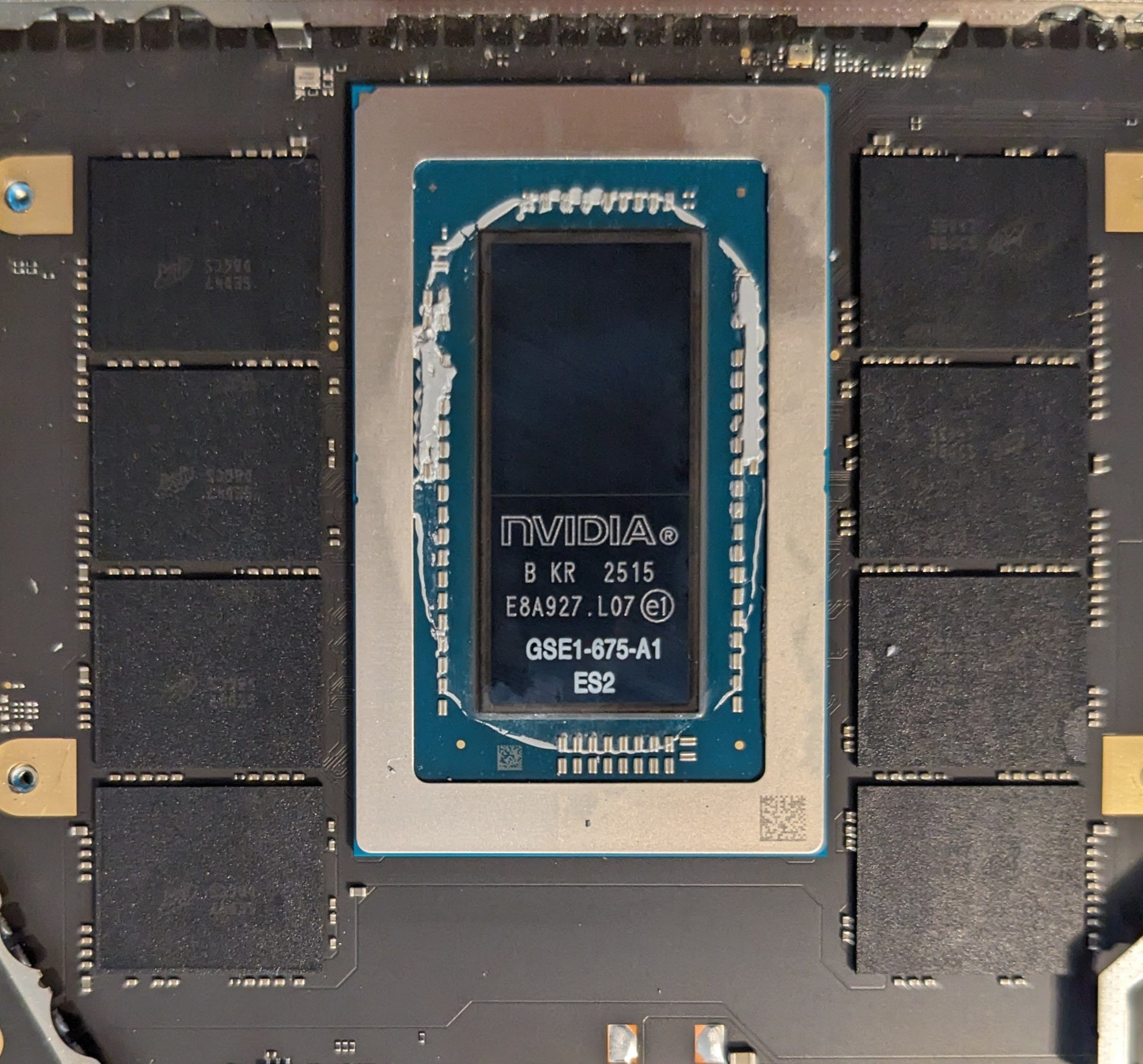
The system reportedly uses Nvidia’s top N1X configuration, combining:
A 20-core Arm processor
A Blackwell GPU with 6,144 CUDA cores
24GB of unified memory
As far as performance, the CPU didn’t do terrible.
In Cinebench 2026, the processor scored 5,771 points in the multicore test and 540 points in single-core. That places it in roughly the same range as Apple’s 14-core M3 Max. And that’s not bad for Nvidia’s first major attempt at a mainstream Windows consumer processor.
Unfortunately, gaming was a completely different story.
According to the tester, GPU clock speeds repeatedly fluctuated between approximately 1.5GHz and 2.3GHz, producing major stutters every few seconds. Increasing the system’s power limit made almost no measurable difference, while certain workloads and games crashed entirely.
Temperatures were also brutal.
The CPU reportedly reached between 98 and 100 degrees Celsius, while the GPU generally operated between 80 and 88 degrees. Desktop idle consumption reached as high as 23 watts in the system’s highest-performance mode.
That all sounds terrible, but this is an early engineering sample running unfinished software and drivers. The results should not be treated as representative of the final retail product.
In fact, the most interesting takeaway may be that Nvidia’s underlying hardware already appears surprisingly capable. The company seems to have created a processor capable of competing with some of the most powerful laptop CPUs on the market.
Now it needs to make Windows, drivers, power management, and existing games work properly on it.
That may prove to be the much harder part.
QUICK BYTES
Intel May Be Building a Real Desktop APU
A preliminary Intel Nova Lake desktop configuration reportedly combines four P-cores, eight E-cores, four low-power E-cores, and 12 Xe3P graphics cores.
That would be a much larger integrated GPU than Intel normally includes inside its socketed desktop processors.
If the configuration reaches production, it could give Intel a proper desktop competitor to AMD’s Ryzen G-series for compact systems and lower-cost gaming PCs that do not need a separate graphics card.
The specifications remain unconfirmed, and Intel has not announced clocks, memory support, pricing, or performance targets.
Someone Built a Fanless RTX 4060 With 2.5 Kilograms of Aluminum
A PC builder has created a completely fanless RTX 4060 by attaching an enormous 2.5-kilogram block of aluminum directly to the card.
The cooler relies entirely on natural convection, allowing warm air to rise through the widely spaced aluminum fins without requiring a fan.
The design is obviously far too large and heavy for a normal PC case, but the relatively efficient 115-watt RTX 4060 makes it one of the few modern graphics cards capable of making the experiment work.
It is silent, technically functional, and only slightly heavier than a small child.
Seagate Is Preparing 50TB Hard Drives
Seagate plans to begin qualification shipments of its first 50TB-class hard drives in late 2027, with wider shipments expected afterward.
The drives will use Seagate’s next-generation Mozaic 5 HAMR platform, with platters capable of storing more than 5TB each. The company’s longer-term roadmap includes approximately 60TB drives around 2029 or 2030, followed by 80TB and eventually 100TB models.
Naturally, much of the demand driving these enormous capacities is coming from AI and cloud companies.
Because apparently every part of the PC industry eventually leads back to AI buying all the hardware.
That’s all the bytes for this week.
Until next time, may your frame rates stay high and your component prices return to Earth.
They are going to wind up pricing themselves out of business
I got the AMD hellhound 9070