


I’m so sorry that I missed last week’s Meld Bytes. I had a couple really important things come up that I had to attend to. Regardless, it’s here, and I won’t let it happen again.
I’ve been seeing new technologies crop up over the last few weeks that could massively improve gaming performance without requiring us to buy new hardware. We already know about AMD adding FSR 4 support to RX 6000 and 7000 cards, along with much faster DLSS 5, a new performance mode in DLSS frame generation. Basically, there’s a lot. And today, there’s a new technology delivers huge improvements in ray tracing, along with a game-changing new tech from AMD.
And the timing of these changes couldn’t be better. Because according to AMD, things are about to get a lot worse! In fact, the timing of these are almost too good…
So let’s get right to it!
Ray Tracing Just Got 66X FASTER?!
AMD, Nvidia and Intel GPUs are all getting new tech that just gave an RX 9070 66X more FPS! In fact, Microsoft is calling this their “most significant upgrade” to DXR since its debut in 2018. And let’s just say, the performance improvements prove that statement to be correct.
So Microsoft just announced three major upgrades to DirectX Raytracing, or DXR. If you don’t know much about the different graphics APIs or how they work, just know that this is the technology that most DirectX 12 games use to enable hardware ray tracing. Whether you use an Nvidia, AMD, or Intel GPU.

The first technology is called Clustered Geometry, and it’s pretty interesting. See, when a game uses ray tracing, your GPU needs to create structures that help determine where rays hit objects in the scene. The problem is that building and updating these structures can be really demanding. In comes Clustered Geometry. It basically breaks the structure down into smaller clusters that can be reused or updated more efficiently. Now, that may sound familiar. And that’s because it’s actually very similar to Nvidia’s Mega Geometry. The difference is that it’s now going to be supported on Nvidia, AMD and Intel GPUs. And the performance this thing can bring is absolutely bonkers!
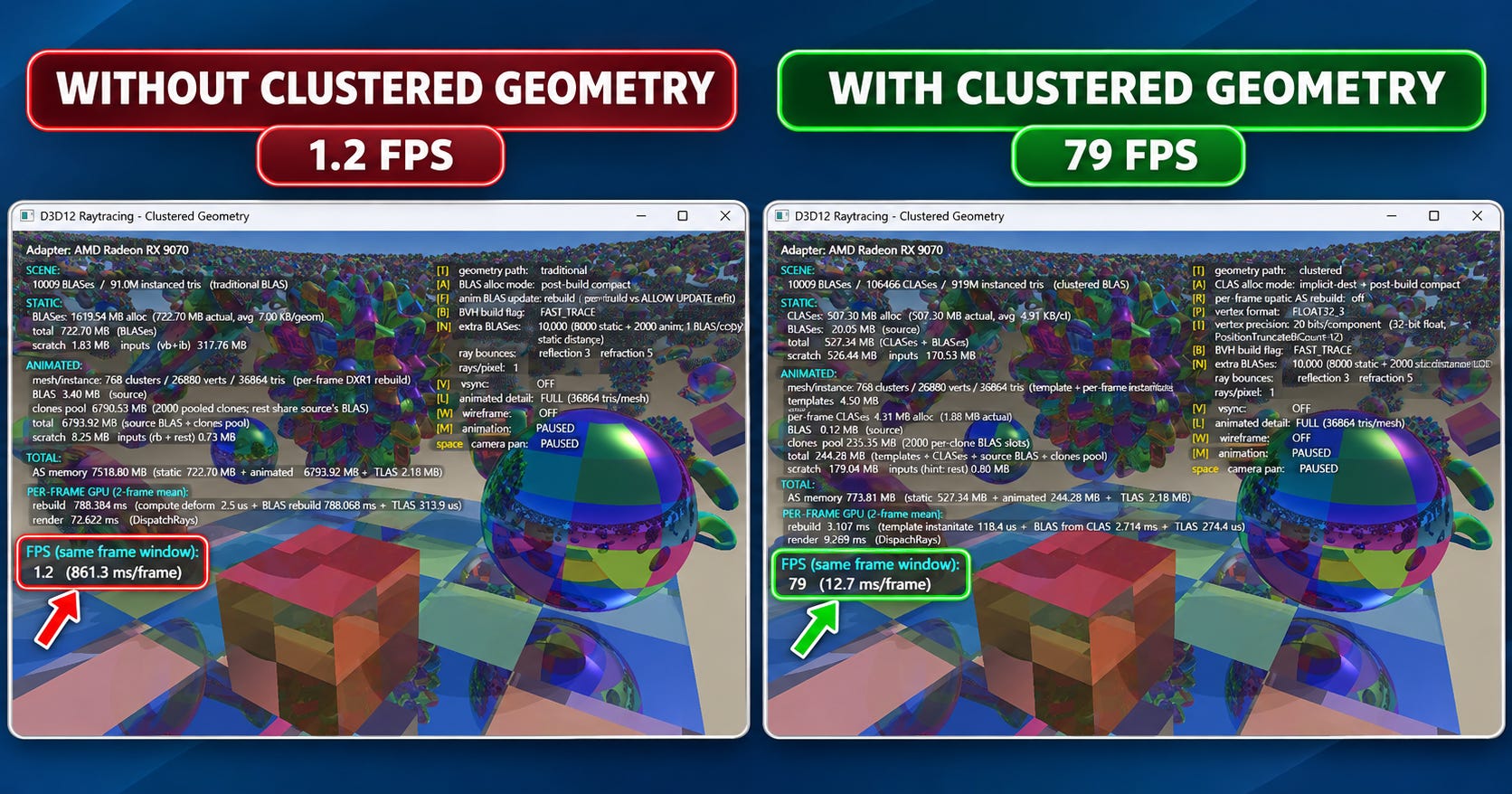
In one demo using an RX 9070, Microsoft saw performance go from just 1.2 FPS to an unreal 79. That’s 66 TIMES FASTER! Not only that, but the time spent building those structures dropped by a whopping 99.6%! And memory usage fell by nearly 90%! Now, with that said, before you start expecting Cyberpunk to run at 4,000+ FPS, this is a special demo where rebuilding geometry was a huge bottleneck itself. So you’re definitely not going to see a 66X FPS improvement in the average game, but it will almost certainly have a big impact. Just not that big.
And the improvements don’t stop there! Remember that we have three new technologies. The second one is called Partitioned TLAS. Basically, when there are only a few changes made from one scene to the other, instead of updating the entire ray tracing scene, Partitioned TLAS can choose to update only the affected portions.
Now, I will say that this was also an Nvidia tech, but I can’t find where it was ever actually used in a game. To give you an idea of how much this helps, in the demonstration below, there are a bunch of dominoes falling. With regular TLAS, it takes a whopping 2.88 milliseconds to rebuild each frame, but with the new Partitioned TLAS, it takes just 0.79!
The final upgrade is called Indirect Acceleration Structure Builds. And this allows the GPU to generate build instructions itself, which reduces the need for the CPU to manage that work.
Now, when it comes to support, there is a problem. As of right now, AMD only supports their RX 9000 series of cards. I’m hoping they release it to older cards as well, but we shall see. Nvidia, on the other hand, supports cards all the way back to their RTX 20 series, and Intel supports their Arc B-series and the Core Ultra 200V and series 3 processors.
As far as the actual release, Microsoft did release their preview SDK, but the full release still doesn’t have a date yet. With all of that said, my fear is that developers use this to simply push graphics forward, instead of giving us back more performance. And obviously, I do understand their point, but it would be nice to play a game with ray tracing that doesn’t require upscaling from 320p or 20 fake frames.
AMD’s New Tech Changes EVERYTHING!
Speaking of fake frames, AMD’s new tech could actually make developers’ lives easier. It’s called Fluid Motion Frames 3, and as the name suggests, it’s AMD’s third iteration of Fluid Motion Frames. But it might as well be called something entirely different, because this completely changes the game.
For those who don’t know, Fluid Motion Frames is AMD’s driver level frame generation tech. Meaning developers don’t have to actually code it into the game. Now, if this is the first time you’re hearing about this, you’re probably wondering why developers even bother building frame generation into games if this is possible. Well, curious reader that I made up, it’s because there are some major problems with the tech. That is, until now…
Historically, driver level frame generation doesn’t have access to the information that integrated frame generation gets. Specifically, it doesn’t have access to motion vectors or depth information from the game engine. So Fluid Motion Frames has to estimate a lot of the movement from the already completed images. This creates problems like ghosting and distorted HUD elements, because the technology doesn’t know which parts of the image are actually the game’s interface. And things get even worse during fast movement. In fact, when movement is fast enough, AMD has to flat turn off the tech. Imagine your FPS randomly getting cut in half because you’re moving too fast. Those are the problems we’re talking about here.
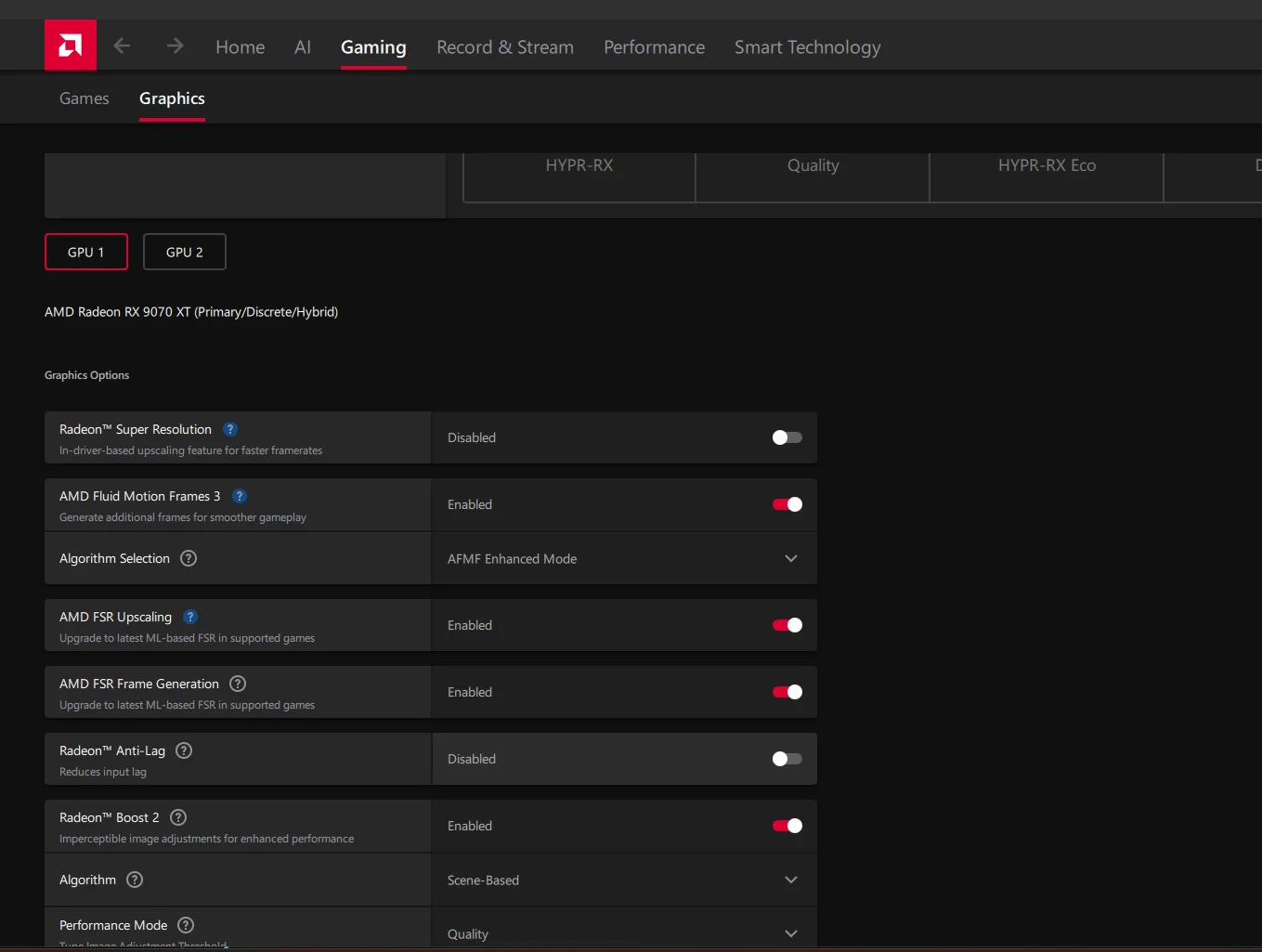
And that’s where Fluid Motion Frames 3 comes in. In a new report by VideoCardz, a Reddit user managed to discover a hidden setting in AMD’s latest graphics drivers using DeepSeek AI. And by modifying a Windows registry setting, he was able to expose two different AFMF 3 modes: Standard and Enhanced. And it’s that enhanced mode where things get interesting.
According to the user who found it, this is able to take motion vector information from technologies like FSR, XeSS, TSR and TAA. Meaning it can use that information to learn way more about the scene without having to guess. The Redditor apparently tested it and seems to claim that it even fixes artifacts in the UI as well!
With that said, there are some downsides. So far, there are a ton of bugs in it, so it obviously needs a lot of work, but also keep in mind that this is not a release. AMD never intended for this to get out, so I don’t suggest anyone try it. Also, according to the Redditor, the new tech makes latency slightly worse. And given frame generation already makes latency worse, that’s not good. BUT at the end of the day, if AMD can get this working well, AMD owners could soon get decent frame generation in just about every game.
AMD Just Admitted It!
Like I said in the intro, all of these performance updates seem almost too timely. Okay, I don’t actually think that there’s some conspiracy to make our GPUs last longer. Really, it probably is a response to inflated prices, but it would make more sense for GPU makers to do the opposite. That way we’d be forced to buy new cards at these inflated prices. Regardless, based on something AMD just admitted, when it comes to buying new hardware, we’re all screwed!

This story originally comes from AMD’s new Q3 earnings call, where the company made history. I’m talking it was so good, that by next quarter, they plan to outsell Intel for the first time ever. When it comes to this quarter, AMD generated a record-smashing 8.5 billion dollars in data center revenue alone, which is a 97% year over year increase. That means Data Center makes up 64% of their total revenue. Not only that, but AMD expects data center to grow to approximately 12.8 billion by next quarter. Basically, gaming is clearly not AMD’s primary focus anymore. Honestly, consumers overall aren’t all that important to the company at this point. And the crazy thing is that AMD actually said it! They actually admitted the truth loud and clear for all to hear.
During a recent interview with Yahoo Finance, AMD’s CEO, Lisa Su, said this:
“We're looking to double the business—more than double the business—as we go into next year. We are a data center first company, that is our profile and people need more computing to power all these applications.”
-AMD CEO, Lisa Su
So yeah… There’s very little ambiguity about that. AMD has officially said the quiet part out loud. They are a data center first company. Of course, we’ve known this for quite a while. Even before AI, AMD had a pretty big focus on the server space, but with AI, it’s gone to a whole new level. And don’t get me wrong. That is understandable. AI demand is quickly dwarfing all other sectors. She mentioned that they’re looking to double the business as they move into next year. That’s a massive jump. Especially for a company that’s already big enough to be in the S&P 500.
She was later asked about Wall Street’s concern over AI spending, and she basically said that investors are too short sighted. That they’re focusing on the future with the expectation that AI computing requirements will become more essential and keep growing. So AMD seems to believe that things will get even worse for gamers. And according to her own words, that isn’t all that important.
Quick Bytes
FSR 4.1.2 Just Arrived On Xbox!
AMD officially announced that its latest machine-learning upscaler is now available to Xbox Series X and S developers! The new FSR 4.1.2 implementation includes a full INT8 model alongside a smaller Lite version that’s less than half the size and costs less GPU processing time. Developers will still need to add support to their games, but it’s another example of newer software bringing advanced features to older hardware.
Nvidia’s RTX 5080 24GB Could Be DELAYED!
Remember that rumored 24GB RTX 5080 supposedly replacing the 16GB model? Well, according to BenchLife, Nvidia reportedly missed its October deadline to provide design kits to board partners. And without those materials, manufacturers can’t finish preparing their graphics cards for production. That makes the rumored January launch increasingly questionable, although an announcement at CES is still possible.
Crypto Mining Is BACK?!
As if graphics card shortages weren’t bad enough, cryptocurrency mining is starting to create problems again. According to reports out of China, some manufacturers are recommending that distributors focus on older graphics cards like the RTX 3060 and 3050 because newer models are becoming difficult to obtain. The report blames both increased cryptocurrency mining demand and China’s shopping season. And that crypto mining is a new currency called Pearl, which makes gaming GPUs profitable again.
China’s New GPU Competitor Is Getting Better!
China’s Lisuan Tech just released another major driver update for its first gaming graphics card, the LX 7G100. According to VideoCardz, the update includes 58 changes, including fixes for games that previously wouldn’t launch. The company also added FreeSync controls and new hardware video decoding support. Performance is still nowhere near AMD or Nvidia’s mainstream graphics cards, but consistent software improvements are a great sign for the new competitor.
That’s all the bytes for this week!
Until next time, may your FPS keep climbing, your hardware keep improving, and your next graphics card not require a second mortgage.
Nvidia "MIGHT" have now also "other problems" 😂😂😂..