


AI this. AI that. AI everywhere. Will it be our destruction or will it make everything cost pennies? Why does it have to be one or the other? Can’t there be a middle ground? Well, there’s now a lawsuit about it.
AMD also just released our clearest look yet at Zen 6 performance, new VRAM is going to change everything, AMD somehow became a trillion-dollar company, and more.
So yeah… we’ve got quite a bit to talk about.
Collusion…
I know everyone is completely sick and tired of hearing about those two letters. The ones that completely broke the PC market. That sent prices soaring, supply into chaos, and somehow managed to infect just about every piece of hardware we buy. I’m of course talking about… AI. And honestly, I’m there with you, but what if four of the largest AI companies were colluding to slow down the development of AI?
Well, that’s exactly what my first story today is about, with a brand new antitrust lawsuit that alleges just that. I know it’s a little different from my usual report, but I really think that this is an important topic to discuss. So right off the bat, you must be wondering… Why?? Why would the four frontier companies: Anthropic, OpenAI, SpaceXAI and Google all agree to slow down their own AI development?
The first answer that likely comes to mind is one you’ve heard time and time again: Safety. And that’s what most of these companies will tell you. That AI could get completely out of control. That AGI (artificial general intelligence) is right around the corner, and could pose an existential threat to not only data entry jobs, but all of humanity. Or something along those lines. But I’d argue that there’s a second motive. Possibly intertwined with the other, but still one that can’t be ignored. Specifically, to hold their positions at the top of the AI food chain and hinder any would-be competitor from knocking them off.
Think about it from their perspective for a second. If one company’s AI pulls far enough ahead of the competition, it would quickly become the dominant player and leave everyone else scrambling to catch up. That’s a scary prospect when you’ve invested billions of dollars in your own AI. So the safest route is to simply work together to remain on top. And when I use the word “safest”, I mean safe from losing the top spot. Not to mention the fact that you won’t have to innovate as much, spend all that big R&D cash, while remaining on top, and the list goes on.
Now, that isn’t to say that safety isn’t a concern. In fact, I’m far more in the middle than most. There are likely some regulations that do need to occur. But there’s one question that I always ask when evaluating whether something is true or not: What is their motive? This is a question that I think should be applied to everything, really. It doesn’t necessarily give you a definitive answer because you could have a reason to lie and still be telling the truth. BUT we are flawed beings, and we can even convince ourselves that what we’re doing is for the right reasons, even if they aren’t.
And believe it or not, there’s actually quite a bit of evidence for safety not being as big of a concern as they pretend. One place to start is in fact the main AI company that never stops talking about “safety”: Anthropic. This is a company that claims to put safe AI use at the forefront of their philosophy. I mean, they care so much about safety that they’re flat begging the government to regulate them. That is, until the competition starts getting ahead, and they ignore their own safety rules. That’s actually something that happened.
Since then, things have been getting really… weird. Specifically, when we look at recent developments around the safety of AI. And how far companies may go to push for regulations. Starting with a man named Jacob Coxon. The former Anthropic employee who claimed to quit his job purely because he’s afraid of what AI will do. Specifically, what his former coworkers are willing to do to win the race. We’re talking he claims that there’s a greater than 10% chance that AI could cause human extinction before the end of the decade.
And while there’s a lot to unpack about his own motives, article after article has already been written about that. Let’s just say there are definitely questions about how quickly the message was amplified. Coxon says he didn’t coordinate with organizations before posting, although he did speak to a reporter beforehand and says he created a group chat afterward with around 10 people to help share the post.
Just know that he never actually saw any next level AI model that would doom us. It’s purely an opinion about where he thinks it will go after working at Anthropic for just 4 months. No, the main focus I’d like to put on him is on the fact that major employees within Anthropic retweeted his message.

But why? Why would the employees retweet a guy who basically claims that they’re all power hungry psychos about to doom us all? Well, his message does two things for Anthropic. First, it basically tells investors that their AI system is so advanced, that it could one day kill us all. And second, it further pushes the notion that AI must be throttled in.
And as you would expect, politicians were quick to jump on. On the one hand, you have power hungry maniacs wanting to control every industry they can get their hands on. And on the other, you have industry leaders willing to do anything to remain industry leaders. Even if it means they submit to regulations.
Now, you might be thinking that corporations hate government regulations, but that’s really just smaller businesses. Huge companies actually thrive under them. In fact, they love them. Because it’s one of the only ways to gain a true, long term monopoly. Regulations help to impose a larger burden on new, competing companies, while ensuring larger companies slow the pace.
So what exactly are those regulations?
Well, this is where things get really interesting. Because Anthropic has already laid out an entire framework for how it thinks the government should regulate advanced AI. And some of the proposals get pretty wild.
Besides independent evaluations and forcing every company to document new models when they release them, Anthropic also wants the government to gain the power to prevent new models from even being released.
Think about what that means. Imagine some new company comes out of nowhere and develops an AI that absolutely crushes the competition. Once that company has to regulate, it could also need approved evaluations, regular reports, cybersecurity programs, penetration testing, lawyers, compliance teams and ultimately a process that could determine whether its even allowed to launch it’s new model. Basically, it won’t be enough anymore to simply build the better product.
Now, to be fair, these rules wouldn’t apply to a tiny AI startup operating out of a garage. Anthropic’s current federal proposal only covers developers that both train models above 10^25 FLOPs and either make more than $500 million a year in AI revenue or spend more than $1 billion a year on AI research and development.
But I’d argue that it makes the competition question more interesting. Because the regulatory wall doesn’t really appear when you’re starting an AI company. It appears when you’re becoming large enough to actually challenge the companies already at the top.
And if all of that wasn’t enough, Anthropic is even asking the government to loosen antitrust rules designed to stop competing companies from coordinating with one another. Dario Amodei specifically called for a “narrow waiver” that would allow the major AI labs to hold certain safety discussions without running the risk of violating antitrust law.
Now, this isn’t some new concept that corporations just discovered with AI. We’ve seen versions of this throughout history. Large companies have supported regulations that also happened to raise the cost of entry for smaller competitors. Economists have an entire concept around companies using regulation to raise rivals’ costs.
Anthropic originally had a pretty straightforward safety philosophy: if its models became too powerful for its safety measures, Anthropic itself would slow down. But earlier this year, the company weakened that unilateral commitment.
And now the proposed solution isn’t simply for Anthropic to slow itself down, but for everyone at the forefront of AI to operate under the same restrictions.
With all of that said, if Anthropic genuinely believes AI development is becoming dangerously fast, there is a reasonable argument for claiming that self restraint doesn’t solve anything. Anthropic stops, somebody else keeps going, and you end up with the exact same supposedly dangerous AI. Just built by another company.
So there can, and probably is some truth to this. But simply put, there’s a serious motive to push this that has nothing to do with safety.
And this bring me back to this new lawsuit. You thought I’d forgotten about it, huh? In it, the plaintiffs allege that direct competitors are coordinating a slowdown together. Effectively replacing competition with collective restraint. The companies’ public position is that the coordination is about managing potentially catastrophic risks, but they almost don’t even deny that coordination is happening.
And whether that's ultimately about saving humanity, protecting their position or some combination of the two, is exactly what this lawsuit could force everyone to take a much closer look at.
But there is also a very obvious business benefit to the alternative. If everyone has to slow down... Nobody gets to race past you.
Zen 6 Just Got Its Biggest Test Yet
AMD just released a slew of new Zen 6 benchmarks that prove their next Gen CPUs are beyond Epyc.
And yes, this is in fact about AMD’s next generation Epyc Venice server CPUs, so we don’t have anything on Ryzen just yet. But don’t forget that Venice is still built from the same Zen 6 architecture as their upcoming consumer chips. So this does at least give us an idea of what we can expect out of next Gen Ryzen.
And apparently, we can expect a lot.
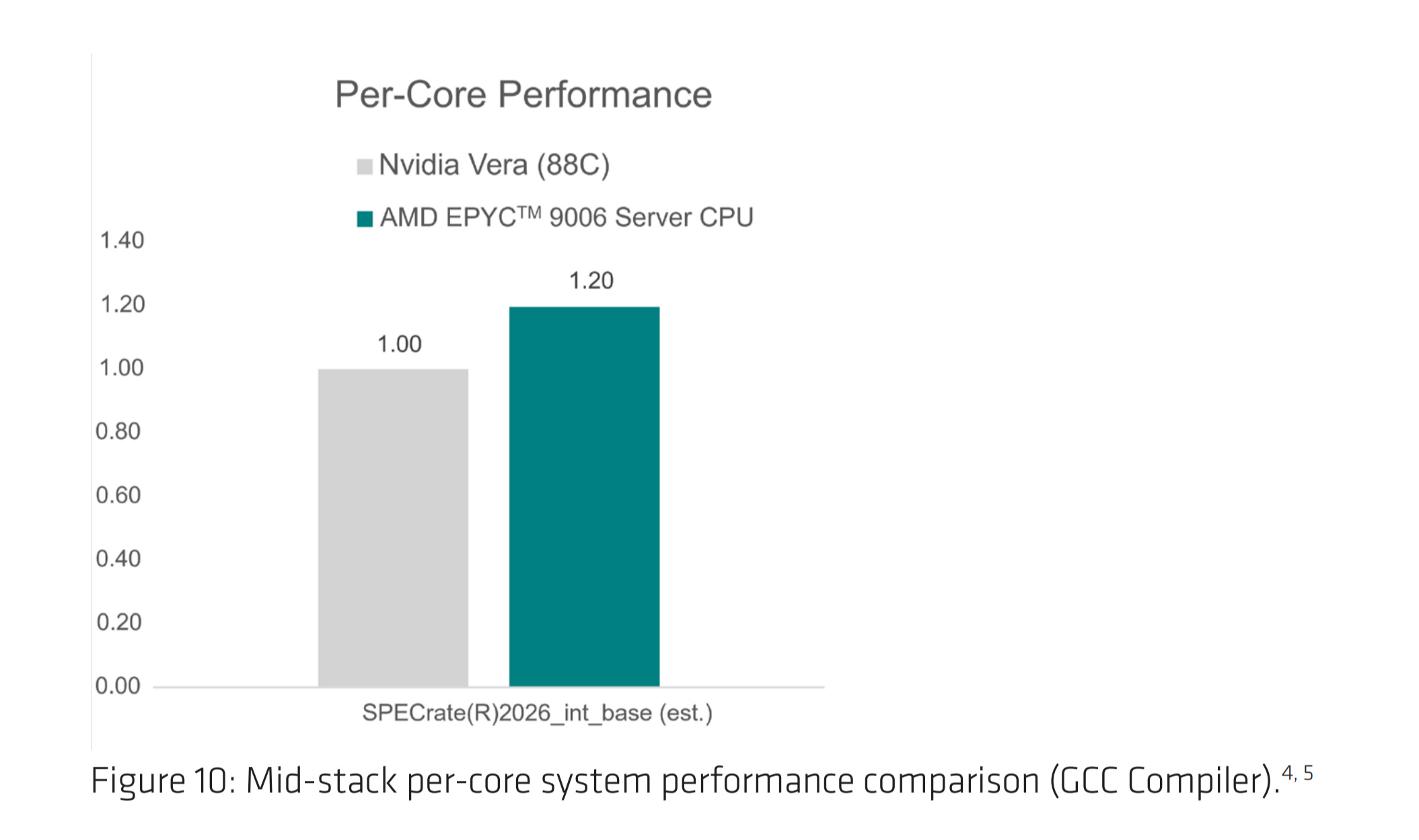
Because starting things off, the company compared their new 96 core Venice processor against Nvidia’s brand new Vera system with 88 cores in the new SPEC CPU 2026 Integer benchmark. Now, before you get concerned about the core count difference, AMD actually shared the per-core performance. And according to them, Venice beat Nvidia’s Vera chip by 20%.
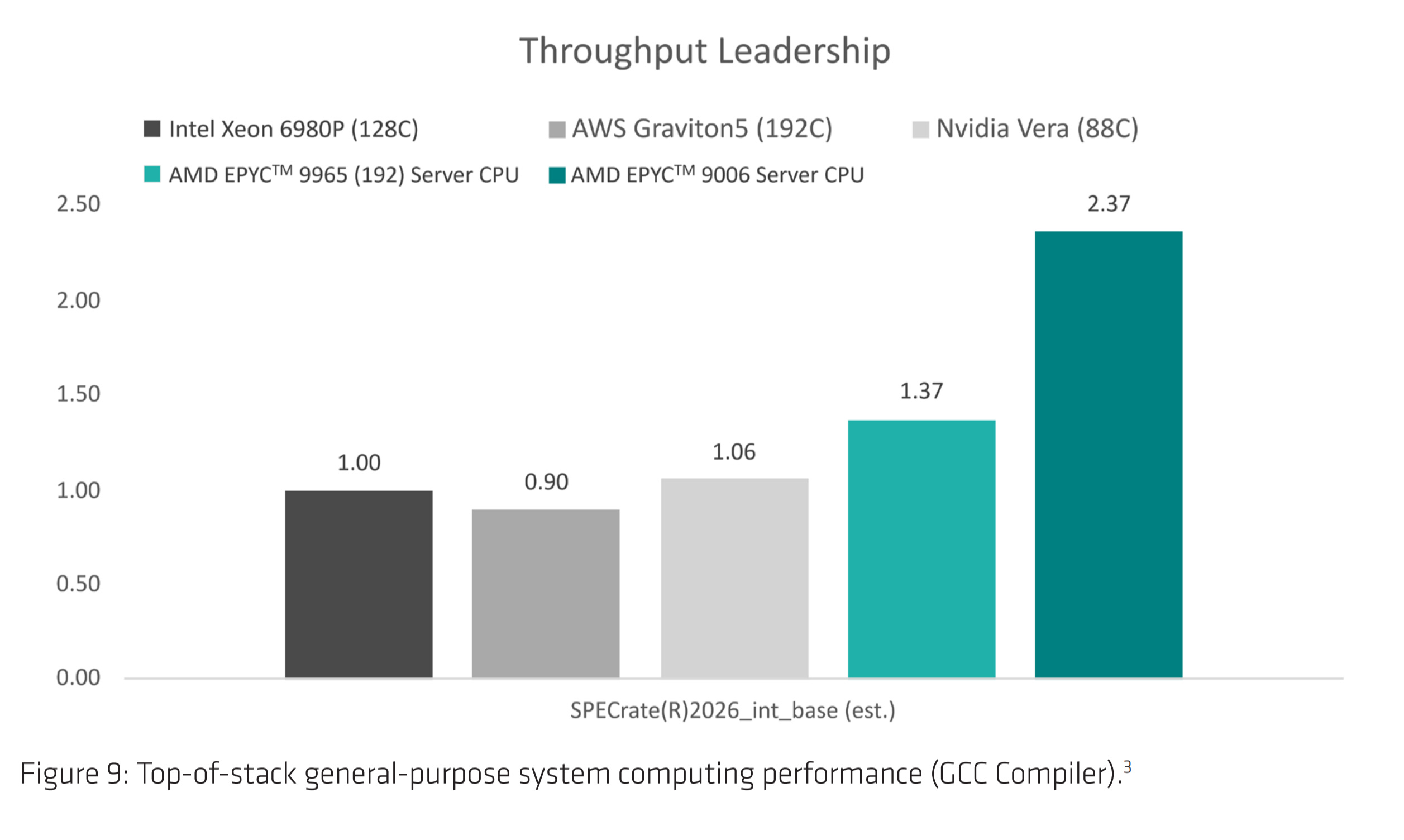
But that’s just the beginning. Because Venice doesn’t just have chips made from AMD’s Zen 6 cores, but also their dense Zen 6C cores. And those CPUs can get up to an unreal 256 cores. When we compare that Epyc 9996 chip to Vera, AMD’s offering completely destroys it with a 2.24X overall performance. In the diagram below, keep in mind that the 2.37X performance is using Intel’s Xeon 6980P CPU as the reference. That’s why those numbers are different.
But it doesn’t stop there, because memory bandwidth is also something to talk about. Because Venice supports an unreal 16 channels of DDR5, with up to 1.6 terabytes per second of bandwidth, AMD’s new chip beats out Vera by 18% in memory bandwidth.
Finally, AMD modeled an entire data center rack within a 100 kilowatt power budget, and according to them, Venice could deliver around 3.4X the throughput of a Vera-based setup. I say “could” there because the rack results are simply modeled. They aren’t actual benchmarks, and even the ones that are, obviously aren’t independent. So definitely wait for those.
All in all though, AMD’s Epyc Venice looks seriously interesting. And if even a portion of this can be seen in Ryzen, next Gen is going to be ridiculous!
GPU Memory Will Never Be The Same
GPUs may finally start getting far more VRAM! Now, I know what you’re thinking: “Not at these prices!” And you’re right. This is more about next generation GPUs, but it does look to be happening. And there’s a couple stories that prove it.
First, Micron just listed both of their 2GB GDDR7 chips as End Of Life. That includes their 28Gb/s and 32Gb/s versions, some of which have already been used on RTX 50 GPUs. And according to Micron’s current catalog, that only leaves their higher density 3GB chips remaining.
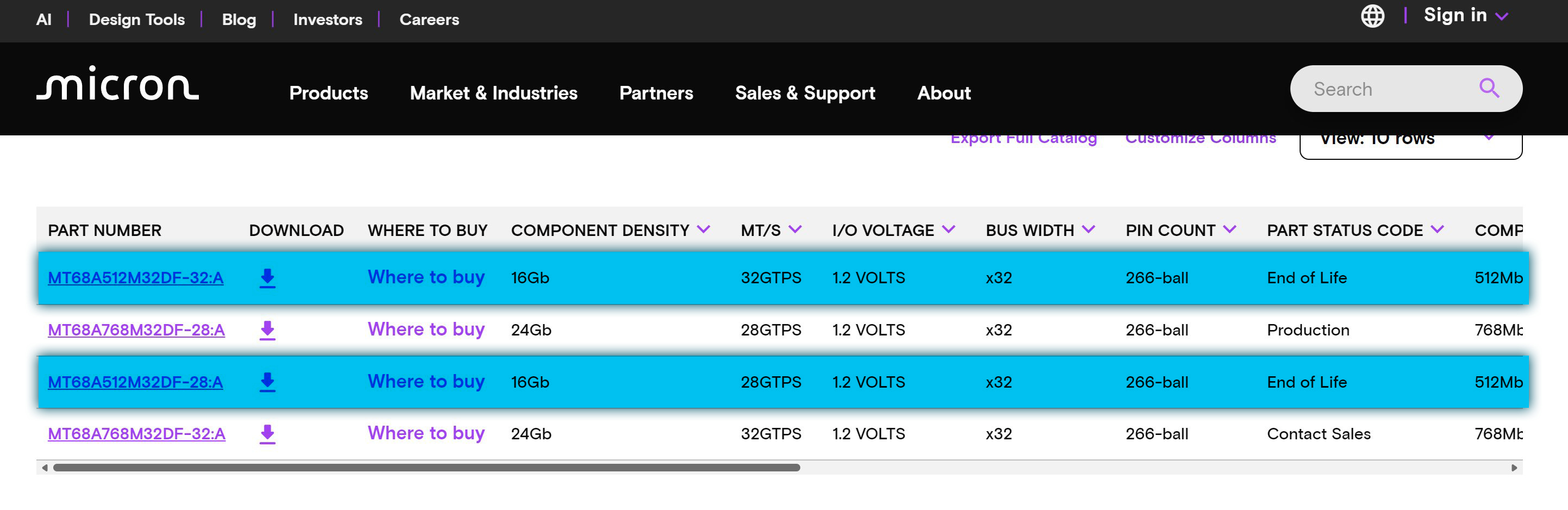
Now, that doesn’t mean that all 2GB GDDR7 is completely disappearing overnight. Both SK Hynix and Samsung still manufacture it, but it does mean that one of the three major manufacturers is doing away with it in what’s a clear market shift.
And what makes this even bigger, is the timing…
Because literally days before this was spotted, the well-known leaker Golden Pig Upgrade actually claimed that memory manufacturers are preparing 4GB and even 6GB GDDR7 chips for 2027 or 2028.
And if that actually happens, it will completely change the GPU market forever!
For those who may not fully understand how GPUs are made, when you hear 4GB or 6GB, you’re probably wondering what the big deal is. But keep in mind that GPUs are made with multiple memory chips to make up the total VRAM you see on the box. And the amount of memory chips you can put on a card, is dependent on the size of your memory bus. And so far, GDDR7 can only come in 2GB or 3GB flavors.
For example, to get a GPU with 16 gigs of VRAM, you would need 8 2GB chips across a 256-bit bus. But with just 4 6GB chips, you could get a whopping 24GB of VRAM on a measly 128-bit bus. That’s a huge difference! And this matters because a shorter bus can lower the cost of the GPU.

With that said, there is one downside. Because bandwidth is heavily dependent on the bus size, you’ll still need a wider bus on higher-end cards. But things brings the possibility of much cheaper cards getting much more total VRAM.
Of course, the memory crisis will have to end first, but here’s to hoping that by the time these come out (if they do), memory prices will have come way down. Fingers crossed.
Quick Bytes
AMD Is Officially A $1 TRILLION Company
This is one of those times that I really wish I didn’t have a rule against trading companies that I talk about. But here it is. AMD briefly crossed the $1 trillion market-cap threshold this week following a surge in it’s stock price.
RTX 30 Just Got Smooth Motion
Nvidia’s Smooth Motion is a driver-level frame generation that officially supports RTX 40 and 50 series cards. Yet two separate mod projects have enabled the feature on cards including an RTX 3050 Laptop, RTX 3070 and RTX 3080.
Microsoft Isn't Sure About Killing The Disc Yet
In a surprise move, Microsoft has sent out a survey to Xbox Insiders with a wild question inside. Specifically, asking h ow important it is that their next Gen system lets you install games from a physical disc. Obviously a survey doesn’t guarantee that the next Gen Xbox will get a disc drive, but it at least suggests Microsoft is still gauging how important a disc drive is to buyers.
We Can Finally See RTX 50 Hotspot Temperatures
GPU-Z 2.71.0 has added hotspot temperature monitoring for Nvidia’s RTX 50-series GPUs. HWiNFO and AIDA64 had already exposed similar data, but GPU-Z is one of the most commonly used GPU monitoring tools around.
That’s all the bytes for this week.
Until next time, may your AI overlords be benevolent, your next Ryzen not require a mortgage, and your 128-bit GPU come with 24GB of VRAM.